These are the Soccer rules for RoboCupJunior Draft 2027. They are released by the RoboCupJunior Soccer League Committee. The English version of these rules has priority over any translations.
Teams are advised to check the RoboCupJunior Soccer site [1] and Soccer forum [2] for procedures and requirements for the international competition. Instead ask tournament organizers for local, regional and super-regional competitions. Each team is responsible for making sure they have the correct rules for each competition. Teams should ask for clarifications on the Forum where necessary. [3]
| Teams are encouraged to get in touch with the RoboCupJunior community on our Discord. Show what you’re working on, ask questions or join the weekly discussions on future rules and league design. [4] You can also reach the Soccer League Committee directly via email [5] |
Preface
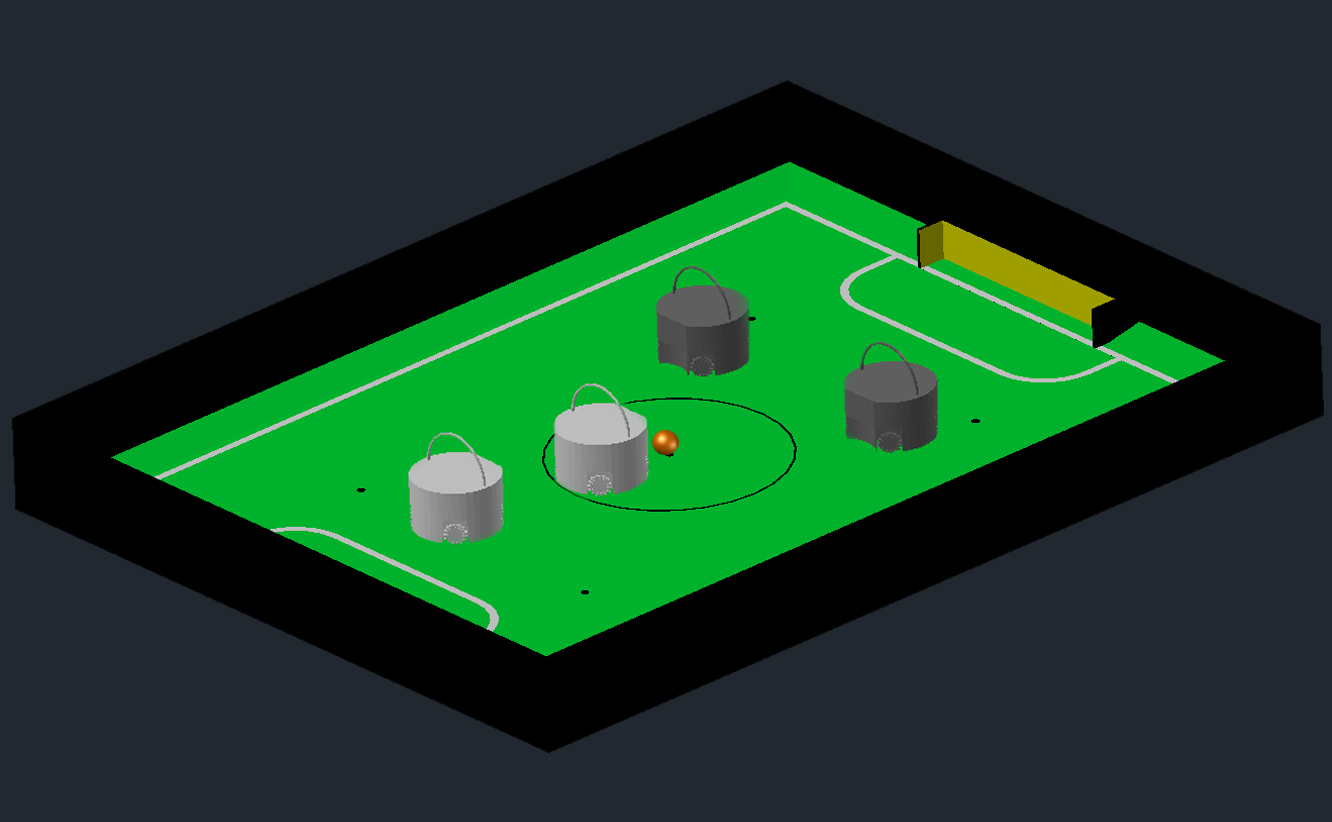
In the RoboCupJunior Soccer challenge, teams of young engineers design, build, and program two fully autonomous mobile robots to compete against another team in matches. The robots must detect a ball and score into a color-coded goal on a special field that resembles a human soccer field.
To be successful, participants must demonstrate skill in programming, robotics, electronics and mechatronics. Teams are also expected to contribute to the advancement of the community as a whole by sharing their discoveries with other participants and by engaging in good sportsmanship, regardless of culture, age or result in the competition. All are expected to compete, learn, have fun, and grow.
RoboCupJunior Soccer consist of two sub-leagues: Soccer Vision (formerly Soccer Open) and Soccer Infrared (formerly Soccer Lightweight). These rules apply for both sub-leagues. There are three main differences between the two leagues.
-
Soccer Infrared is played using a special ball that emits an IR signal and robots may weigh up to 1.5 kg, and be up to 22cm in size.
-
Soccer Vision is played using a brightly colored orange golf ball, robots have no weight restriction and may be up to 18cm in size.
| A large part of the overall ranking (for the international tournament, other tournaments operate differently) is determined by the judged categories. There are points for documentation, inteview performance etc. [6] |
If you would like to start with RoboCupJunior Soccer, please contact the organizer of your regional RoboCupJunior competition and ask them about Rule 8, “ENTRY LEAGUE”.
| The Soccer league is planning to increase the team size to 5. As of 2026 the international competitions can guarentee a team size of 4, but no guarentees can be made for the team size of 5. [7] We recommend team size 5 for SuperRegionals and where organizers find it practical also for regional and local competitions. Ask the organizers for each tournament you attend what team size they can accomodate - tournament organizers are encouraged to adapt rules to fit with their situation. Contact information for the world championships is: robocupjunior-soccer [ at \] robocup [ dot \] org |
1. RoboCupJunior General Rules
License: This document is licensed under the Creative Commons Attribution-NonCommercial-ShareAlike 4.0 International (CC BY-NC-SA 4.0) license.
RoboCupJunior Regional committees are free to share and adapt this material for non-commercial, educational purposes, provided appropriate credit is given to RoboCupJunior and any derivative works are distributed under the same license.
Exceptions may be granted by RoboCupJunior on a case-by-case basis.
© RoboCupJunior — https://junior.robocup.org
These are the RoboCupJunior General Rules. They apply to every competition that uses this rulebook, including the International RoboCupJunior competition. Under the license above, the organizing committee of a SuperRegional, Regional, or local competition may adapt them as needed for its competition. Check with the organizers of each competition which rules they use.
If you are unsure about any part of the General Rules or the League Rules, you are encouraged to ask on the official RoboCupJunior Forum: https://junior.forum.robocup.org/
You can also ask questions about the rules, or about RoboCupJunior in general, on the official Discord Server (https://robocup-junior.github.io/soccer-rules/discord/).
1.1. Getting Started
If you are new to RoboCupJunior, the Getting Started guides on the Official Website (https://junior.robocup.org/gettingstarted/) explain everything from building your first robot to entering your first competition:
-
Starting a Team (https://junior.robocup.org/robocup-beginners-guide/): form a team, build a robot, keep costs down, and find tutorials for your league.
-
Qualification and Competitions (https://junior.robocup.org/qualification/): how the season works, how regions qualify teams, and how to enter competitions outside your region.
-
Your First Competition (https://junior.robocup.org/your-first-competition/): what to expect at a competition, what to bring, and what to do when something goes wrong.
-
For Educators (https://junior.robocup.org/for-educators/): why robotics works in schools, and how to start a program with your students.
1.2. Team Requirements
1.2.1. Team Definition
Team: A team is its robot(s) and the students who build and develop them. The team members are the students who design, build, and program the robot(s) they enter. Membership may change between competition levels as described in Team Changes.
Technical Roles: Every team member must have a defined technical role, for example, mechanical design, electronics and sensors, or software. During technical judging, each member must be able to explain their role and what they contributed to the robot(s). Non-technical tasks, such as documentation, the poster, graphic design, or the presentation, can be shared by the team, but they do not count as a technical role.
Shared Members and Robots: Team members and robots must not be shared between teams.
1.2.2. Age Requirements
Junior Student Members: Must be 14 to 19 years old (inclusive) on July 1st of the competition year.
Junior Mentors and Parent/Chaperones: Must be 19 years or older on July 1st of the competition year.
Entry Leagues: Entry leagues and other "Primary" divisions are not part of the International competition, but many Regional and SuperRegional competitions run them. Their organizers set the age limits, which may differ from the range above.
1.2.3. Team Size
Minimum Team Size: A team must have at least 2 members.
Maximum Team Size:
-
Soccer and Rescue Leagues: 4 members.
-
OnStage League: 5 members.
Regional and SuperRegional competitions may set their own team sizes, for example, because of venue space. At a higher-level competition (a SuperRegional or International competition the team qualified for), a team must follow that competition’s maximum team size, even if the team was larger at its qualifying competition.
1.2.4. Team Changes
Team membership may change between competition levels, for example, when a member can no longer take part. At a higher-level competition, at least half of the team (rounded up) must be students who were members when the team qualified for that competition. New members must take part in designing, building, or programming the robot(s) before they compete, and must meet the Technical Roles requirement. A qualification and the robot(s) belong to the team and cannot be given to another team. How a region reassigns a place that a team does not use is part of the qualification process (https://junior.robocup.org/qualification/).
1.2.5. Team Supervision
Junior Mentor: A Junior Mentor is a supervisor who guides the team and meets the Age Requirements. Junior Mentors are not team members. They must not design, build, or program the robot(s) for the team (see Mentoring and Onsite Assistance).
Junior Mentor Requirement: Every Junior team must have at least one Junior Mentor who is registered with the team, attends the competition with the team, and can be reached by the team and the event organizers throughout the competition.
Junior Mentors and Parent/Chaperones are responsible for supervising their team and have a duty of care for their team members' well-being, as required by their home region’s rules. Any concern about a team member’s well-being should be reported to the event organizers immediately.
Unless the event organizers decide otherwise, Junior Mentors and Parent/Chaperones may not enter the competition areas during rounds and interviews. They must not pressure or intimidate teams, judges, or the judging process, and must not interfere with robots. Event organizers will handle inappropriate behavior, which may lead to disciplinary action.
1.3. Robot Requirements
1.3.1. Robot Communication
Permitted Communication: During competition rounds, robots may communicate with each other only on the 2.4 GHz band. Their transmission power must never exceed 100 mW EIRP (Effective Isotropic Radiated Power).
Responsibility: Teams are responsible for their robots' communication. Their wireless equipment, and how they use it, must follow the laws of the host country. Spectrum availability is not guaranteed.
Component Communication: Parts of the same robot may communicate with each other.
League Adaptability: Each league may change these communication rules to fit its needs.
1.3.2. Safety and Power Requirements
Electrical Power:
-
Robots must not be powered from a wall socket (mains electricity).
-
Maximum voltage: 48 V DC or 25 V AC RMS (Root Mean Square).
-
Voltage must be easy to measure during inspections. Measuring points must be covered or designed to be safe.
Battery Safety:
-
Lithium batteries must be stored in safety bags, and charging must be supervised by team members in competition areas.
-
Teams must follow the safety procedures, including how to handle a battery fire and how to evacuate.
Robot Safety Design:
-
Power Management: Batteries must be firmly mounted and wiring must be safe. Every robot must have an easy-to-reach way to cut its power immediately in an emergency.
-
Mechanical Safety: Robots must not have sharp edges, places where fingers can get caught, or other hazards. Actuators must suit the robot’s size and purpose.
-
Hazardous Behavior: If a robot could behave dangerously, the team must tell the event organizers at least two weeks before the competition. If the team discovers such a behavior later, it must tell the organizers immediately and must not use that behavior in competition until the organizers approve it.
1.4. Documentation and Sharing Requirements
1.4.1. RoboCupJunior Team Posters
Purpose: Posters help teams share their robot designs and ideas with judges, other teams, and the public. Posters are displayed in the venue’s public competition areas, and RoboCupJunior shares digital copies or photos after the competition.
Size: Posters must be no larger than A1 (59.4 x 84.1 cm).
Content: Posters should summarize the team’s design documents and present the robot’s capabilities attractively.
1.4.2. Technical Description Video (See League Documentation)
Content:
-
Robot Demonstration: Show the fully working robot systems and highlight their technical features.
-
Design Process: Explain the team’s design choices and how the team solved problems.
-
Presentation: The video should be clear and of good quality, and should explain any innovative or unusual techniques.
-
Innovation & Sustainability: Show new technologies and sustainable practices.
Submission: Each league’s guidelines will specify the video length and the deadlines.
1.4.3. Bill of Materials (BOM)
Submission: Teams must submit a Bill of Materials (BOM) that lists the main components and materials of their robot(s).
Details: For each component, the BOM must include:
-
Name or description (for example, the part number).
-
Supplier or source (including PCBs and machined parts).
-
Whether it is new or reused.
-
Whether it comes from a kit or is custom-built.
-
Price.
Template: For the International competition, a standard BOM template will be provided with the league documentation submissions.
1.4.4. Sharing Team Resources
Sharing: Materials that teams submit as part of their documentation will be shared in the leagues' GitHub repositories: https://github.com/robocup-junior
Credit: Teams must give credit to the creators of any outside work they use and follow its license. The focus should stay on the team’s own learning.
1.4.5. Plagiarism Guidelines
External Code Use: Teams may use code written by others, but must give credit to the original authors.
Learning Priority: Teams should focus on learning and should not use complete solutions made by others. Always check the license.
1.4.6. Acceptable Uses of AI
Teams must disclose any generative AI tools they used to create content in their code or documentation (for example, text, figures, or images). Teams must name each AI system they used and briefly explain how they used it. Using AI for editing, grammar correction, or translation into English is common practice and does not need to be disclosed.
1.5. Spirit and Behavior
1.5.1. Behavior
All participants are expected to be respectful and polite to everyone, including other participants, volunteers, referees, the organizers of all Junior and Major Leagues, and the host venue.
1.5.2. Code of Conduct
All organizers, volunteers, team members, mentors, supporters, and visitors must follow the RoboCup Code of Ethics and Conduct (https://robocup.org/conduct). Anything that breaks the Code must be reported in the way the Code describes. The Code gives the formal reporting address (conduct@robocup.org) and explains what to do at the competition, including in an emergency.
1.5.3. Mentoring and Onsite Assistance
Help from other teams, mentors, teachers, parents, sponsors, and online communities is an important part of how teams learn and grow.
For fair competition and the best learning, this help must never do the team’s competition work for them. A good test: the team can explain not only what each part of their robot does, but also how it works.
1.5.4. Teams Onsite
-
During the competition, only official team members may represent the team at registration, during setup, and in the competition areas during rounds and interviews.
-
At least 2 team members must be present at the competition. If fewer can attend, the team must contact the event organizers as early as possible. The organizers decide whether and how the team may compete. Unless the organizers decide otherwise, a team that competes with fewer than 2 members present is not eligible for awards or for SuperTeam participation.
-
Teams are responsible for making sure their members are at the right place at the right time for every scheduled activity.
-
During the competition, teams must not receive remote help with their robot, code, or strategy from anyone outside the team, for example, by phone or remote desktop. Help on site is covered by Mentoring and Onsite Assistance.
-
Teams that break these rules may face disciplinary action.
-
If teams have problems on site, they are encouraged to ask other teams or the organizers for help.
1.5.5. Violations
The event organizers may disqualify teams, team members, Junior Mentors, or Parent/Chaperones from the competition and ask them to leave the venue. This can happen for repeated or serious unacceptable behavior, or for repeated or serious violations of the General Rules or League Rules.
Changes from the 2026 RoboCupJunior Soccer Rules
The rule changes developed by the Soccer League Committee in cooperation with the RoboCup Junior Soccer Community (please continue to post ideas for the future at any time) aim to improve gameplay.
Detailed changes are listed below and link to the corresponding place in the rules.
2. GAMEPLAY
2.1. Game procedure and length of a game
RCJ Soccer games consist of two teams of robots playing soccer against each other. Each team has two autonomous robots. The game will consist of two halves. The duration of each half is 10-minutes. There will be a 5-minute break in between the halves.
Teams are expected to be at the field 5 minutes before their game starts. Being at the inspection table does not count in favor of this time limit. Teams are considered late for the start of the game if they don’t show up with at least one working robot. [8] They may be penalized one goal per 30 seconds at the referee’s discretion. When the penalty has reached 10 — 0, they automatically will lose the game.
The final game score will be trimmed so that there is at most 10-goal difference between the losing and the winning team.
2.2. Pre-match meeting
At the start of the first half of the game, a referee will toss a coin. The team mentioned first in the draw shall call the coin. The winner of the toss can choose either which end to kick towards, or to kick off first. The loser of the toss chooses the other option. After the first half, teams switch sides. The team not kicking off in the first half of the game will kick off to begin the second half of the game.
During the pre-match meeting the referee(s) may check whether the robots are capable of playing (i.e., whether they are at least able to follow and react to the ball). If none of the robots is capable of playing, the game will not be played and zero goals will be awarded to both teams.
2.3. Kick-off
Each half of the game begins with a kick-off. All robots must be located on their own side of the field. All robots must be halted. The ball is positioned by a referee in the center of the field.
The team kicking off places their robots on the field first.
The team not kicking off will now place their robots on the defensive end of the field. All robots on the team not kicking off must be at least 30 cm away from the ball (outside of the center circle).
Robots cannot be placed out of bounds. Robots cannot be repositioned once they have been placed, except if the referee requests to adjust their placement to make sure that the robots are placed properly within the field positions.
On the referee’s command (usually by whistle), all robots will be started immediately. Any robots that are started early will be removed by the referee from the field and deemed damaged.
Before a kick-off, all damaged or out-of-bounds robots are allowed to return to the playing field immediately if they are ready and fully functional.
2.3.1. Neutral kick-off
A neutral kick-off is the same as the one described in Rule 2.3, “Kick-off” with a small change: all robots must be at least 30 cm away from the ball (outside of the center circle). A neutral kick-off will occur when all robots from both teams are out of the field.
2.4. Scoring
A goal is scored when the ball strikes or touches the back wall of the goal. Goals scored by any robot have the same end result: they give one goal to the team on the opposite side. After a goal, the game will be restarted with a kick-off from the team who was scored against.
2.5. Ball movement
A robot cannot hold a ball. Holding a ball is defined as taking full control of the ball by removing all of degrees of freedom. Examples for ball holding include fixing a ball to the robot’s body, surrounding a ball using the robot’s body to prevent access by others, encircling the ball or somehow trapping the ball with any part of the robot’s body. If a ball does not roll while a robot is moving, it is a good indication that the ball is trapped. If this happens during gameplay, the robot will be deemed damaged and will lose its inspection sticker until the robot complies with this rule.
The only exception to holding is the use of a rotating drum (a "dribbler") that imparts dynamic back spin on the ball to keep the ball on its surface.
Other players must be able to access the ball.
The ball needs to stay within the bounds of the field, as defined by the walls. If a robot moves the ball outside of the field (that is, beyond the walls or above their height), it is deemed damaged. (Rule 2.9, “Damaged robots”)
Any robot must approach and touch the ball when it is placed on the nearest neutral spot. It must do this before lack of progress is called. When on its own side of the field, any robot must be able to move the ball from the nearest neutral spot to the opponent’s side of the field. If a specific robot does not act this way, referees may deem it damaged at their discretion. (See Damaged Robots.) This rule does not apply if the robot is hindered from detecting or playing the ball by the opponent.
2.6. Inside the Penalty Area (Pushing and Multiple defense)
No robots are allowed to be fully inside the penalty area. As the penalty areas are marked with a white line, the Out of Bounds rule applies. (Rule 2.8, “Out of bounds”)
If two robots from the same team are at least partially in their own penalty area, the robot further from the ball will be moved to the furthest unoccupied neutral spot immediately. If this happens repeatedly, a robot may be deemed damaged at referee’s discretion. (Rule 2.9, “Damaged robots”)
NOTE: THIS IMPLEMENTATION COULD CHANGE. PLEASE DO NOT DRAW THIS LINE FOR YOUR FIELD YET. Robot-to-robot or robot-ball-robot contact where the defender reaches the 'pushing'-line is considered pushing. The 'pushing'-line will be an extra black line drawn within the penalty area. This line will be shown in an updated version of the field specification document. [9] In this case, the ball will be moved to the furthest unoccupied neutral spot immediately.
If a goal is scored as a result of a "pushing" situation, it will not be granted.
If pushing and multiple defense happen at the same time the referees will call and resolve the pushing situation first, then the multiple defense.
2.7. Lack of progress
Lack of progress occurs if there is no progress in the gameplay for a reasonable period of time and the situation is not likely to change. Typical lack of progress situations are when the ball is stuck between robots, when there is no change in ball and robot’s positions, or when the ball is beyond detection or reach capability of all robots on the field.
After a visible and loud count [10],
a referee will call lack of progress and
will move the ball to the nearest unoccupied neutral spot. If this does not
solve the lack of progress, the referee can call lack of progress again and
move the ball to a different neutral spot in the same way.
If the situation arises that one or multiple robots for either team are out of bounds and their time penalty has passed, as described in the next section, the referee will return the out of bounds robot(s) first before moving the ball. If the lack of progress does not resolve after the return of the out of bounds robot(s) then the referee wil move the ball.
2.8. Out of bounds
If a robot touches a wall or moves completely into the penalty area it
will be called for being out of bounds. When this situation arises, the
robot is removed from the field for a
minimum of one-minute.
There is no time stoppage for the game itself.
The robot is allowed to return whenever there is a game interruption after the initial one-minute penalty, i.e. kick-off, lack-of-progress, pushing etc.
[11]
The one-minute penalty starts when the robot is removed from play. Furthermore, any goal scored by the penalized robot will not be granted.
However, if the penalized robot scores an own goal, that goal will be awarded to the opposing team. Out-of-bounds robots can be fixed if the team needs to do so, as described in Rule 2.9, “Damaged robots”.
After the penalty time has passed, the robot will be placed on the general area of one of its own corners, while not touching the white lines and facing its own goal. [12]
2.9. Damaged robots
If a robot is damaged, it has to be taken off the field and must be fixed before it can play again. Even if repaired, the robot must remain off the field for at least one minute or until the next kick-off is due.
Some examples of a damaged robot include:
-
it does not respond to the ball, or is unable to move (it lost pieces, power, etc.).
-
it continually moves into the penalty area or out of bounds.
-
it turns over on its own accord.
After a robot has been fixed, it will be placed on the unoccupied neutral spot furthest from the ball, facing its own goal.
Only the referee decides whether a robot is damaged. A robot can only be taken off or returned with the referee’s permission.
If both robots from the same team are deemed damaged at kick-off, gameplay will be paused and the remaining team will be awarded 1 goal for each elapsed 30 seconds that their opponent’s robots remain damaged. However, these rules only apply when none of the two robots from the same team were damaged as the result of the opponent team violating the rules.
Whenever a robot is removed from play, its motors must be turned off.
2.10. Human interference
Except for the kick-off, human interference from the teams (e.g. touching the robots) during the game is not allowed unless explicitly permitted by a referee. Violating team(s)/team member(s) may be disqualified from the game.
The referee(s) can help robots get unstuck if the ball is not being disputed near them and if the situation was created from normal interaction between robots (i.e. it was not a design or programming flaw of the robot alone). The referee(s) will pull back the robots just enough for them to be able to move freely again.
2.11. Interruption of Game
In principle, a game will not be stopped.
A referee can stop the game if there is a situation on or around the field which the referee wants to discuss with an official of the tournament or if the ball malfunctions and a replacement is not readily available.
When the referee has stopped the game, all robots must be stopped and remain on the field untouched. The referee may decide whether the game will be continued/resumed from the situation in which the game was stopped or by a neutral kick-off.
3. ROBOTS
3.1. Interference
Robots are not allowed to be colored orange, yellow or blue in order to avoid interference. Orange, yellow, blue colored parts used in the construction of the robot must either be occluded by other parts from the perception by other robots or be taped/painted with a neutral color.
Robots must not produce magnetic interference in other robots on the field.
Robots must not produce visible light that may prevent the opposing team from playing when placed on a flat surface. Any part of a robot that produces light that may interfere with the opposing robot’s vision system must be covered. For Infrared league specific regulations see Rule 6.2.2, “Infrared interference”
| These interference rules mean that often when red lights (e.g. line sensors) are detected by other teams' camera systems as the orange ball and therefore must be covered up for the robot to be allowed to play. This has been the case in Vision for many years but may be new to Infrared teams. Teams are advised to make sure their robots do not have these bright red lights/parts to avoid having to make surprise adjustments at the competition. |
Robots are expected to be capable of dealing with any visible colors above the walls (e.g. blue, yellow, green or orange shirts) either in hardware (e.g. limiting the field of view from looking up) or in software (e.g. masking the input image).
The referee can interrupt a game in progress if any kind of interference from spectators is suspected (IR emitters, camera flashes, mobile phones, radios, computers, etc.).
A team claiming that their robot is affected by the other team’s robot in any way must provide proof or evidence of the interference. Any interference needs to be confirmed by the tournament organizers if a claim is placed by the other team.
3.2. Control & Communication
The use of remote control of any kind is not allowed during the match. Robots must be controlled autonomously.
For at least at the world championships (ask other competition organizers) use of a Communications Module is required for referees to control the robots. See Rule 7.1, “International Competition Specifics”
3.3. Agility
Robots must be constructed and programmed in a way that their movement is not limited to only one dimension (defined as a single axis, such as only moving in a straight line). They must move in all directions, for example by turning.
3.4. Handle
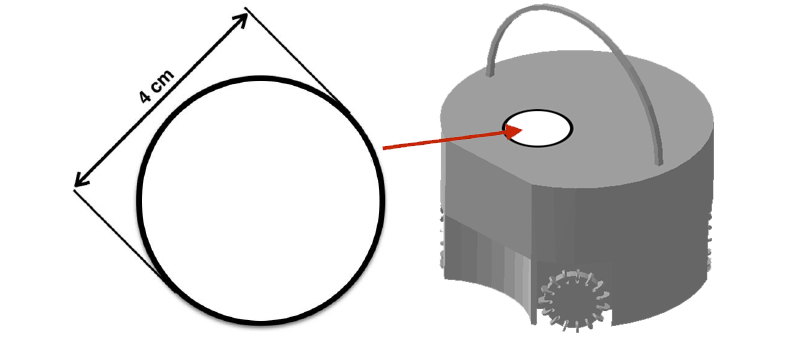
All robots must have a stable and easily noticeable handle to hold and to lift them. The handle must be easily accessible and allow the robot to be picked up from at least 5 cm above the highest structure of the robot. There must be a minimum clearance of 5 cm for hands between the highest non-handle part of the robot and the handle.
The dimensions of the handle may exceed the robot height limitation, but the part of the handle that exceeds this limit cannot be used to mount components of the robot.
The weight of the robot includes that of the handle.
3.5. Top Markers
A robot must have markings in order to be distinguished by the referee. Each robot must have a white plastic circle with a diameter of at least 4 cm mounted horizontally on top. This white circle will be used by the referee to write numbers on the robots using markers, therefore the white circles must be accessible and visible. The top markers do not need to be within the size limit of the robot.
Before the game, the referee will designate the numbers for each robot and will write them on the top white circle. Robots not carrying the top white circle are not eligible to play.
3.6. Violations
Robots that do not abide by the specifications/regulations (see Rule 6.2, “Regulations”) are not allowed to play, unless these rules specify otherwise.
If violations are detected during a running game the team may be disqualified for that game.
If similar violations occur repeatedly, the team may be disqualified from the tournament.
3.7. Material specifications
Detailed specifications of the ball and fields can be found in the footnote [13].
3.8. Soccer Infrared League Ball change 2026 and beyond
Starting from the year 2026 [14], Soccer Infrared is using a new IR Ball. The key difference with this ball is the size change from 74mm to 42mm diameter, which is the same size as the Vision League golf ball. This ball is Open Source, so anyone can produce one from the files & instructions on the GitHub Page here: https://github.com/robocup-junior/ir-golf-ball . If you or someone you know can help by making or distributing balls for one or more regions the Soccer Committee is interested in helping to make that happen and listing you as a source for balls on the official website. Please get in touch via Forum, Discord or Email
Entry Leagues will continue to use the large infrared ball. [15]
3.9. Tournament balls
Balls for the tournament must be made available by the tournament organizers. Tournament organizers are not responsible for providing balls for practice.
4. CODE OF CONDUCT
4.1. Fair Play
It is expected that the aim of all teams is to play a fair and clean game of robot soccer. It is expected that all robots will be built with consideration to other participants.
Robots are not allowed to cause deliberate interference with or damage to other robots during normal gameplay.
Robots are not allowed to cause damage to the field or to the ball during normal gameplay.
A robot that causes damage may be disqualified from a specific match at the tournament organizer’s discretion.
Humans are not allowed to cause deliberate interference with robots or damage to the field or the ball.
5. CONFLICT RESOLUTION
5.1. Referees
The referee(s) are in charge of making decisions with regards to the game, according to these rules.
During gameplay, the decisions made by the referee(s) are final.
Only the team member(s) at the table have a mandate to freely speak to the referee(s).
At the conclusion of the game the results become final with signatures from both teams. Disputes need to be settled before signing.
5.2. Rule clarification
Rule clarification may be made by members of the tournament organizers and the Soccer League Committee, if necessary even during a tournament.
5.3. Rule modification
If special circumstances, such as unforeseen problems or capabilities of a robot occur, rules may be modified by the tournament organizers, if necessary even during a tournament.
5.4. Competition specifics
Each competition (from local to international) may have adapted rules and added specifics (scoring, interviews, tournament modes, rule variations etc.). Check with organizers of each tournament you participate in.
6. LEAGUE REGULATIONS
6.1. Preamble
For RoboCupJunior, there are two sub-leagues: Soccer Infrared and Soccer Vision
The matches in the Soccer Vision sub-league are conducted using a (passive) orange golf ball, whereas the matches in the Soccer Infrared sub-league are played using the (also orange) IR ball. [16]
6.2. Regulations
6.2.1. Dimensions
Robots will be measured in an upright position with all parts extended. A robot’s dimensions must not exceed the following limits:
sub-league |
Soccer Vision |
Soccer Infrared |
size [0] |
18.0 cm |
22.0 cm |
height |
18.0 cm |
22.0 cm |
weight |
No limit |
1500g |
ball-capturing zone |
1.5 cm |
1.5 cm |
| [0] Robot must fit smoothly into a cylinder of this diameter. Being 3mm below the size limit and 50g below the weight limit will usually make inspections go more smoothly. |
Ball-capturing zone is defined as any internal space created when a straight edge is placed on the protruding points of a robot. This means the ball must not enter the convex hull of a robot by more than the specified depth. Furthermore, it must be possible for another robot to take possession of the ball.
6.2.2. Infrared interference
FOR THE INFRARED LEAGUE ONLY: Components designed to emit IR (e.g. ToF, LiDAR, IR distance sensors, IR LEDs/LASERs etc.) are not allowed and tournament organizers will require such devices to be removed or covered up.
6.2.3. Limitations
A robot may use any number of cameras without restrictions on lenses, optical parts, optical systems, and total field of view. Components may be sourced in any way the team sees fit.
Kicker strength is subject to compliance check at any time during the competition. During gameplay, a referee can test the kicker power on the field before each half when a damaged robot is returned to the field or when the game is about to be restarted after a goal. See Appendix A, Kicker Power Measuring Procedures for more details.
6.2.4. Inspections
Robots must be inspected and certified every day before the first game is played. The tournament organizers may request other inspections if necessary, including random inspections which may happen at any time.
7. INTERNATIONAL COMPETITION
7.1. International Competition Specifics
At the international competition (for others ask organizers) the Soccer League Committee will provide each team with a Communication Module. This allow for easier co-ordination of games and referee control of robots during matches. Each team will be expected to interface with this module using a single 2.54mm GPIO pin at present to start and stop the robots. The Soccer League Committee plans on extending this to using UART for more complex applications in future years. Please see the GitHub page for more information on the module: https://github.com/robocup-junior/soccer-communication-module
The module itself may exceed the maximum height of the robot. It must be placed at least 1cm away from the outside and protected from impact damage.
7.2. Interviews
During the international competition, the tournament organizers may arrange to interview teams during the Setup Day of the event. This means that the teams need to be already present early on this day.
Details on what is required for and what to expect from interviews can be found in the scoring document available here [17].
The Soccer League Committee recommends the implementation of interviews in regional competitions as well, but this is not mandatory. Teams should check with tournament organizers if they hold interviews and if so and what kind of interview to expect.
7.3. Technical Challenges
Inspired by the major leagues and the need for further technological advancement of the leagues, the Soccer League Committee runs what are called Technical Challenges. New challenges are added each year, and are unknown until during the International Competition.
The idea of these challenges is to give the teams an opportunity to show off various abilities of their robots which may not get noticed during the regular games. Furthermore, the Soccer League Committee envisions these challenges to be a place for testing new ideas that may make it to the future rules, or otherwise shape the competition.
Any RoboCupJunior Soccer team will be eligible to try to tackle these challenges.
7.4. Further information on International Competition
All teams qualified to the international competition must share their designs, both hardware and software, with all present and future participants. These teams are also required to send a digital portfolio before the competition. Further details on how will be provided by the Soccer League Committee which acts as the tournament organizers for the international competition.
During the competition days of the international competition (as well as before the event) the team members are responsible for checking all relevant information published by the Soccer League Committee or any other RoboCup official.
There will also be a SuperTeam competition, in which various teams from around the world share their robots in one "SuperTeam" and play against other SuperTeams on a so called "Big Field". Teams could utilise different camera lenses or sensors optimised for the larger playing fields to improve their performance. The full rules of this challenge can be found at https://robocup-junior.github.io/soccer-rules/master/superteam_rules.html or https://robocup-junior.github.io/soccer-rules/master/superteam_rules.pdf
Teams competing in the international competition can receive awards for their performance. These awards are decided and introduced by the Soccer League Committee, which publishes all necessary details well before the actual event. [18]
8. ENTRY LEAGUE
In order to help newcomers experience the RoboCupJunior Soccer competition, the Soccer League Committee would like to encourage competitions to include a so called "Entry League". Although such a league will not be part of the international competition, it is run in many regions and at the SuperRegional competitions (RoboCupJunior SuperRegional Americas, EMEA (Europe, Middle East, Africa) and RoboCup Asia Pacific). To this end, the Soccer League Committee has prepared a suggested ruleset. [19] Some regional and super-regional competitions already have rulesets and will likely make changes to the suggested rulesets or replace them entirely for their events. [20] Teams should ask their local/regional/super-regional tournament organizers for details on what Entry leagues (if any) will be running in their region.
Appendix A: Kicker Power Measuring Procedures
All robot kickers will be tested with the tournament ball used in the sub-league they participate in.
Starting from the 2027 season we want to pilot a change in the kicker power measuring. We have noticed that different fields (or goal posts) give out different results. With some goal posts the posts absorb much of the bounce, with other goal posts the posts make the ball bounce back a lot. We want to try out a vertical kicker test that we feel will be much easier and much more consistent to see the actual kicker power. The test is performed as follows: 1. Place the robot on its back with the kicker facing up. 2. Place the ball inside the ball capturing zone. 3. Perform a vertical kick into the air. 4. The kick power test is passed if the ball height does not exceed 100 cm. You can measure this by performing the test near a wall with a measuring tape.