
Labyrinthos
Document register
- Poster1 pagePublished
- Presentation videoYouTubePublished
- Bill of materials30 KBPublished
- Team description paperNot shared
- Engineering journalNot shared
- Source code7.4 MB · GitHubPublished
Sharing each document is the team's decision. “Not shared” means this team chose not to publish it, or did not submit one — not that it is missing from the archive.

In their words
This paper introduces an autonomous rescue robot built for the RoboCupJunior Rescue Simulation competition in the Erebus environment. The robot can navigate, map, and find victims inside an unknown maze.
Our robot uses a simple dual-layer system for movement. It explores the maze using a grid-based Depth-First Search (DFS) algorithm. When it hits a dead-end, it switches to Dijkstra’s algorithm to find the shortest path back to unvisited areas. For mapping, the robot processes 256 LiDAR rays and projects them onto a local 9×9 grid window. This method filters out simulator sensor noise and saves CPU power. To avoid traps like black holes, we added a validation step that requires consistent detections before updating the map. Finally, a TensorFlow-based vision model identifies victim types from camera images.
What makes our robot better than others is its efficiency. By using a small local window for mapping and dynamic rerouting, it achieves fast exploration with low computing limits, ensuring an accurate map for the final submission.
Poster
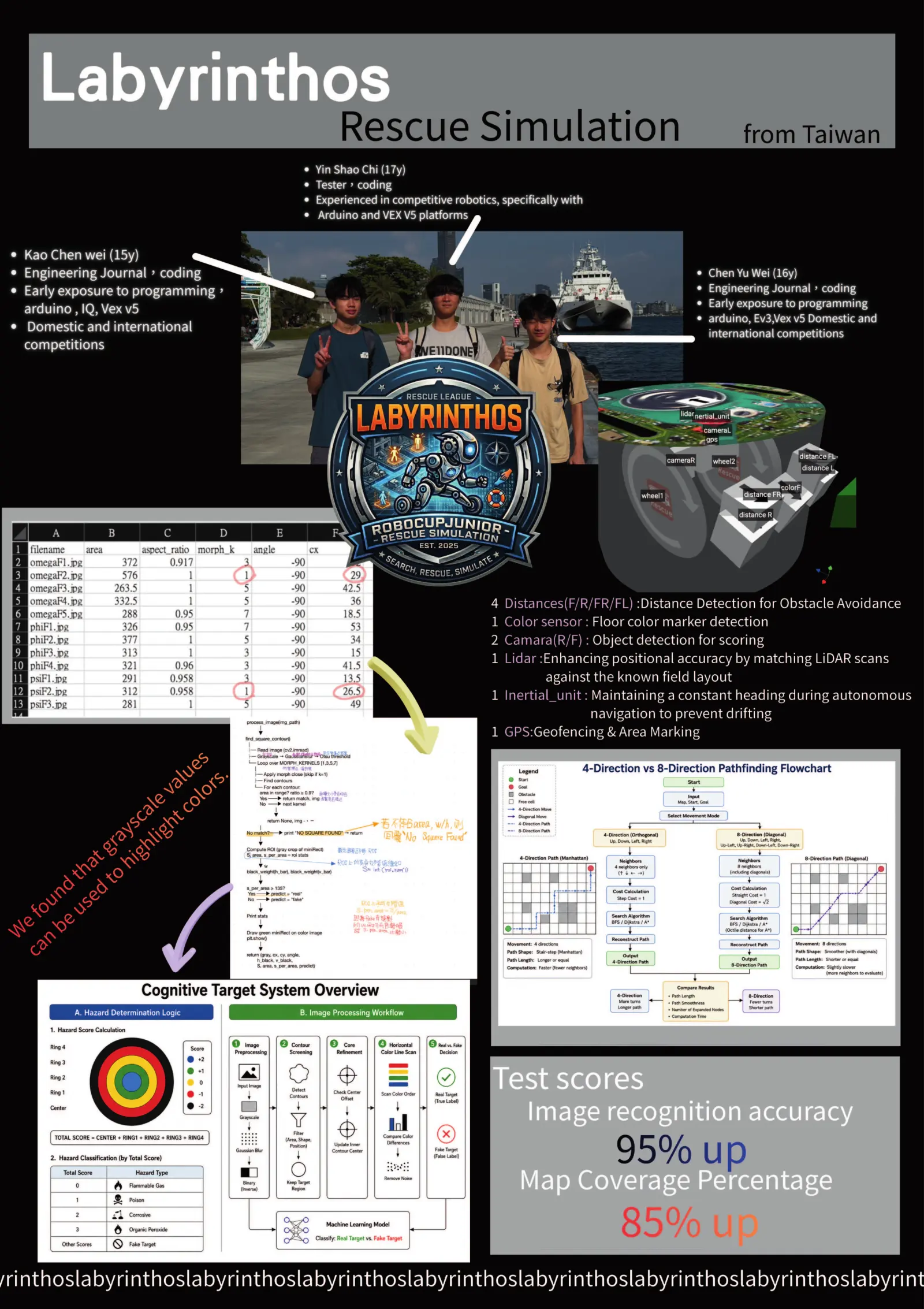
1 page, rendered as images so they load quickly. This document has no text layer — the words in it are part of the image.
Presentation video
Hosted on YouTube. The player loads only when you press play.
Bill of materials
Shown as the original PDF, because this one is smaller that way and its text stays selectable and searchable.
Source code
The team's own source code, 7.4 MB. It is a download rather than part of this page, because a zip is something you open on your computer. It comes from GitHub, which some school networks block.