
VAST
Document register
- Poster1 pagePublished
- Presentation videoYouTubePublished
- Bill of materials69 KBPublished
- Team description paperNot shared
- Engineering journalNot shared
- Source code15 KB · GitHubPublished
Sharing each document is the team's decision. “Not shared” means this team chose not to publish it, or did not submit one — not that it is missing from the archive.
In their words
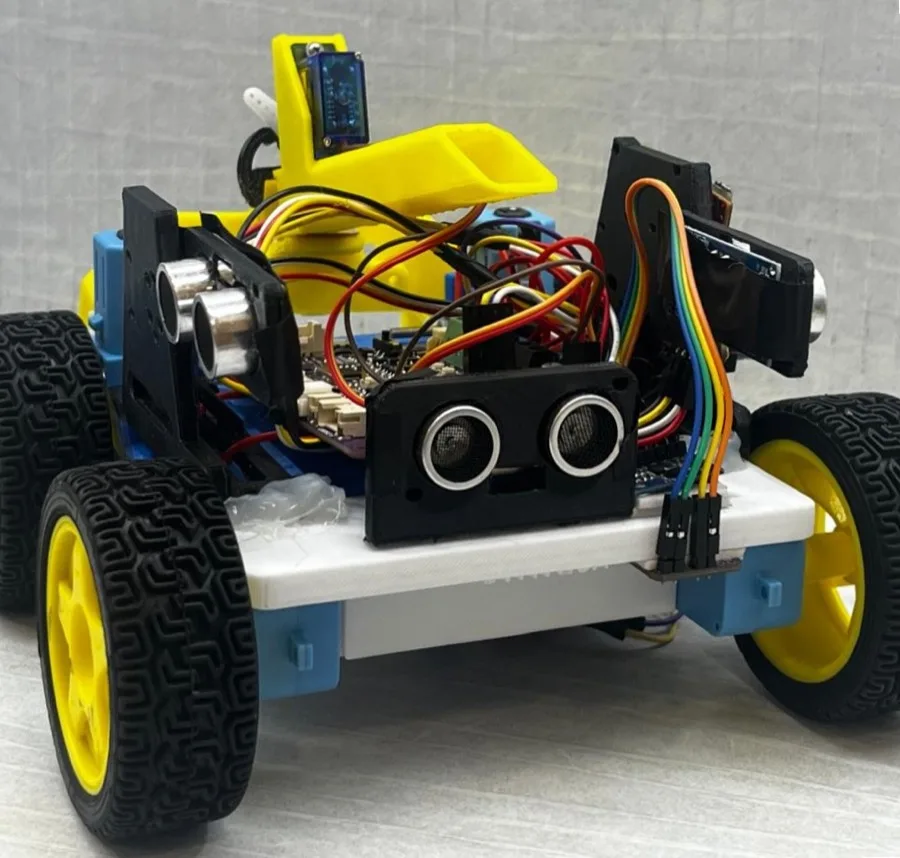
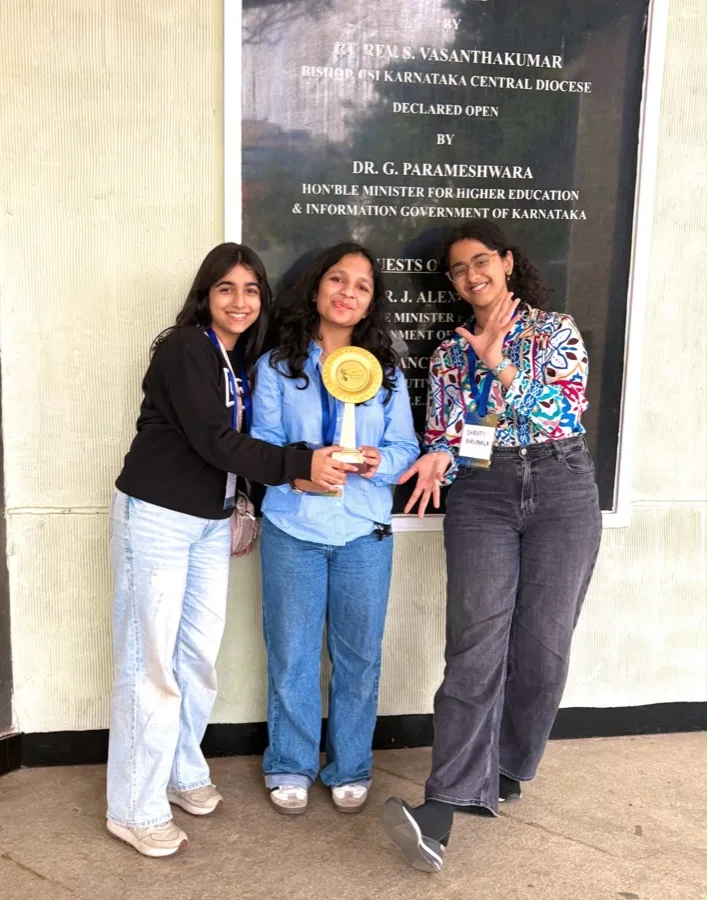
VAST is a three-member team from India competing internationally at RoboCup Junior Rescue Maze. Our robot, Samarth — Sanskrit for "equal to the task at hand" — is a fully autonomous maze-solving robot built on the Cytron Maker Pi RP2040.
What sets Samarth apart is its two-tier navigation architecture: a greedy Depth-First Search drives real-time exploration, while a BFS flood-fill planner handles recovery and relocation across confirmed-safe cells to the nearest unexplored frontier or back to start. This hybrid approach gives Samarth both speed and resilience, it doesn't just explore, it always knows how to recover. Three ultrasonic sensors, an MPU-6050 gyro, and a TCS34725 color sensor support reliable navigation and tile identification. We deliberately prioritize a guaranteed return to start over strict blue tile avoidance, securing full maze completion points.
Building on our nationals foundation, we continuously advanced Samarth's hardware and software: the chassis was redesigned in Fusion 360 into a 217×119×139mm PLA frame with dedicated mounting points for every component, and our codebase evolved from proven algorithms into a more robust, competition-ready system. The rescue kit deployment mechanism is a servo-driven dual chute carrying up to 12 kits and also doubles as the robot's handle, keeping the design compact.
Victim detection via an OpenMV H7+ running an Edge Impulse model keeps detection fully autonomous. The camera identifies victims, triggers color-coded LED signals, and feeds results directly into Samarth's decision-making, pushing it beyond navigation into a robot that genuinely perceives and responds to its environment.
Poster
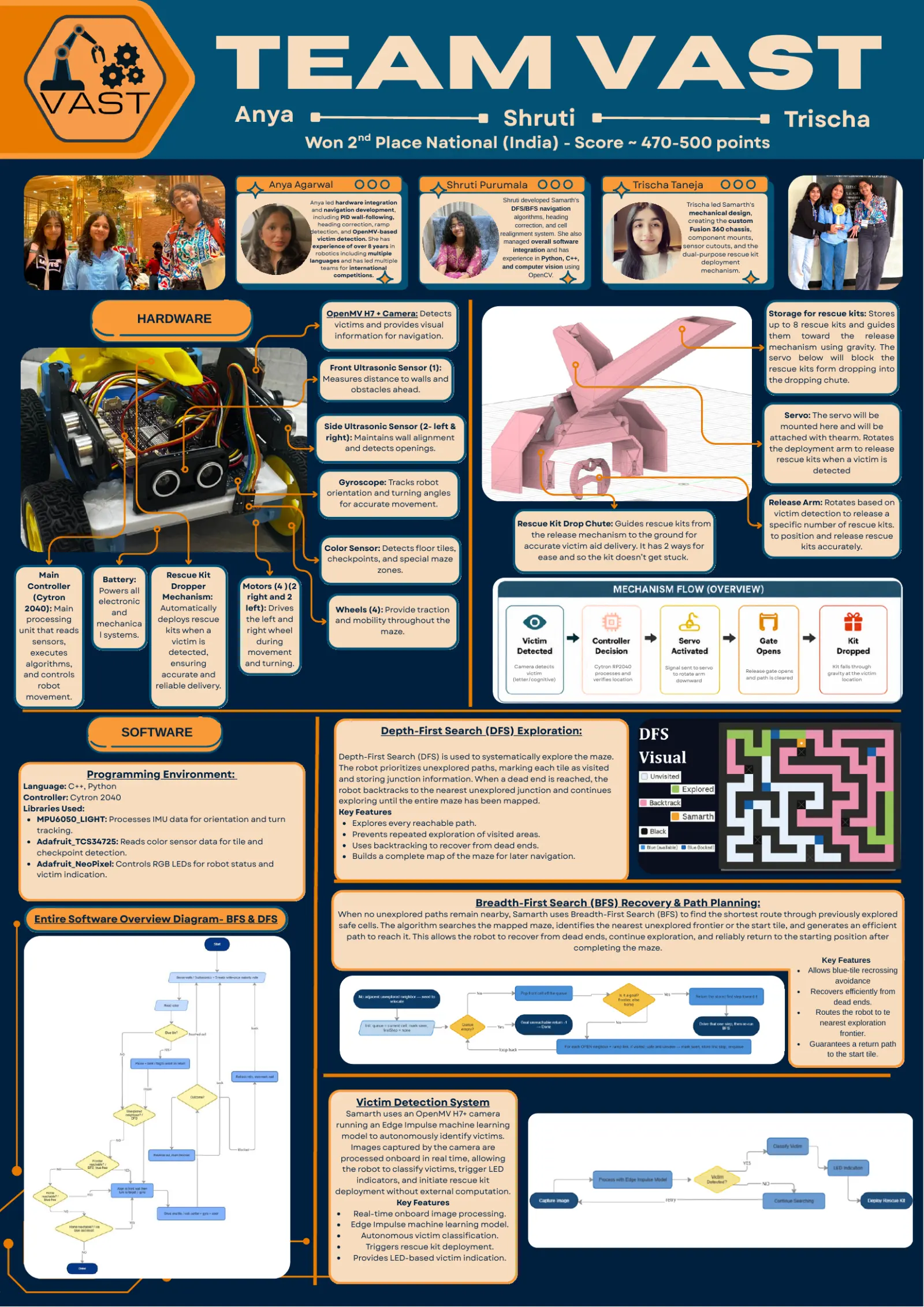
Read the text of this document — 679 words
TEAM VAST
Anya Shruti Trischa
Won 2nd Place National (India) - Score ~ 470-500 points
Anya Agarwal Shruti Purumala Trischa Taneja
Anya led hardware integration Shruti developed Samarth's
Trischa led Samarth's
and navigation development, DFS/BFS navigation
mechanical design,
including PID wall-following, algorithms, heading
creating the custom
heading correction, ramp correction, and cell
detection, and OpenMV-based Fusion 360 chassis,
realignment system. She also
victim detection. She has component mounts,
managed overall software
experience of over 8 years in sensor cutouts, and the
integration and has
robotics including multiple dual-purpose rescue kit
languages and has led multiple experience in Python, C++,
deployment
teams for international and computer vision using
mechanism.
competitions. OpenCV.
OpenMV H7 + Camera: Detects Storage for rescue kits: Stores
HARDWARE victims and provides visual up to 8 rescue kits and guides
information for navigation. them toward the release
mechanism using gravity. The
servo below will block the
Front Ultrasonic Sensor (1): rescue kits form dropping into
Measures distance to walls and the dropping chute.
obstacles ahead.
Servo: The servo will be
Side Ultrasonic Sensor (2- left & mounted here and will be
right): Maintains wall alignment attached with thearm. Rotates
and detects openings. the deployment arm to release
rescue kits when a victim is
detected
Gyroscope: Tracks robot
orientation and turning angles
for accurate movement. Release Arm: Rotates based on
victim detection to release a
Rescue Kit Drop Chute: Guides rescue kits from specific number of rescue kits.
the release mechanism to the ground for to position and release rescue
Color Sensor: Detects floor tiles, accurate victim aid delivery. It has 2 ways for kits accurately.
checkpoints, and special maze ease and so the kit doesn’t get stuck.
zones.
Main Rescue Kit
Battery:
Controller Dropper Motors (4 )(2
Powers all
(Cytron Mechanism: right and 2
electronic
2040): Main Automatically left): Drives Wheels (4): Provide traction
and
processing deploys rescue the left and and mobility throughout the
mechanica
unit that reads kits when a right wheel maze.
l systems.
sensors, victim is during
executes detected, movement
algorithms, ensuring and turning. Camera detects Cytron RP2040 Signal sent to servo Kit falls through
Release gate opens
and controls accurate and victim
(letter/cognitive)
processes and
verifies location
to rotate arm
and path is cleared
gravity at the victim
location
downward
robot reliable delivery.
movement.
SOFTWARE Depth-First Search (DFS) Exploration:
Depth-First Search (DFS) is used to systematically explore the maze.
The robot prioritizes unexplored paths, marking each tile as visited
Programming Environment: and storing junction information. When a dead end is reached, the
Language: C++, Python robot backtracks to the nearest unexplored junction and continues
Controller: Cytron 2040 exploring until the entire maze has been mapped.
Libraries Used: Key Features
MPU6050_LIGHT: Processes IMU data for orientation and turn Explores every reachable path.
tracking. Prevents repeated exploration of visited areas.
Adafruit_TCS34725: Reads color sensor data for tile and Uses backtracking to recover from dead ends.
checkpoint detection. Builds a complete map of the maze for later navigation.
Adafruit_NeoPixel: Controls RGB LEDs for robot status and
victim indication.
Breadth-First Search (BFS) Recovery & Path Planning:
When no unexplored paths remain nearby, Samarth uses Breadth-First Search (BFS) to find the shortest route through previously explored
Entire Software Overview Diagram- BFS & DFS
safe cells. The algorithm searches the mapped maze, identifies the nearest unexplored frontier or the start tile, and generates an efficient
path to reach it. This allows the robot to recover from dead ends, continue exploration, and reliably return to the starting position after
completing the maze.
Key Features
Allows blue-tile recrossing
avoidance
Recovers efficiently from
dead ends.
Routes the robot to te
nearest exploration
frontier.
Guarantees a return path
to the start tile.
Victim Detection System
Samarth uses an OpenMV H7+ camera
running an Edge Impulse machine learning
model to autonomously identify victims.
Images captured by the camera are
processed onboard in real time, allowing
the robot to classify victims, trigger LED
indicators, and initiate rescue kit
deployment without external computation.
Key Features
Real-time onboard image processing.
Edge Impulse machine learning model.
Autonomous victim classification.
Triggers rescue kit deployment.
Provides LED-based victim indication.
1 page, rendered as images so they load quickly. The text above is the document's own, extracted from the PDF.
Presentation video
Hosted on YouTube. The player loads only when you press play.
Bill of materials
Shown as the original PDF, because this one is smaller that way and its text stays selectable and searchable.
Source code
The team's own source code, 15 KB. It is a download rather than part of this page, because a zip is something you open on your computer. It comes from GitHub, which some school networks block.