
Tuton
Document register
- Poster1 pagePublished
- Presentation videoYouTubePublished
- Bill of materials73 KBPublished
- Team description paper1.0 MBPublished
- Engineering journal981 KBPublished
- Source code7.3 MB · GitHubPublished
Sharing each document is the team's decision. “Not shared” means this team chose not to publish it, or did not submit one — not that it is missing from the archive.
In their words
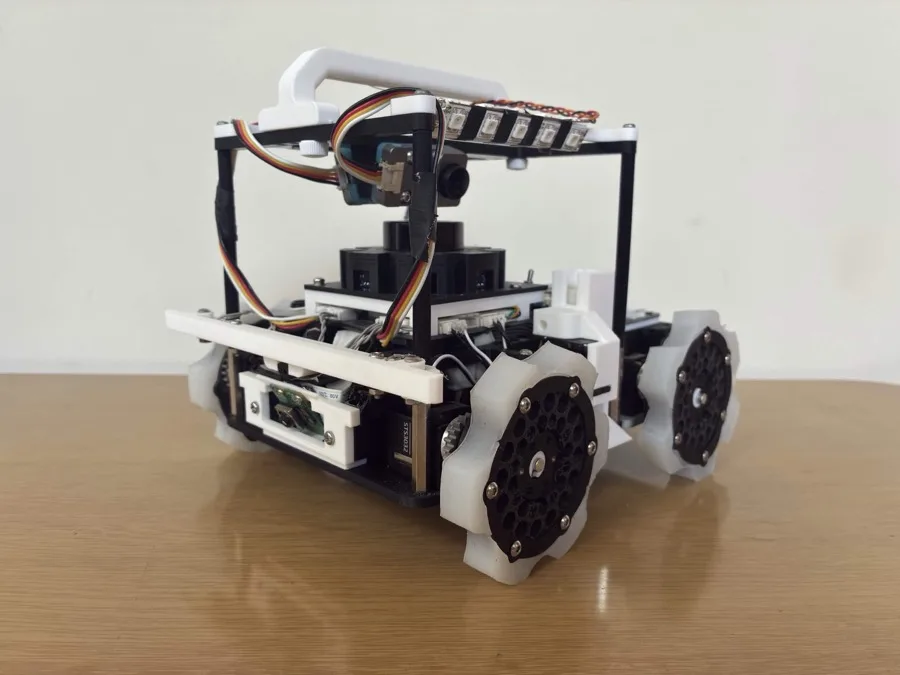
Our robot is designed to efficiently navigate and complete tasks in the RoboCup Rescue Maze competition. Through experience gained in previous competitions, we found that a well-structured design and thorough project planning are essential for achieving high performance and reliability.
To address the challenges of uneven terrain, we developed a custom articulated chassis equipped with deformable silicone tires, enabling stable traversal of bumps, ramps, and stairs. The robot employs a distributed architecture consisting of multiple STM32 microcontrollers and a Raspberry Pi, improving modularity, maintainability, and stable electronic operation. LiDAR-based mapping and an orientation-aware Dijkstra’s algorithm enable efficient autonomous exploration.
The victim detection system, refined through extensive development and testing, ensures reliable victim identification and rescue kit deployment. Through rigorous performance evaluation, we validated the robot's capabilities under competition-like conditions and confirmed compliance with competition requirements.
Our team remains committed to continuous improvement and innovation, striving for excellence in the RoboCup Rescue Maze competition.
Poster
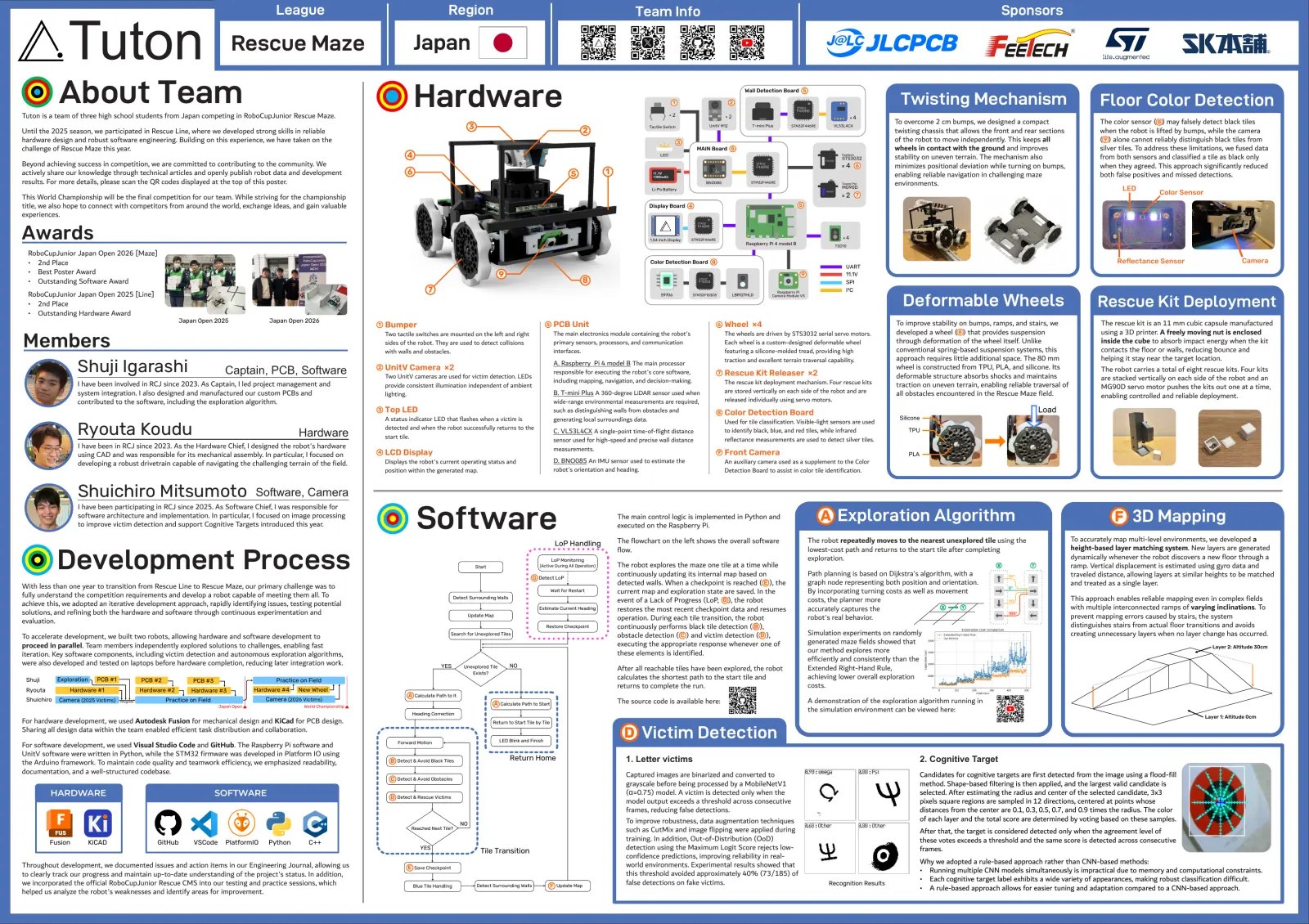
Read the text of this document — 1975 words
•
Tuton
League Region Team Info Sponsors
Rescue Maze Japan
About Team
Tuton is a team of three high school students from Japan competing in RoboCupJunior Rescue Maze.
Hardware 1
×2
M5
2
×2
Wall Detection Board 5
STM32
F446RE
×4
Twisting Mechanism Floor Color Detection
To overcome 2 cm bumps, we designed a compact The color sensor ( 8 ) may falsely detect black tiles
3 2
Tactile Switch UnitV M12 T-mini Plus STM32F446RE VL53L4CX
twisting chassis that allows the front and rear sections when the robot is lifted by bumps, while the camera
Until the 2025 season, we participated in Rescue Line, where we developed strong skills in reliable
hardware design and robust software engineering. Building on this experience, we have taken on the 3 of the robot to move independently. This keeps all ( 9 ) alone cannot reliably distinguish black tiles from
challenge of Rescue Maze this year. MAIN Board 5 wheels in contact with the ground and improves silver tiles. To address these limitations, we fused data
4 LED Feetech
STS3032 stability on uneven terrain. The mechanism also from both sensors and classified a tile as black only
Beyond achieving success in competition, we are committed to contributing to the community. We
STS3032
STM32
F446RE ×4 6 minimizes positional deviation while turning on bumps, when they agreed. This approach significantly reduced
6 1
y
actively share our knowledge through technical articles and openly publish robot data and development 5 11.1V
1300mAh
Z x
enabling reliable navigation in challenging maze both false positives and missed detections.
results. For more details, please scan the QR codes displayed at the top of this poster. BNO085 STM32F446RE Tower Pro environments.
Li-Po Battery MG90D LED
MG90D
×2 7 Color Sensor
This World Championship will be the final competition for our team. While striving for the championship
title, we also hope to connect with competitors from around the world, exchange ideas, and gain valuable Display Board 4 5
experiences.
Awards
STM32
F446RE
1.54 inch Display STM32F446RE ×4
Raspberry Pi 4 model B TSD10
RoboCupJunior Japan Open 2026 [Maze]
• 2nd Place Color Detection Board 8 Reflectance Sensor Camera
UART
• Best Poster Award 9 9 11.1V
• Outstanding Software Award 8 STM32
F103C8 SPI
7 I²C
RoboCupJunior Japan Open 2025 [Line] S9706 STM32F103C8 LBR127HLD
Raspberry Pi
Camera Module V3
• 2nd Place Deformable Wheels Rescue Kit Deployment
• Outstanding Hardware Award
Japan Open 2025 Japan Open 2026 To improve stability on bumps, ramps, and stairs, we The rescue kit is an 11 mm cubic capsule manufactured
1 Bumper 5 PCB Unit 6 Wheel ×4
Members
Two tactile switches are mounted on the left and right The main electronics module containing the robot's The wheels are driven by STS3032 serial servo motors. developed a wheel ( 6 ) that provides suspension using a 3D printer. A freely moving nut is enclosed
sides of the robot. They are used to detect collisions primary sensors, processors, and communication Each wheel is a custom-designed deformable wheel through deformation of the wheel itself. Unlike inside the cube to absorb impact energy when the kit
with walls and obstacles. interfaces. featuring a silicone-molded tread, providing high conventional spring-based suspension systems, this contacts the floor or walls, reducing bounce and
approach requires little additional space. The 80 mm helping it stay near the target location.
Shuji Igarashi
traction and excellent terrain traversal capability.
A. Raspberry Pi 4 model B The main processor
Captain, PCB, Software 2 UnitV Camera ×2 wheel is constructed from TPU, PLA, and silicone. Its The robot carries a total of eight rescue kits. Four kits
Two UnitV cameras are used for victim detection. LEDs
responsible for executing the robot's core software, 7 Rescue Kit Releaser ×2 deformable structure absorbs shocks and maintains
including mapping, navigation, and decision-making. The rescue kit deployment mechanism. Four rescue kits
are stacked vertically on each side of the robot and an
I have been involved in RCJ since 2023. As Captain, I led project management and provide consistent illumination independent of ambient traction on uneven terrain, enabling reliable traversal of MG90D servo motor pushes the kits out one at a time,
system integration. I also designed and manufactured our custom PCBs and lighting. B. T-mini Plus A 360-degree LiDAR sensor used when are stored vertically on each side of the robot and are all obstacles encountered in the Rescue Maze field.
released individually using servo motors.
enabling controlled and reliable deployment.
contributed to the software, including the exploration algorithm. wide-range environmental measurements are required,
3 Top LED such as distinguishing walls from obstacles and 8 Color Detection Board Load
A status indicator LED that flashes when a victim is generating local surroundings data. Silicone
Ryouta Koudu
Used for tile classification. Visible-light sensors are used
detected and when the robot successfully returns to the
Hardware start tile.
C. VL53L4CX A single-point time-of-flight distance to identify black, blue, and red tiles, while infrared
reflectance measurements are used to detect silver tiles.
TPU
sensor used for high-speed and precise wall distance
I have been in RCJ since 2023. As the Hardware Chief, I designed the robot's hardware measurements.
4 LCD Display 9 Front Camera
using CAD and was responsible for its mechanical assembly. In particular, I focused on PLA
developing a robust drivetrain capable of navigating the challenging terrain of the field. Displays the robot's current operating status and D. BNO085 An IMU sensor used to estimate the An auxiliary camera used as a supplement to the Color
position within the generated map. robot's orientation and heading. Detection Board to assist in color tile identification.
Shuichiro Mitsumoto Software, Camera
I have been participating in RCJ since 2025. As Software Chief, I was responsible for
A Exploration Algorithm F 3D Mapping
software architecture and implementation. In particular, I focused on image processing
to improve victim detection and support Cognitive Targets introduced this year. Software The main control logic is implemented in Python and
executed on the Raspberry Pi.
The flowchart on the left shows the overall software The robot repeatedly moves to the nearest unexplored tile using the To accurately map multi-level environments, we developed a
LoP Handling
flow. lowest-cost path and returns to the start tile after completing height-based layer matching system. New layers are generated
Development Process Start
LoP Monitoring
(Active During All Operation)
G Detect LoP
The robot explores the maze one tile at a time while
continuously updating its internal map based on
exploration.
Path planning is based on Dijkstra's algorithm, with a
X
90°
Y
dynamically whenever the robot discovers a new floor through a
ramp. Vertical displacement is estimated using gyro data and
traveled distance, allowing layers at similar heights to be matched
With less than one year to transition from Rescue Line to Rescue Maze, our primary challenge was to detected walls. When a checkpoint is reached ( E ), the graph node representing both position and orientation. and treated as a single layer.
0°
fully understand the competition requirements and develop a robot capable of meeting them all. To
Wait for Restart current map and exploration state are saved. In the By incorporating turning costs as well as movement
Detect Surrounding Walls
event of a Lack of Progress (LoP, G ), the robot costs, the planner more This approach enables reliable mapping even in complex fields
achieve this, we adopted an iterative development approach, rapidly identifying issues, testing potential 90°
with multiple interconnected ramps of varying inclinations. To
solutions, and refining both the hardware and software through continuous experimentation and
Estimate Current Heading restores the most recent checkpoint data and resumes accurately captures the X Y
Update Map
operation. During each tile transition, the robot robot's real behavior.
180°
prevent mapping errors caused by stairs, the system
evaluation. distinguishes stairs from actual floor transitions and avoids
Restore Checkpoint continuously performs black tile detection ( B ),
To accelerate development, we built two robots, allowing hardware and software development to Search for Unexplored Tiles obstacle detection ( C ) and victim detection ( D ), Simulation experiments on randomly creating unnecessary layers when no layer change has occurred.
proceed in parallel. Team members independently explored solutions to challenges, enabling fast executing the appropriate response whenever one of generated maze fields showed that
Layer 2: Altitude 30cm
iteration. Key software components, including victim detection and autonomous exploration algorithms, these elements is identified. our method explores more
were also developed and tested on laptops before hardware completion, reducing later integration work. efficiently and consistently than the
YES NO Extended Right-Hand Rule,
Unexplored Tile After all reachable tiles have been explored, the robot
Exists?
Shuji Exploration PCB #1 PCB #2 PCB #3 Practice on Field
calculates the shortest path to the start tile and achieving lower overall exploration
returns to complete the run. costs.
Ryouta Hardware #1 Hardware #2 Hardware #3 Hardware #4 New Wheel
A Calculate Path to It
Shuichiro Camera (2025 Victims) Integrate Practice on Field Camera (2026 Victims)
A Calculate Path to Start The source code is available here: A demonstration of the exploration algorithm running in
Japan Open World Championship
Heading Correction
the simulation environment can be viewed here:
Layer 1: Altitude 0cm
For hardware development, we used Autodesk Fusion for mechanical design and KiCad for PCB design. Return to Start Tile by Tile
Sharing all design data within the team enabled efficient task distribution and collaboration.
LED Blink and Finish
D Victim Detection
For software development, we used Visual Studio Code and GitHub. The Raspberry Pi software and Forward Motion
UnitV software were written in Python, while the STM32 firmware was developed in Platform IO using
Return Home 1. Letter victims 2. Cognitive Target
the Arduino framework. To maintain code quality and teamwork efficiency, we emphasized readability, B Detect & Avoid Black Tiles
documentation, and a well-structured codebase. Captured images are binarized and converted to Candidates for cognitive targets are first detected from the image using a flood-fill
C Detect & Avoid Obstacles
grayscale before being processed by a MobileNetV1 method. Shape-based filtering is then applied, and the largest valid candidate is
HARDWARE SOFTWARE (α=0.75) model. A victim is detected only when the selected. After estimating the radius and center of the selected candidate, 3x3
D Detect & Rescue Victims
model output exceeds a threshold across consecutive pixels square regions are sampled in 12 directions, centered at points whose
frames, reducing false detections. distances from the center are 0.1, 0.3, 0.5, 0.7, and 0.9 times the radius. The color
To improve robustness, data augmentation techniques of each layer and the total score are determined by voting based on these samples.
NO
Reached Next Tile? such as CutMix and image flipping were applied during After that, the target is considered detected only when the agreement level of
training. In addition, Out-of-Distribution (OoD) these votes exceeds a threshold and the same score is detected across consecutive
Fusion KiCAD GitHub VSCode PlatformIO Python C++
YES
Tile Transition
detection using the Maximum Logit Score rejects low- frames.
confidence predictions, improving reliability in real-
Throughout development, we documented issues and action items in our Engineering Journal, allowing us world environments. Experimental results showed that Why we adopted a rule-based approach rather than CNN-based methods:
E Save Checkpoint
to clearly track our progress and maintain up-to-date understanding of the project's status. In addition, this threshold avoided approximately 40% (73/185) of • Running multiple CNN models simultaneously is impractical due to memory and computational constraints.
we incorporated the official RoboCupJunior Rescue CMS into our testing and practice sessions, which false detections on fake victims. • Each cognitive target label exhibits a wide variety of appearances, making robust classification difficult.
F Update Map Recognition Results
helped us analyze the robot's weaknesses and identify areas for improvement.
Blue Tile Handling Detect Surrounding Walls
• A rule-based approach allows for easier tuning and adaptation compared to a CNN-based approach.
1 page, rendered as images so they load quickly. The text above is the document's own, extracted from the PDF.
Presentation video
Hosted on YouTube. The player loads only when you press play.
Bill of materials
Shown as the original PDF, because this one is smaller that way and its text stays selectable and searchable.
Team description paper
Shown as the original PDF, because this one is smaller that way and its text stays selectable and searchable.
Engineering journal
Shown as the original PDF, because this one is smaller that way and its text stays selectable and searchable.
Source code
The team's own source code, 7.3 MB. It is a download rather than part of this page, because a zip is something you open on your computer. It comes from GitHub, which some school networks block.