
The Worriers
Document register
- Poster1 pagePublished
- Presentation videoYouTubePublished
- Bill of materials1 pagePublished
- Team description paper16 pagesPublished
- Engineering journalNot shared
- Source code62 KB · GitHubPublished
Sharing each document is the team's decision. “Not shared” means this team chose not to publish it, or did not submit one — not that it is missing from the archive.
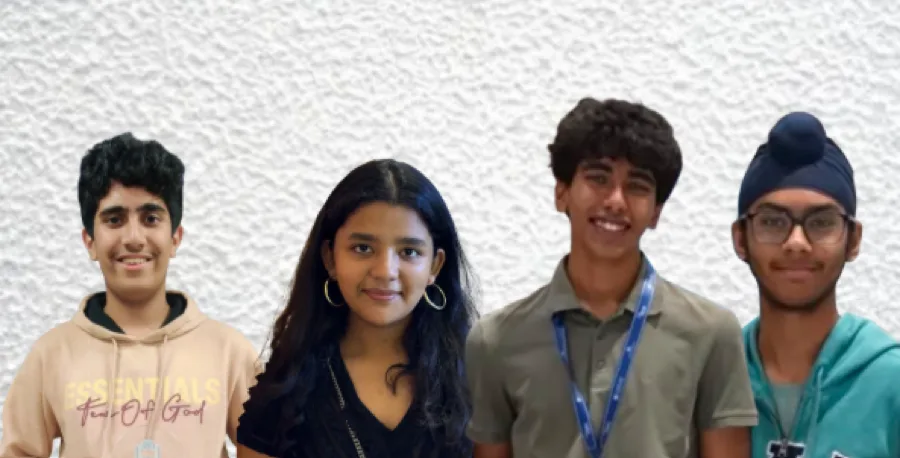
In their words
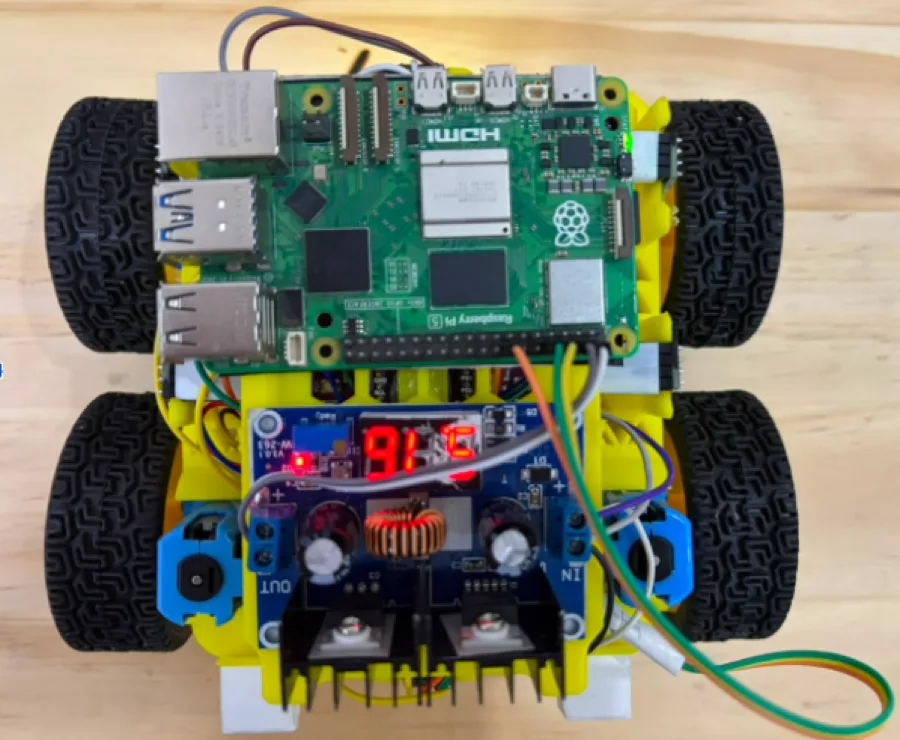
Our team aims to develop a robot that operates with exceptional targeted precision, rescuing victims and overcoming all obstacles in accordance with the Robocup Junior Rescue Maze Rules .. What makes it unique is a strict three-tier body / mind / dev architecture: a Cytron Motion 2350 Pro (RP2350) handles all real-time sensing and closed-loop motion primitives, a Raspberry Pi 5 runs the mapping, frontier exploration and turn-aware Dijkstra routing, and a laptop is used only for development. The two boards speak a simple ACK-gated ASCII protocol over UART, so exactly one command is ever in flight and every motion is verified by sensors rather than assumed.
Six VL53L0X time-of-flight sensors (four for mapping, two dedicated to wall-following), an AS7341 spectral sensor for floor colour, and a BNO055 IMU sit behind a PCA9548A I²C multiplexer. A ~70 Hz control loop (rebuilt from an original 5 Hz blocking design) drives absolute-cardinal turns, calibrated single-tile moves with residual-error carry, PD wall-following, a blind-odometry fallback for long corridors, and IMU-based ramp traversal across multiple floors. The robot persists its map at every silver checkpoint and can resume after a Lack of Progress in any orientation, relocalising itself by matching sensed walls against the saved map
Poster
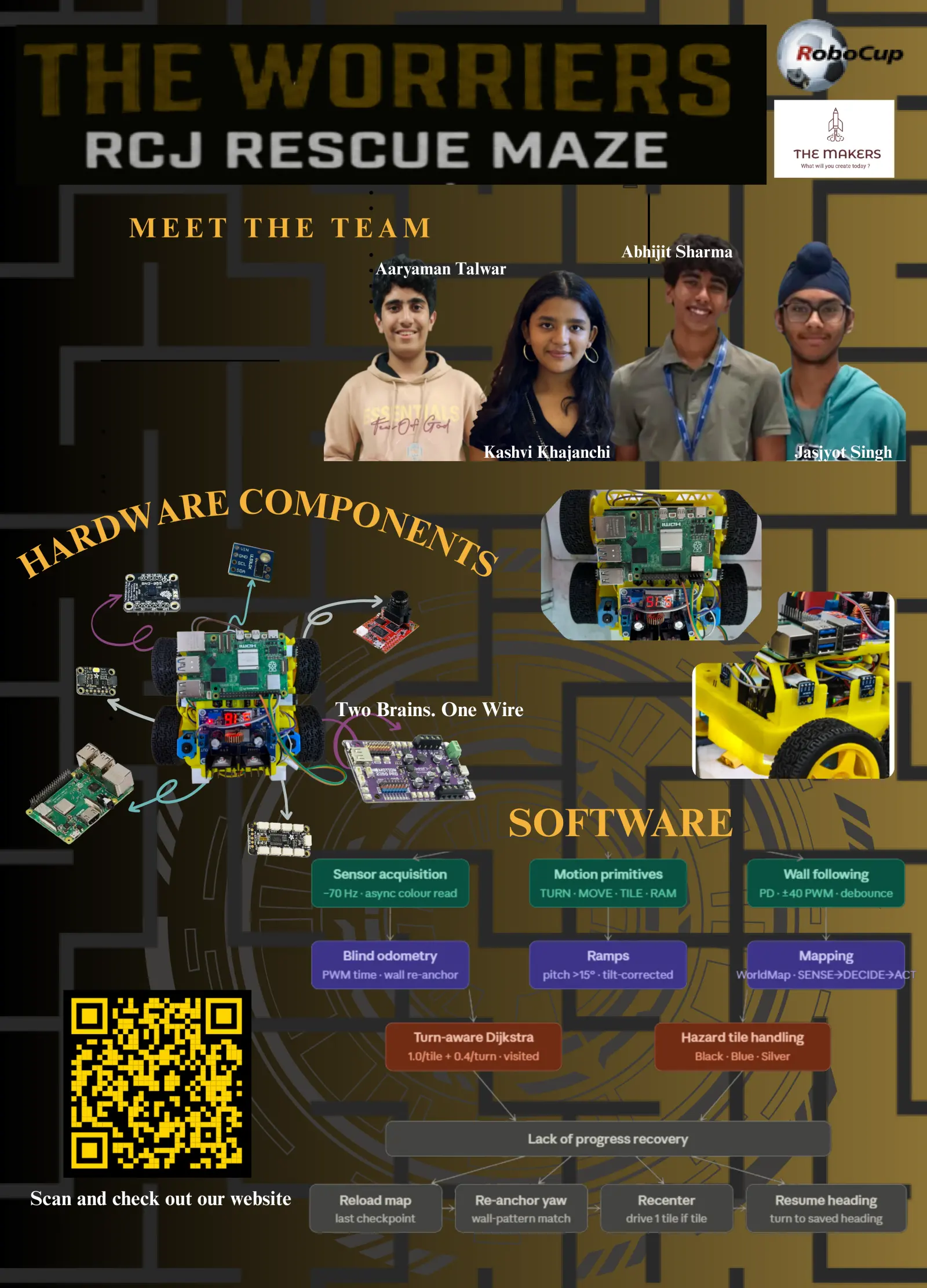
Read the text of this document — 29 words
MEET THE TEAM
                                                                    Abhijit Sharma
                                     Aaryaman Talwar

                                                 Kashvi Khajanchi                    Jasjyot Singh

     ARE COMPON
   DW          EN
 AR              TS
H

                                 Two Brains. One Wire

                                                       SOFTWARE

Scan and check out our website
1 page, rendered as images so they load quickly. The text above is the document's own, extracted from the PDF.
Presentation video
Hosted on YouTube. The player loads only when you press play.
Bill of materials
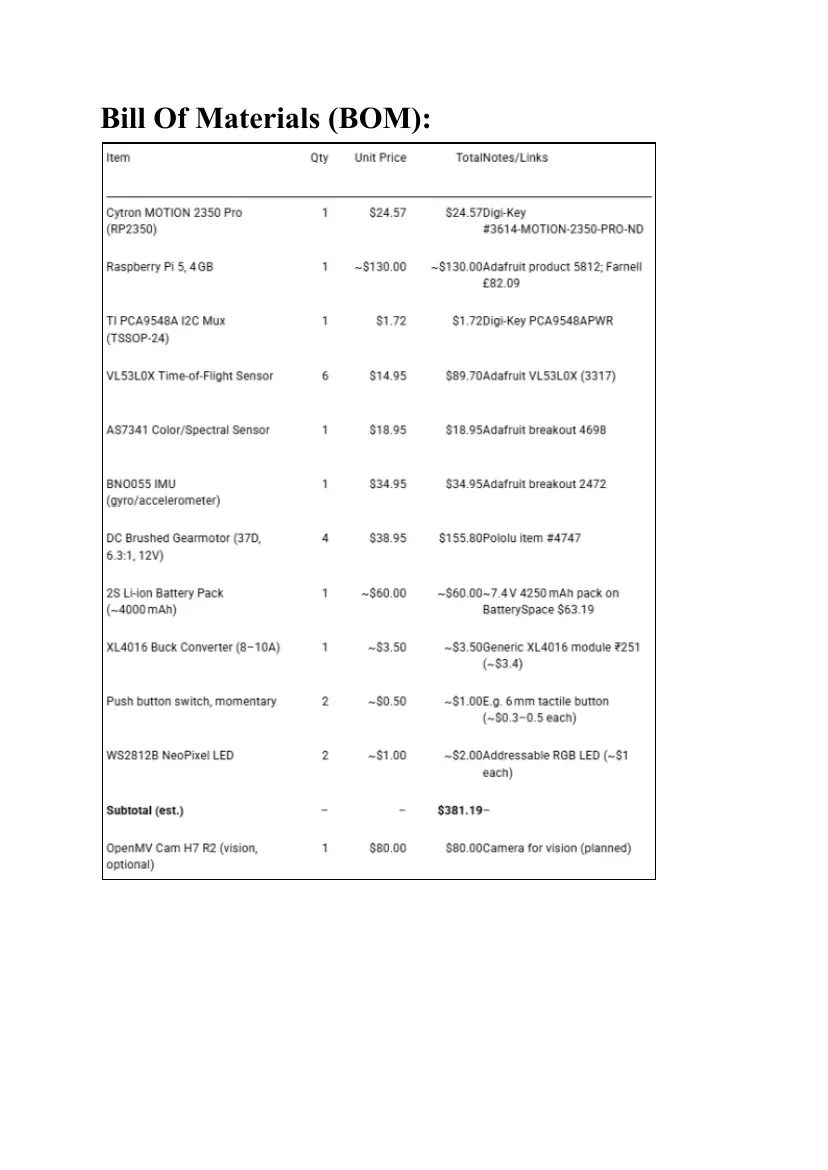
1 page, rendered as images so they load quickly. This document has no text layer — the words in it are part of the image.
Team description paper
Show the remaining 13 pages
Read the text of this document — 2867 words
RoboCup Internationals - Rescue Maze 2026
Team Description Paper
League Name: RCJ RESCUE MAZE
Age Group: Secondary
Team Name: The Worriers
Team Website: Worriersrcj
Participants:
● Abhijit Sharma
● Aaryaman Talwar
● Jasjyot Singh Sethi
● Kashvi Khajanchi
Document: Team Description Paper
Mentor Name: Mr. Vivek Gautum
Institution: The Makers Robotics
Region: INDIA
Contact Email: vivekgautam51@gmail.com
1 | Team - The Worriers
INTENT
Our team, THE WORRIERS, is dedicated to advancing the frontiers of robotics and
collaboration by participating in RoboCup Junior Internationals 2026 for the
category Rescue Maze. We are a group of three students from diverse backgrounds,
united by our passion for problem-solving through the integration of AI and
programming. While participating in the rescue Maze mission our intent was to
innovate and construct a robot capable of analysing complex situations and
performing rescue operations with precision, reliability and ensuring the safety
of the target keeping the sustainability aspect at the heart of our innovation.
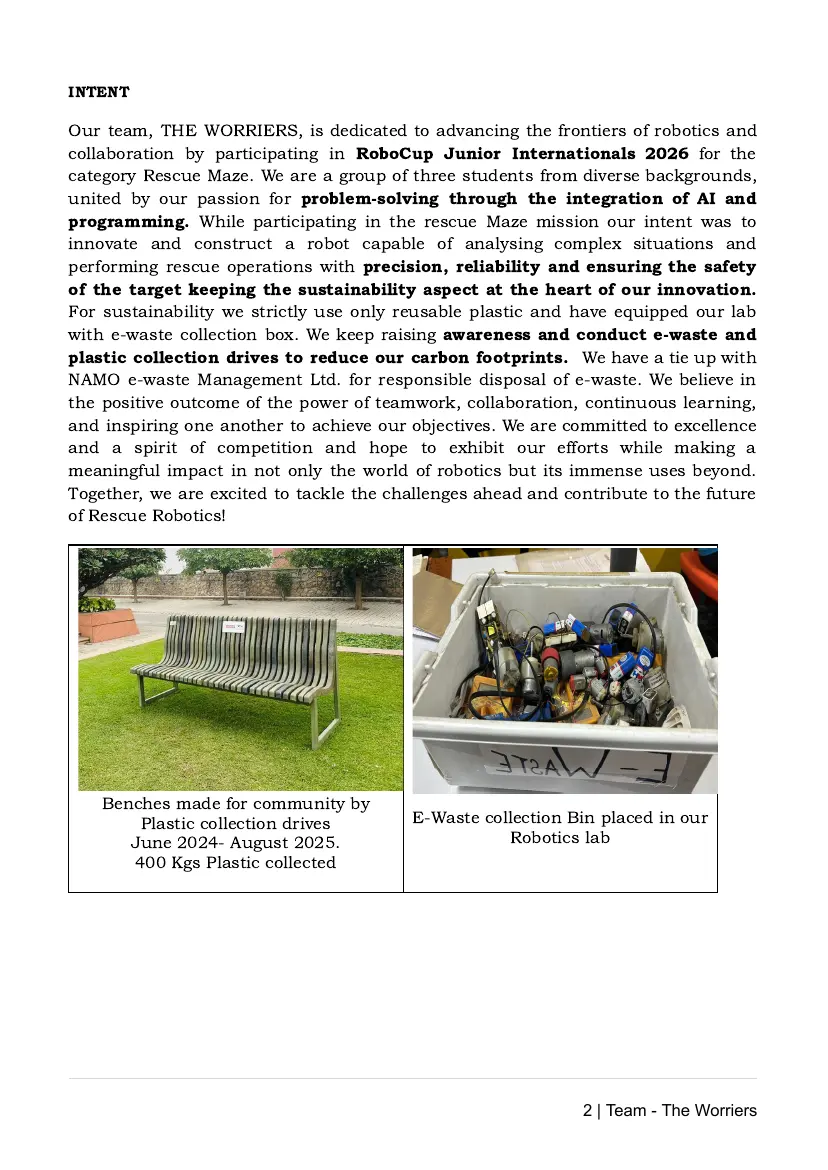
For sustainability we strictly use only reusable plastic and have equipped our lab
with e-waste collection box. We keep raising awareness and conduct e-waste and
plastic collection drives to reduce our carbon footprints. We have a tie up with
NAMO e-waste Management Ltd. for responsible disposal of e-waste. We believe in
the positive outcome of the power of teamwork, collaboration, continuous learning,
and inspiring one another to achieve our objectives. We are committed to excellence
and a spirit of competition and hope to exhibit our efforts while making a
meaningful impact in not only the world of robotics but its immense uses beyond.
Together, we are excited to tackle the challenges ahead and contribute to the future
of Rescue Robotics!
Benches made for community by
Plastic collection drives E-Waste collection Bin placed in our
June 2024- August 2025. Robotics lab
400 Kgs Plastic collected
2 | Team - The Worriers
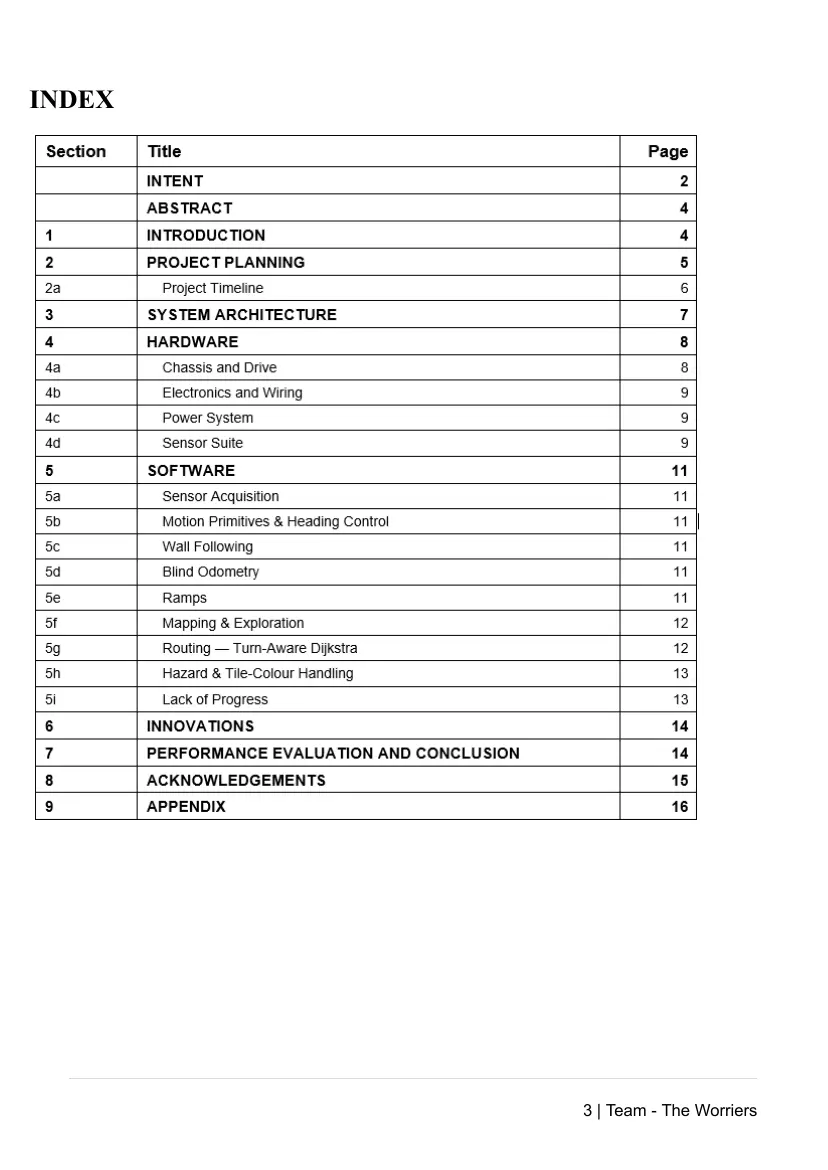
INDEX
3 | Team - The Worriers
ABSTRACT
Our team aims to develop a robot that operates with exceptional targeted precision, rescuing victims
and overcoming all obstacles in accordance with the Robocup Junior Rescue Maze Rules .. What
makes it unique is a strict three-tier body / mind / dev architecture: a Cytron Motion 2350 Pro
(RP2350) handles all real-time sensing and closed-loop motion primitives, a Raspberry Pi 5 runs the
mapping, frontier exploration and turn-aware Dijkstra routing, and a laptop is used only for
development. The two boards speak a simple ACK-gated ASCII protocol over UART, so exactly one
command is ever in flight and every motion is verified by sensors rather than assumed.
Six VL53L0X time-of-flight sensors (four for mapping, two dedicated to wall-following), an AS7341
spectral sensor for floor colour, and a BNO055 IMU sit behind a PCA9548A I²C multiplexer. A ~70
Hz control loop (rebuilt from an original 5 Hz blocking design) drives absolute-cardinal turns,
calibrated single-tile moves with residual-error carry, PD wall-following, a blind-odometry fallback for
long corridors, and IMU-based ramp traversal across multiple floors. The robot persists its map at
every silver checkpoint and can resume after a Lack of Progress in any orientation, relocalising itself
by matching sensed walls against the saved map
1) INTRODUCTION
Our team comprises four members — Abhijit Sharma, Aaryaman Talwar, Kashvi Khajanchi and
Jasjyot Singh Sethi bringing together a blend of unique perspectives and experiences, united by a
shared goal: to collaborate and deliver the best possible outcome. Our journey toward the RoboCup
Junior Rescue Maze began in our robotics lab, and our participation in earlier RoboCup events gave
us insight into the level of precision and reliability an international arena demands.
We divided tasks based on our strengths, yet our roles constantly overlapped as we worked as a
unified team , whether designing the chassis, writing firmware, building the mapping engine, or
testing in our practice maze. The competition has not only expanded our technical knowledge but
also sharpened essential 21st-century skills like collaboration, problem-solving and critical thinking.
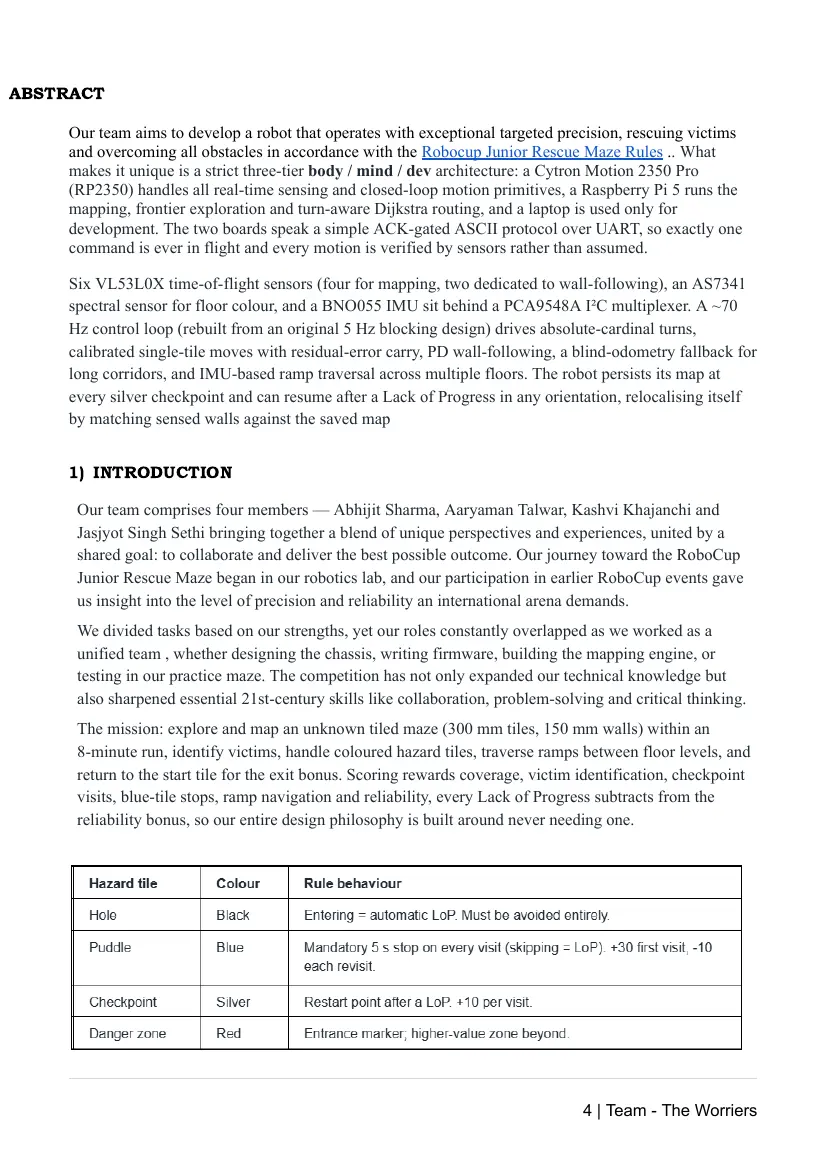
The mission: explore and map an unknown tiled maze (300 mm tiles, 150 mm walls) within an
8-minute run, identify victims, handle coloured hazard tiles, traverse ramps between floor levels, and
return to the start tile for the exit bonus. Scoring rewards coverage, victim identification, checkpoint
visits, blue-tile stops, ramp navigation and reliability, every Lack of Progress subtracts from the
reliability bonus, so our entire design philosophy is built around never needing one.
4 | Team - The Worriers
2) PROJECT PLANNING
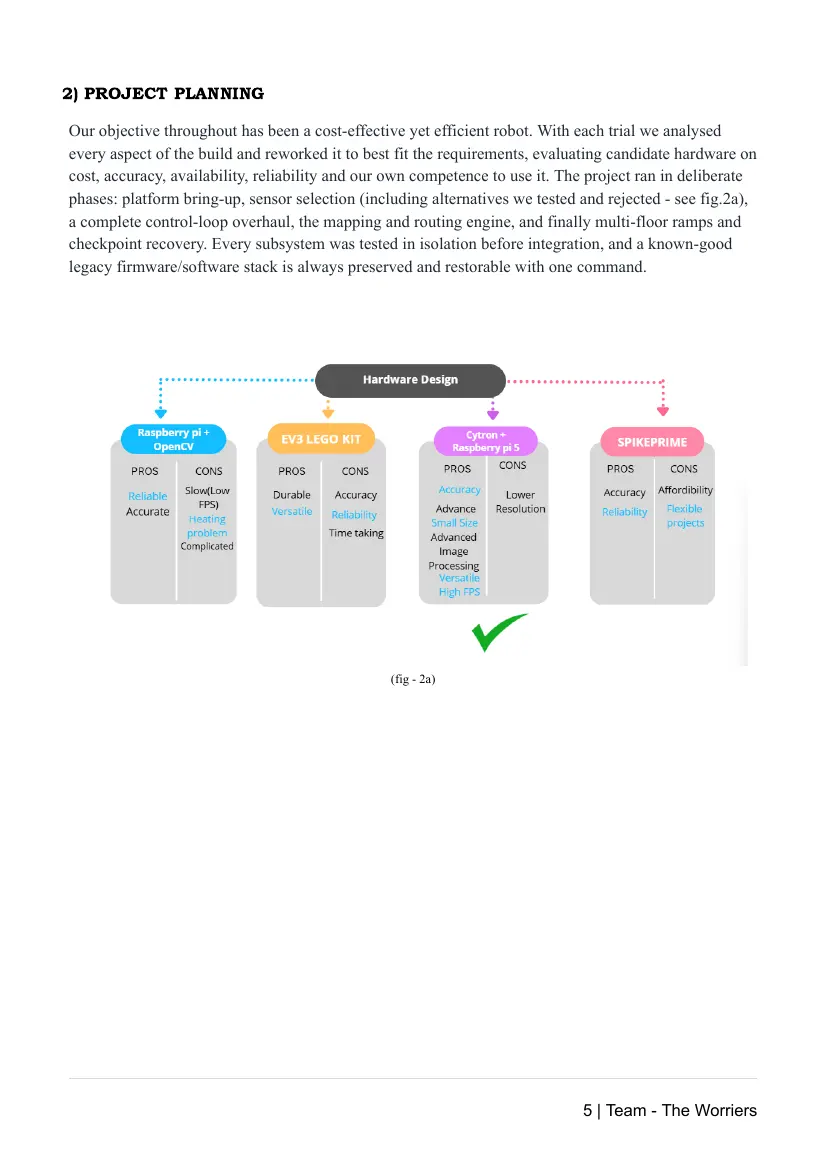
Our objective throughout has been a cost-effective yet efficient robot. With each trial we analysed
every aspect of the build and reworked it to best fit the requirements, evaluating candidate hardware on
cost, accuracy, availability, reliability and our own competence to use it. The project ran in deliberate
phases: platform bring-up, sensor selection (including alternatives we tested and rejected - see fig.2a),
a complete control-loop overhaul, the mapping and routing engine, and finally multi-floor ramps and
checkpoint recovery. Every subsystem was tested in isolation before integration, and a known-good
legacy firmware/software stack is always preserved and restorable with one command.
(fig - 2a)
5 | Team - The Worriers
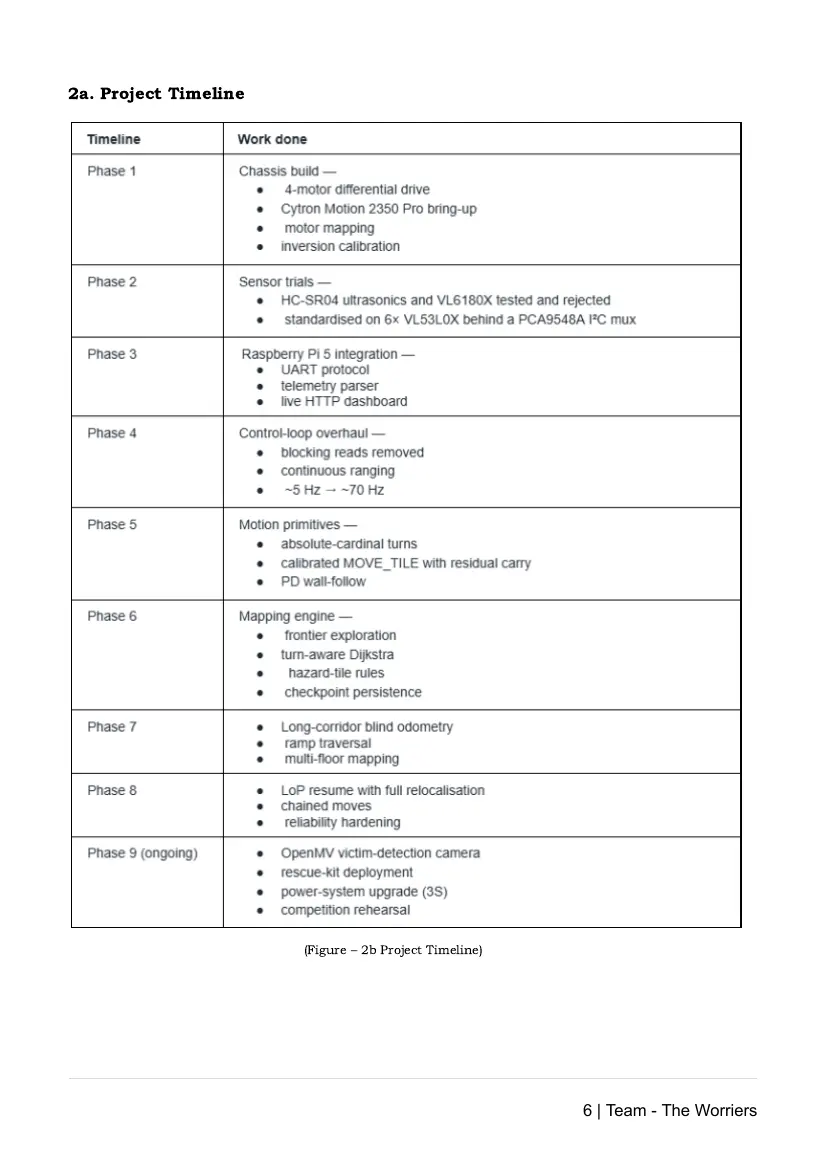
2a. Project Timeline
(Figure – 2b Project Timeline)
6 | Team - The Worriers
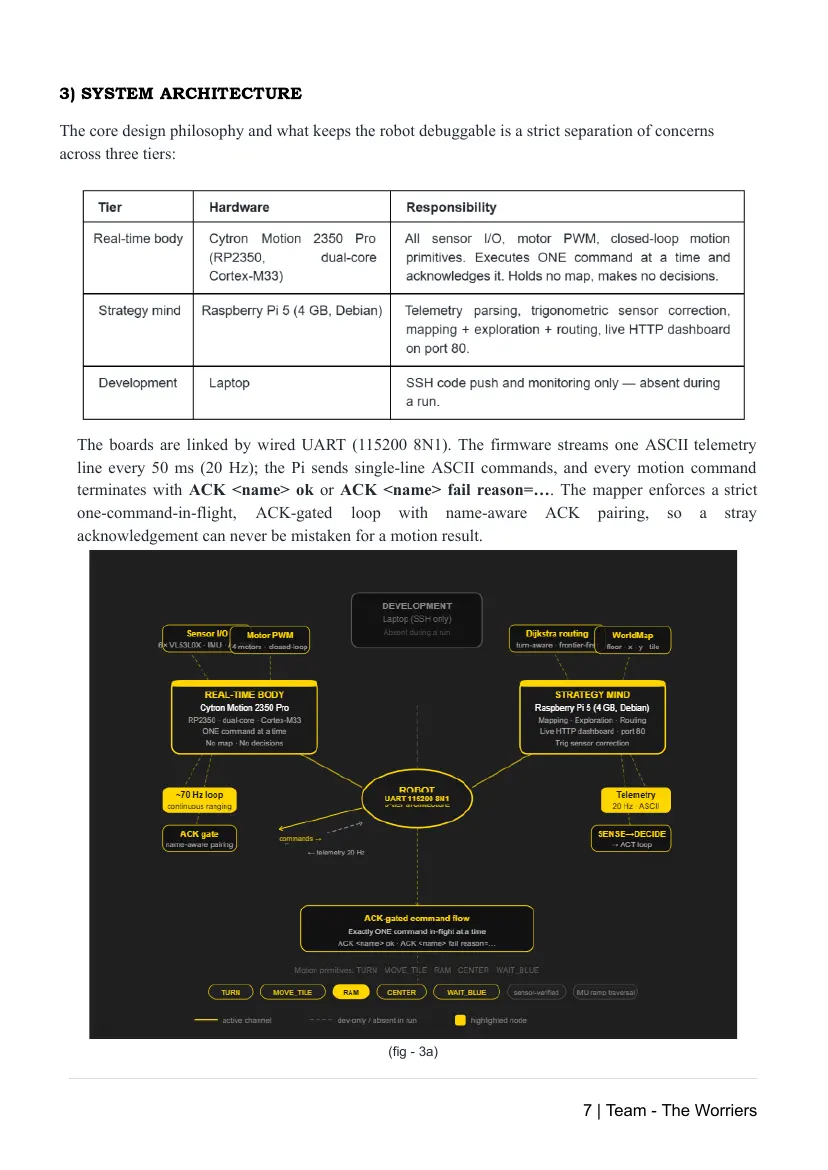
3) SYSTEM ARCHITECTURE
The core design philosophy and what keeps the robot debuggable is a strict separation of concerns
across three tiers:
The boards are linked by wired UART (115200 8N1). The firmware streams one ASCII telemetry
line every 50 ms (20 Hz); the Pi sends single-line ASCII commands, and every motion command
terminates with ACK <name> ok or ACK <name> fail reason=…. The mapper enforces a strict
one-command-in-flight, ACK-gated loop with name-aware ACK pairing, so a stray
acknowledgement can never be mistaken for a motion result.
(fig - 3a)
7 | Team - The Worriers
4) HARDWARE
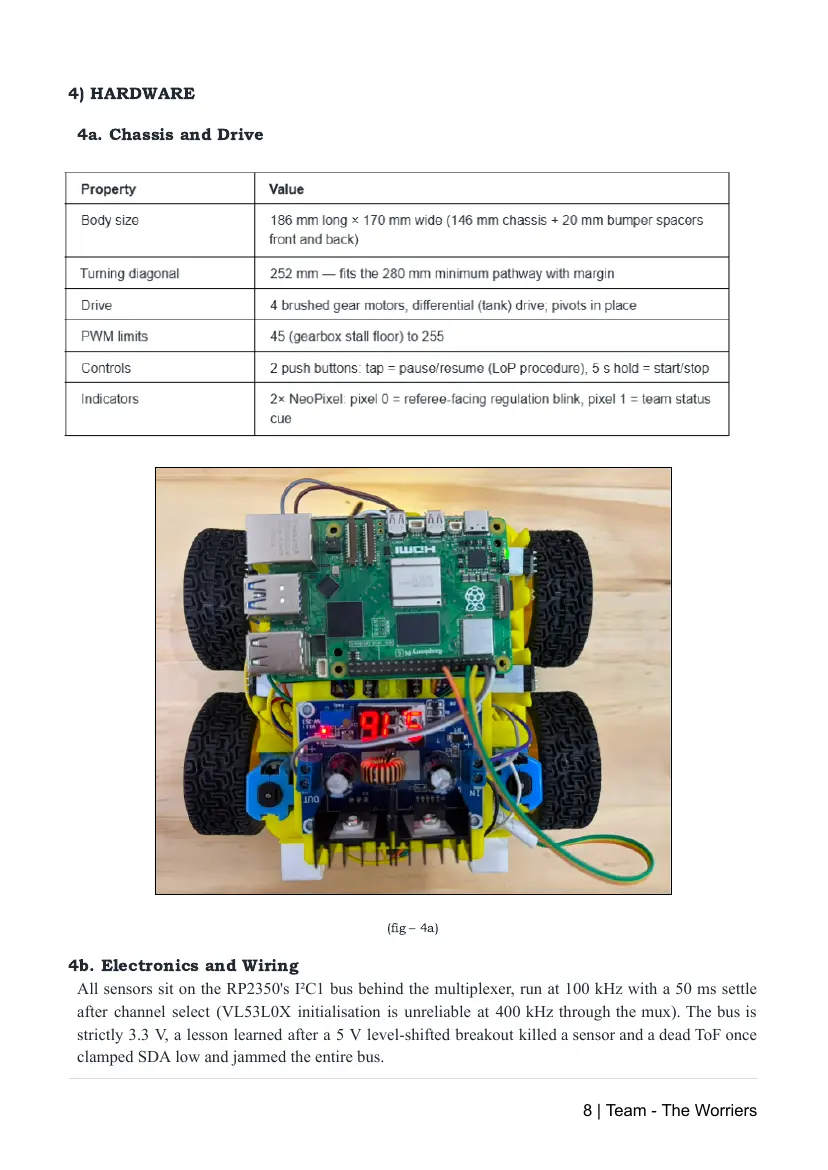
4a. Chassis and Drive
(fig – 4a)
4b. Electronics and Wiring
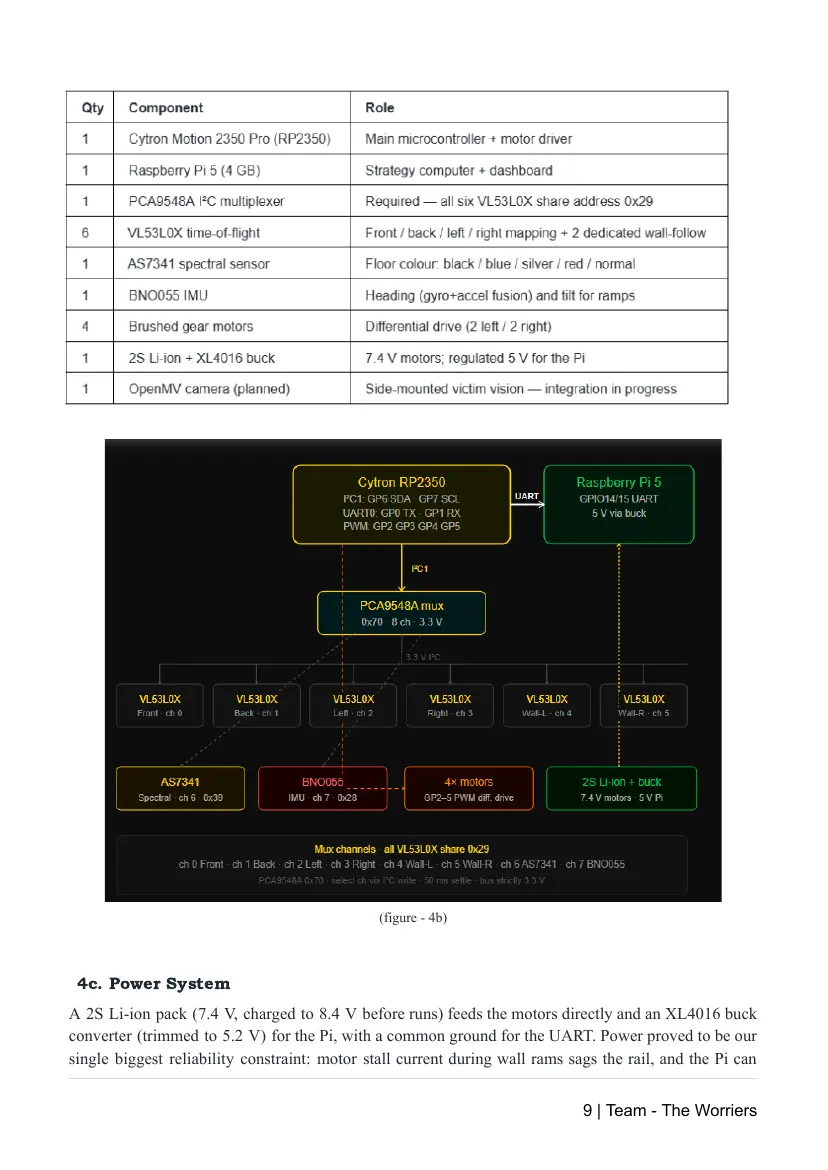
All sensors sit on the RP2350's I²C1 bus behind the multiplexer, run at 100 kHz with a 50 ms settle
after channel select (VL53L0X initialisation is unreliable at 400 kHz through the mux). The bus is
strictly 3.3 V, a lesson learned after a 5 V level-shifted breakout killed a sensor and a dead ToF once
clamped SDA low and jammed the entire bus.
8 | Team - The Worriers
(figure - 4b)
4c. Power System
A 2S Li-ion pack (7.4 V, charged to 8.4 V before runs) feeds the motors directly and an XL4016 buck
converter (trimmed to 5.2 V) for the Pi, with a common ground for the UART. Power proved to be our
single biggest reliability constraint: motor stall current during wall rams sags the rail, and the Pi can
9 | Team - The Worriers
brown out under combined load. We mitigated this in software, lower ram PWM, fewer rams,
sensor-verified moves, and a two-sample yaw reference that detects an IMU reset caused by a
brown-out , and a 3S upgrade with bulk capacitance is planned. This constraint shaped the whole
design: the software is deliberately conservative and verifies every motion with sensors rather than
assuming success.
4d. Sensor Suite
We did not arrive at the final suite on the first attempt; the rejected alternatives shaped the design:
• HC-SR04 ultrasonics (rejected): originally fitted for wall-following, but the blocking echo timing
starved the control loop, the RP2350 GPIO is not 5 V tolerant, and the wide beam blurred the wall
edges needed for alignment.
• VL6180X short-range ToF (rejected): ideal range on paper for a wall ~94 mm away, but the
modules repeatedly failed to initialise on the 3.3 V bus and one unit died.
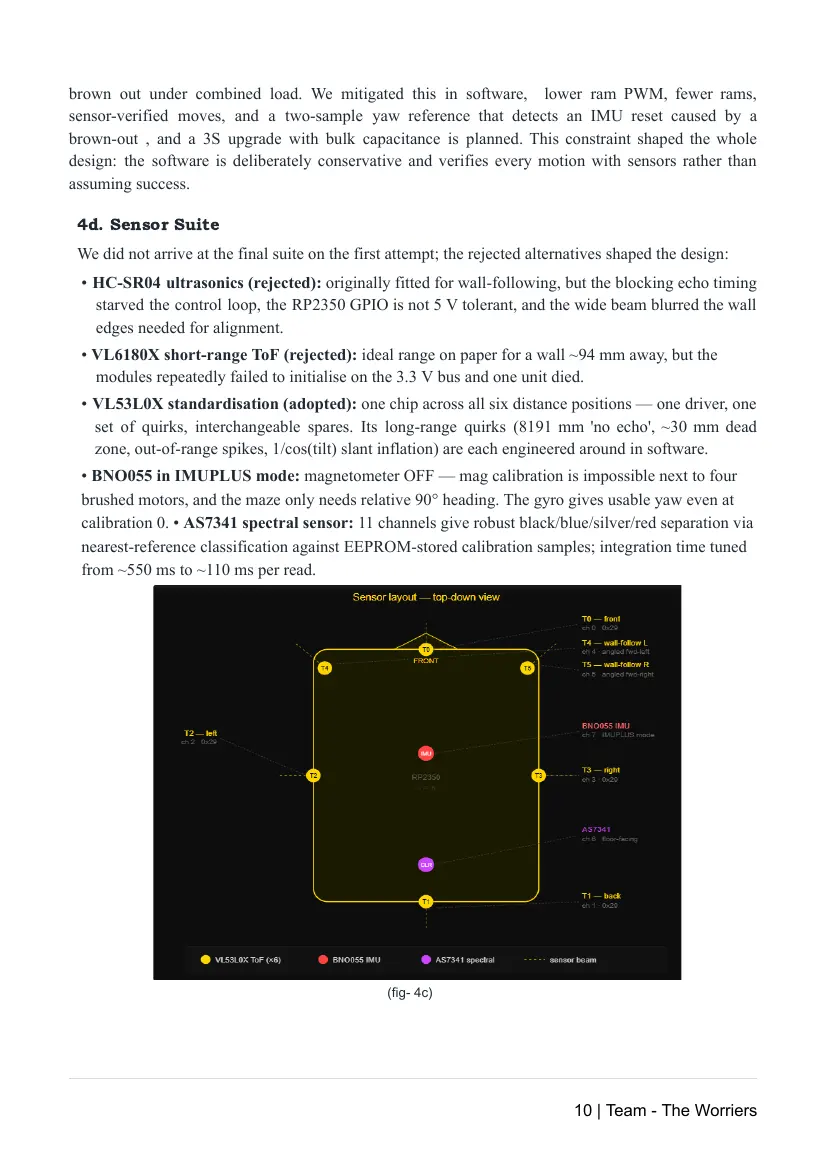
• VL53L0X standardisation (adopted): one chip across all six distance positions — one driver, one
set of quirks, interchangeable spares. Its long-range quirks (8191 mm 'no echo', ~30 mm dead
zone, out-of-range spikes, 1/cos(tilt) slant inflation) are each engineered around in software.
• BNO055 in IMUPLUS mode: magnetometer OFF — mag calibration is impossible next to four
brushed motors, and the maze only needs relative 90° heading. The gyro gives usable yaw even at
calibration 0. • AS7341 spectral sensor: 11 channels give robust black/blue/silver/red separation via
nearest-reference classification against EEPROM-stored calibration samples; integration time tuned
from ~550 ms to ~110 ms per read.
(fig- 4c)
10 | Team - The Worriers
5) SOFTWARE
5a. Sensor Acquisition
Our original loop performed six blocking ToF reads plus a blocking colour read every iteration — a
~250 ms loop. Every behaviour sampled at ~5 Hz, causing tile overshoot, centering oscillation and
erratic turns. The overhaul moved all six VL53L0X into hardware continuous-ranging mode (the loop
just polls 'ready?'), made the colour read fully asynchronous, and rate-limited telemetry to 20 Hz. A
sensor producing no data for 400 ms is flagged offline and automatically re-initialised — self-healing,
and the loop can never block on a wedged chip. Result: a ~70 Hz control loop with millimetre-accurate
stops.
5b. Motion Primitives & Heading Control
The firmware exposes closed-loop primitives — TURN, MOVE_TILE, RAM, CENTER,
WAIT_BLUE — and the key heading insight is that turns target absolute grid cardinals, not relative
90° steps: an off-axis entry is corrected by the turn instead of accumulated (relative turns once
desynced the map until the robot 'phased through a wall'). A grid yaw reference is captured at
power-on and drift is managed in layers: an in-place re-square every 3 tiles, and every 10 tiles a full
recalibration — ram a known wall to physically square the chassis, re-anchor the yaw reference,
recenter.
MOVE_TILE drives exactly one calibrated tile using the front ToF shrinking or back ToF growing,
with a residual-error carry so each move cancels the previous one's leftover; a stop at a front wall
runs an absolute alignment that zeroes the error. Tile size itself is calibrated live from corridor runs
(yaw-gated, band-limited 250–360 mm, running-averaged), so the robot adapts to any arena. A
phantom-tile guard refuses to start a move when the front reads ≤ 150 mm — geometrically the bands
of 'my boundary walled' vs 'next boundary walled' can never overlap it.
5c. Wall Following
Lateral steering uses the two dedicated side ToFs with a PD controller (bias = Kp·error + Kd·∆error,
clamped ±40 PWM, applied differentially) and per-side targets — the two sensors legitimately read
different distances at the true centre, and a shared target steered into a wall. Wall presence is
debounced asymmetrically (500 ms to assert, 100 ms to release) and a wall must persist 750 ms
before its loss triggers any reaction, so a single flaky frame can neither invent nor delete a wall.
5d. Blind Odometry
In a 7-tile corridor both end walls are beyond reliable ToF range, so a move can begin with no valid
travel reference. Blind mode drives at fixed PWM with a field-calibrated time-based travel estimate,
re-anchors whenever an established side wall ends (wall edges sit exactly on tile boundaries), and
snaps the stop target onto the grid the moment a front wall comes into range — an absolute re-anchor
that absorbs the accumulated time error.
5e. Ramps
A ramp is distinguished from an obstacle by a sustained pitch change (>15°) with minimal roll
change (<6°). Going up, the robot climbs on tilt-corrected wall-follow until the floor is flat, then
reverses until pitch returns — at that instant the rear wheel contact sits exactly on the crest edge, a
known tile boundary. From the edge the chassis geometry gives an exact advance to the next tile
centre, and the traversal acts as an absolute position re-anchor. RAMP UP/DOWN events drive the
11 | Team - The Worriers
mapper's floor transitions.
5f. Mapping & Exploration
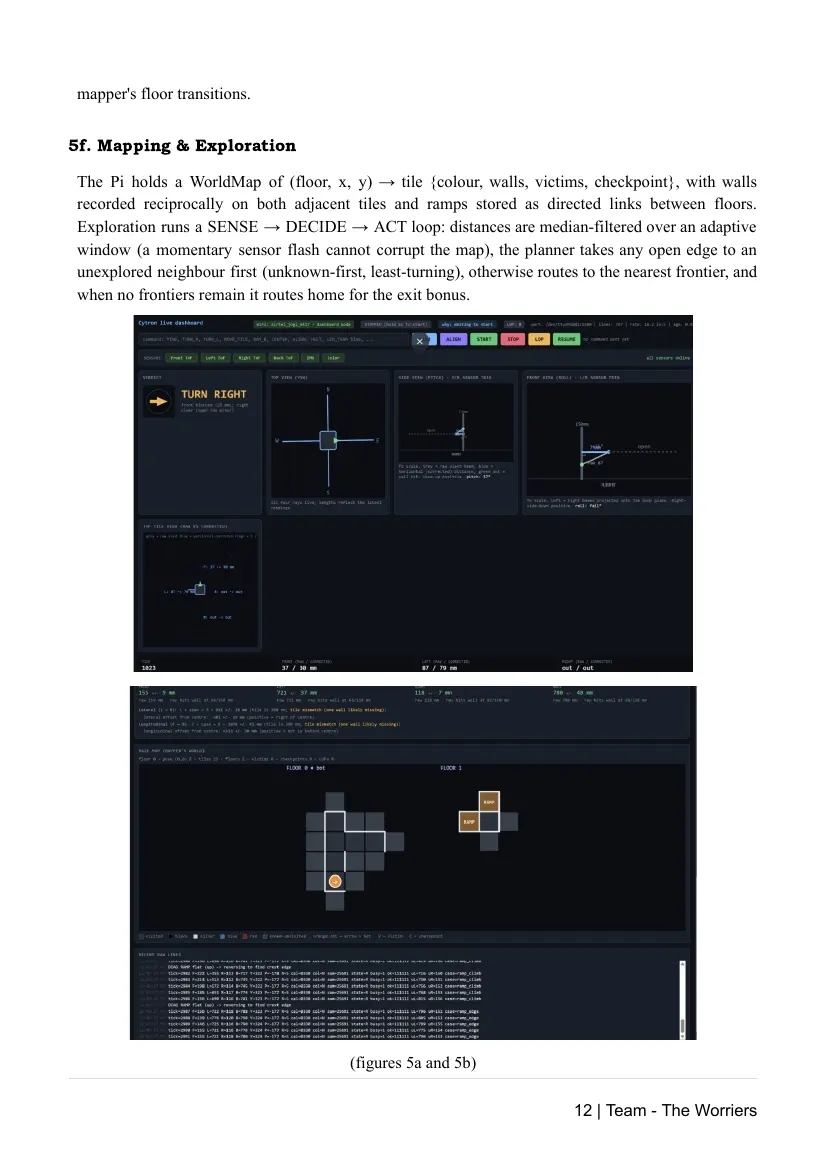
The Pi holds a WorldMap of (floor, x, y) → tile {colour, walls, victims, checkpoint}, with walls
recorded reciprocally on both adjacent tiles and ramps stored as directed links between floors.
Exploration runs a SENSE → DECIDE → ACT loop: distances are median-filtered over an adaptive
window (a momentary sensor flash cannot corrupt the map), the planner takes any open edge to an
unexplored neighbour first (unknown-first, least-turning), otherwise routes to the nearest frontier, and
when no frontiers remain it routes home for the exit bonus.
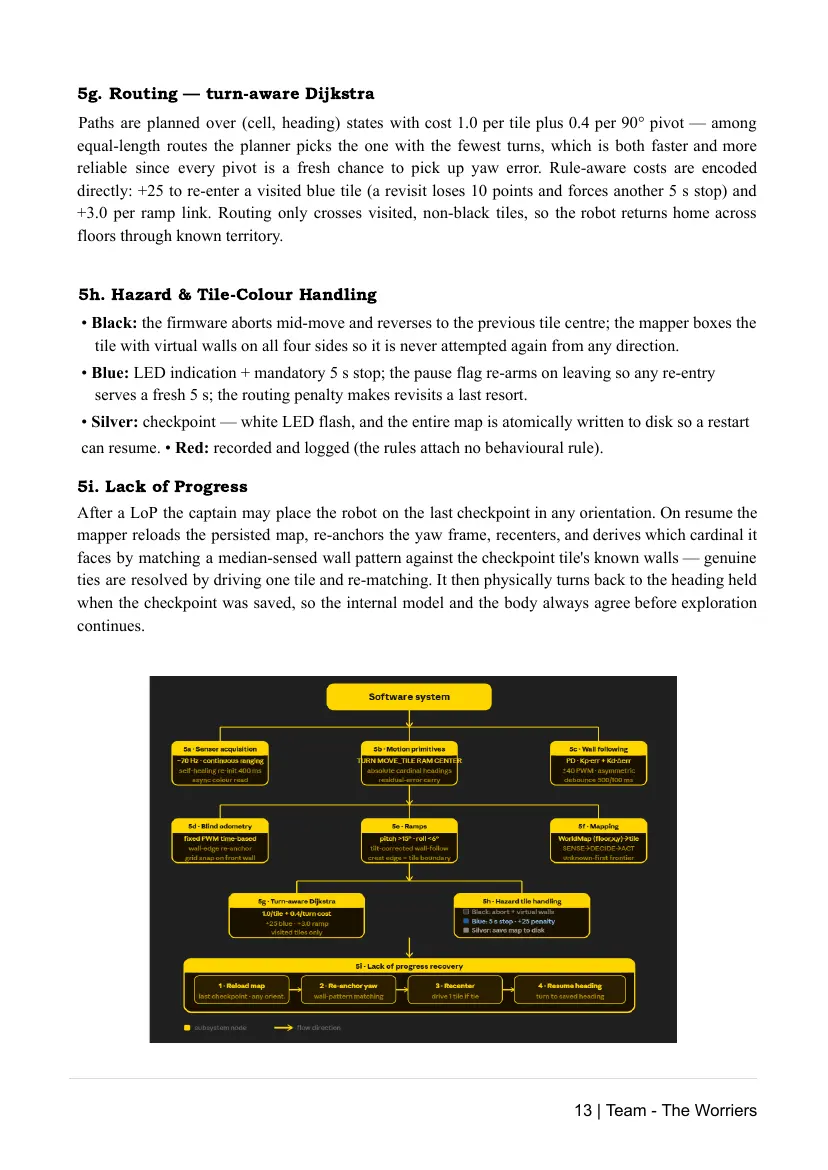
(figures 5a and 5b)
12 | Team - The Worriers
5g. Routing — turn-aware Dijkstra
Paths are planned over (cell, heading) states with cost 1.0 per tile plus 0.4 per 90° pivot — among
equal-length routes the planner picks the one with the fewest turns, which is both faster and more
reliable since every pivot is a fresh chance to pick up yaw error. Rule-aware costs are encoded
directly: +25 to re-enter a visited blue tile (a revisit loses 10 points and forces another 5 s stop) and
+3.0 per ramp link. Routing only crosses visited, non-black tiles, so the robot returns home across
floors through known territory.
5h. Hazard & Tile-Colour Handling
• Black: the firmware aborts mid-move and reverses to the previous tile centre; the mapper boxes the
tile with virtual walls on all four sides so it is never attempted again from any direction.
• Blue: LED indication + mandatory 5 s stop; the pause flag re-arms on leaving so any re-entry
serves a fresh 5 s; the routing penalty makes revisits a last resort.
• Silver: checkpoint — white LED flash, and the entire map is atomically written to disk so a restart
can resume. • Red: recorded and logged (the rules attach no behavioural rule).
5i. Lack of Progress
After a LoP the captain may place the robot on the last checkpoint in any orientation. On resume the
mapper reloads the persisted map, re-anchors the yaw frame, recenters, and derives which cardinal it
faces by matching a median-sensed wall pattern against the checkpoint tile's known walls — genuine
ties are resolved by driving one tile and re-matching. It then physically turns back to the heading held
when the checkpoint was saved, so the internal model and the body always agree before exploration
continues.
13 | Team - The Worriers
6) INNOVATIONS
• ACK-gated body/mind split: one command in flight, every motion verified, name-aware
acknowledgement pairing — the architecture itself is our main reliability feature.
• Self-healing sensor pipeline: continuous ranging + automatic re-initialisation of any sensor that
goes silent, without ever blocking the 70 Hz loop.
• Live tile-size calibration: the robot measures the arena's actual tile pitch from corridor runs,
yaw-gated and running-averaged — no per-arena reconfiguration.
• Geometry-gated sensor correction: every distance reading is tilt-projected and rejected if the beam
ray would clear the wall top or hit the floor — a shaken or ramp-climbing robot never draws phantom
walls.
• Blind odometry with edge re-anchoring: time-based travel fused with wall-edge events and grid
snapping survives corridors longer than the sensor range.
• Scoring-aware routing: the rulebook's point values are encoded as edge costs, so the planner
natively avoids blue-tile revisits and unnecessary floor changes.
• Orientation-free LoP recovery: scored wall-pattern relocalisation means the captain can place the
robot any way round and it sorts itself out.
• Chained moves: known corridors are driven without full stops, naturally slowing near each tile
centre — exactly when the future victim cameras get their best look at the walls.
7) PERFORMANCE EVALUATION AND CONCLUSION
Every subsystem was validated both off-bot and on-bot. The complete mapping algorithm runs
against a simulated maze with fake firmware callbacks, asserting full coverage, correct hazard
handling and return-home; a port of the same algorithm passes 40/40 randomly generated mazes
headless. On the robot, a bring-up checklist verifies telemetry and sensor health, single-turn accuracy
(≤ 2° error), corridor centering, the colour-tile drills (blue slow-and-stop, silver flash, black box-out),
the full LoP drill, and ramp climbs onto the dashboard's second floor.
Rich diagnostic telemetry (turn completion error, move position error, blind-mode transitions, ramp
phases) plus the live dashboard let us post-evaluate every run and measure each fix. The headline
result of this process is the control-loop overhaul — from ~5 Hz to ~70 Hz — which transformed the
robot's behaviour from 30–50 mm tile overshoots and oscillating centering to millimetre-accurate
stops. The problems table in our engineering log (brown-outs, wall-follow controller iterations,
heading desync, phantom tiles, jammed I²C bus) reads as the true history of the design: nearly every
feature described in this paper exists because a specific failure demanded it.
We look forward to showcasing our robot in the actual arena and to exchanging ideas with competing
teams about the engineering behind their robots.
14 | Team - The Worriers
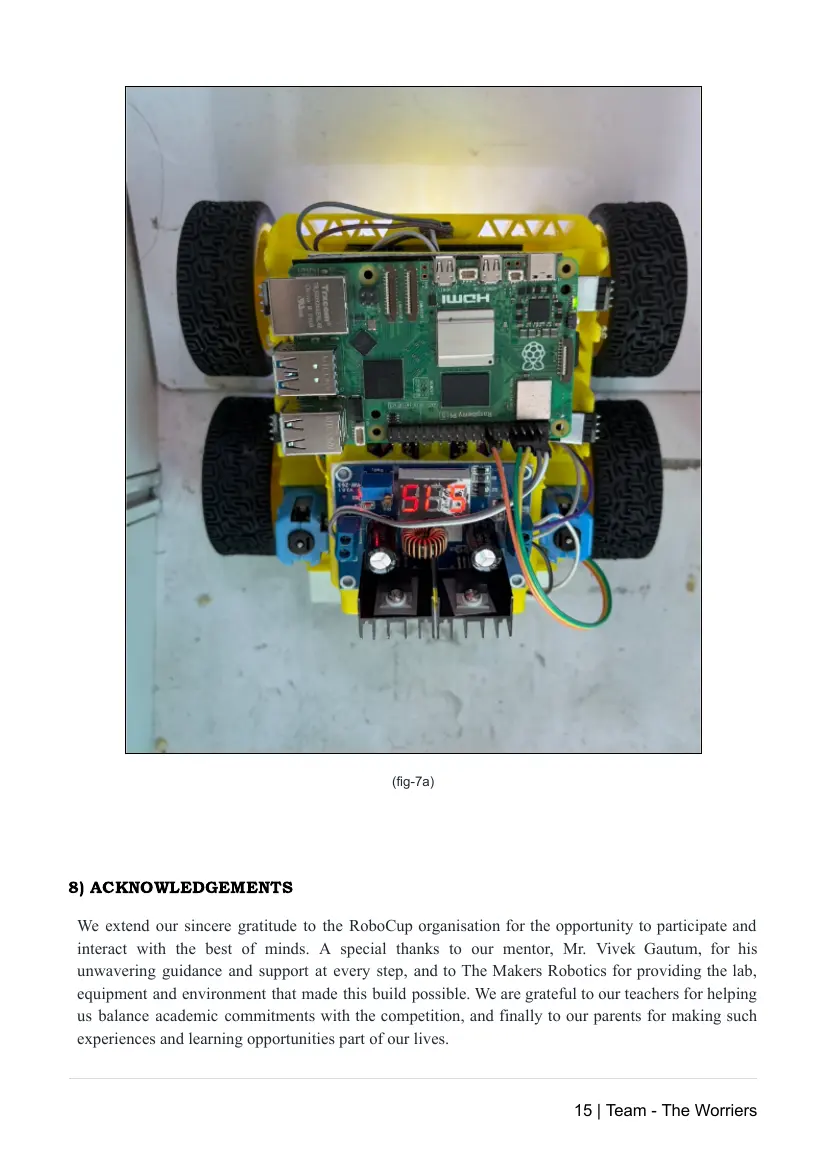
(fig-7a)
8) ACKNOWLEDGEMENTS
We extend our sincere gratitude to the RoboCup organisation for the opportunity to participate and
interact with the best of minds. A special thanks to our mentor, Mr. Vivek Gautum, for his
unwavering guidance and support at every step, and to The Makers Robotics for providing the lab,
equipment and environment that made this build possible. We are grateful to our teachers for helping
us balance academic commitments with the competition, and finally to our parents for making such
experiences and learning opportunities part of our lives.
15 | Team - The Worriers
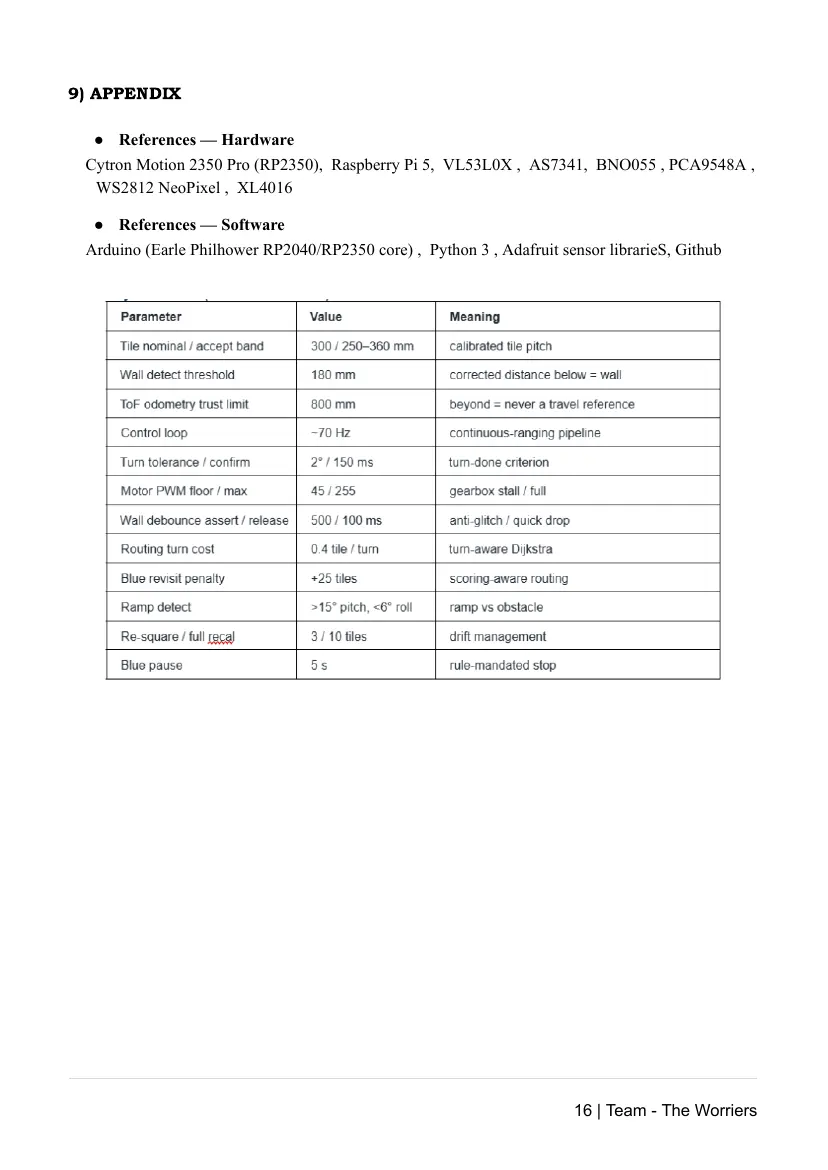
9) APPENDIX
● References — Hardware
Cytron Motion 2350 Pro (RP2350), Raspberry Pi 5, VL53L0X , AS7341, BNO055 , PCA9548A ,
WS2812 NeoPixel , XL4016
● References — Software
Arduino (Earle Philhower RP2040/RP2350 core) , Python 3 , Adafruit sensor librarieS, Github
16 | Team - The Worriers
16 pages, rendered as images so they load quickly. The text above is the document's own, extracted from the PDF.
Source code
The team's own source code, 62 KB. It is a download rather than part of this page, because a zip is something you open on your computer. It comes from GitHub, which some school networks block.