
SERŠ TEAM
Document register
- Poster1 pagePublished
- Presentation videoYouTubePublished
- Bill of materials112 KBPublished
- Team description paperNot shared
- Engineering journalNot shared
- Source codeNot shared
Sharing each document is the team's decision. “Not shared” means this team chose not to publish it, or did not submit one — not that it is missing from the archive.
In their words
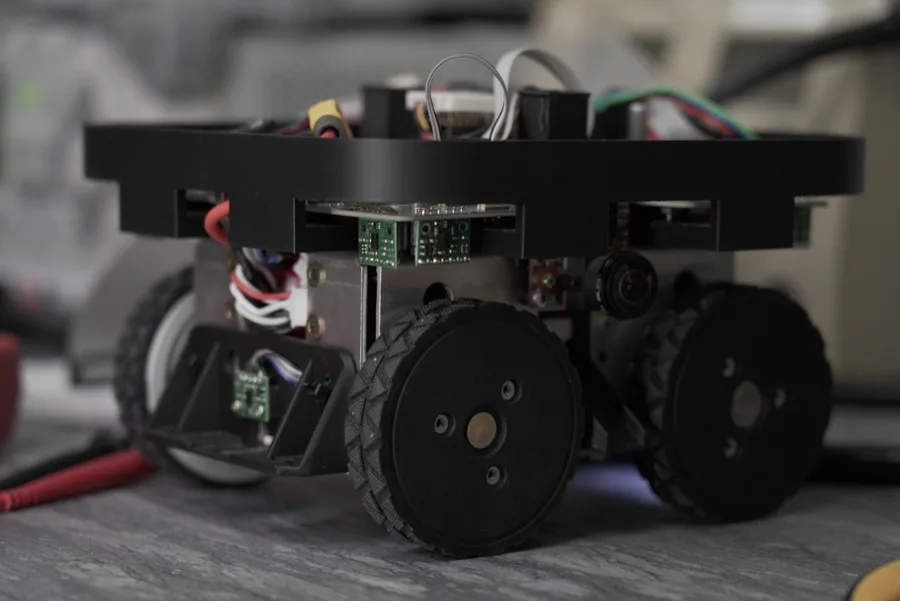
This document presents our fully autonomous rescue robot, which is expressly designed to navigate complex maze-like environments and locate "victims" in real-time. Among its most distinguishing features is its durable, modular hardware architecture, centered around a custom-made multi-layer printed circuit board featuring an STM32F767ZI microcontroller. The setup includes provisions for several sensors—from Time-of-Flight distance modules to inertial measurement units—that collectively help build a three-dimensional map of the environment. The robot applies a Dijkstra's algorithm to systematically explore unvisited tiles, repeatedly altering its route as it acquires more information.
To enhance movement accuracy, highly calibrated Proportional-Integral-Derivative (PID) controllers are applied at the motor driver level as well as in the high-level driving loop to minimize unintentional speed differences between motors and alignment errors between successive maneuvers. In the background, an improved Convolutional Neural Network (CNN) on a Raspberry PI 5 SBC (Single Board Computer) conducts video frame analysis for recognizing specific letters indicating victims. Upon passing a threshold confidence level, the system triggers an interrupt in the main controller for instant response without manual polling.
In short, our design focuses on the optimal combination of hardware, software, and control logic to develop an efficient platform that maintains peak performance under various conditions. With the incorporation of accurate mapping, precise movement, and efficient victim detection, this robot is characterized by its agility and stability in competitive environments.
Poster
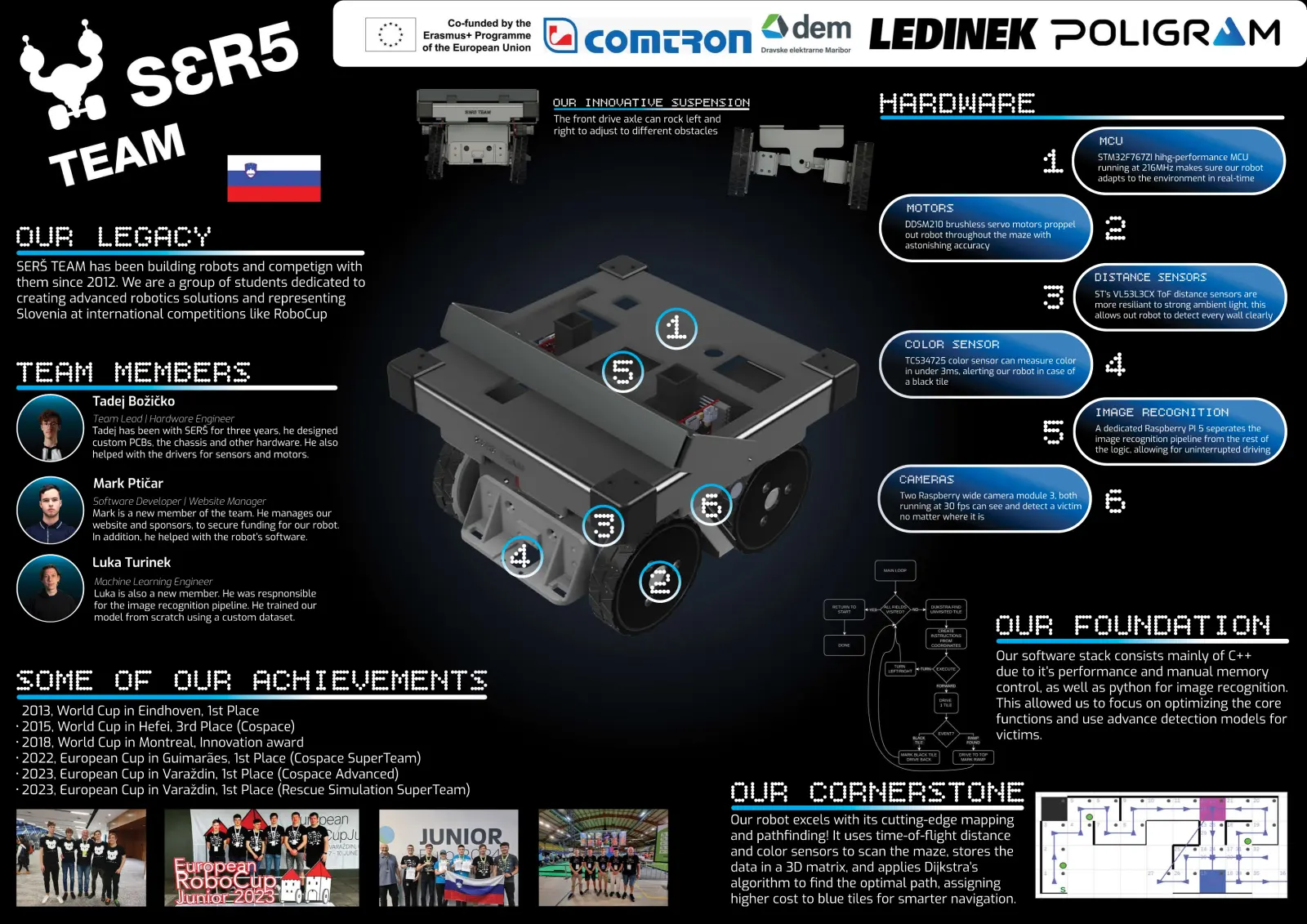
Read the text of this document — 430 words
OUR INNOVATIVE SUSPENSION
The front drive axle can rock left and
HARDWARE
right to adjust to different obstacles
MCU
1 STM32F767ZI hihg-performance MCU
running at 216MHz makes sure our robot
adapts to the environment in real-time
MOTORS
OUR LEGACY
DDSM210 brushless servo motors proppel
out robot throughout the maze with
astonishing accuracy
2
SERŠ TEAM has been building robots and competign with
them since 2012. We are a group of students dedicated to DISTANCE SENSORS
creating advanced robotics solutions and representing 3 ST’s VL53L3CX ToF distance sensors are
more resiliant to strong ambient light, this
1
Slovenia at international competitions like RoboCup allows out robot to detect every wall clearly
COLOR SENSOR
TEAM MEMBERS 5
TCS34725 color sensor can measure color
in under 3ms, alerting our robot in case of
a black tile
4
Tadej Božičko
IMAGE RECOGNITION
5
Team Lead | Hardware Engineer
Tadej has been with SERŠ for three years, he designed A dedicated Raspberry PI 5 seperates the
custom PCBs, the chassis and other hardware. He also image recognition pipeline from the rest of
the logic, allowing for uninterrupted driving
helped with the drivers for sensors and motors.
Mark Ptičar CAMERAS
Software Developer | Website Manager
6 Two Raspberry wide camera module 3, both
running at 30 fps can see and detect a victim 6
3
Mark is a new member of the team. He manages our no matter where it is
website and sponsors, to secure funding for our robot.
In addition, he helped with the robot’s software.
Luka Turinek 4
Machine Learning Engineer
Luka is also a new member. He was respnonsible
for the image recognition pipeline. He trained our
2
model from scratch using a custom dataset.
OUR FOUNDATION
Our software stack consists mainly of C++
SOME OF OUR ACHIEVEMENTS due to it’s performance and manual memory
control, as well as python for image recognition.
This allowed us to focus on optimizing the core
2013, World Cup in Eindhoven, 1st Place
functions and use advance detection models for
• 2015, World Cup in Hefei, 3rd Place (Cospace)
victims.
• 2018, World Cup in Montreal, Innovation award
• 2022, European Cup in Guimarães, 1st Place (Cospace SuperTeam)
• 2023, European Cup in Varaždin, 1st Place (Cospace Advanced)
• 2023, European Cup in Varaždin, 1st Place (Rescue Simulation SuperTeam)
OUR CORNERSTONE
Our robot excels with its cutting-edge mapping
and pathfinding! It uses time-of-flight distance
and color sensors to scan the maze, stores the
data in a 3D matrix, and applies Dijkstra’s
algorithm to find the optimal path, assigning
higher cost to blue tiles for smarter navigation.
1 page, rendered as images so they load quickly. The text above is the document's own, extracted from the PDF.
Presentation video
Hosted on YouTube. The player loads only when you press play.
Bill of materials
Shown as the original PDF, because this one is smaller that way and its text stays selectable and searchable.