
Rescue Rats
Document register
- Poster1 pagePublished
- Presentation videoYouTubePublished
- Bill of materials94 KBPublished
- Team description paper483 KBPublished
- Engineering journalNot shared
- Source codeNot shared
Sharing each document is the team's decision. “Not shared” means this team chose not to publish it, or did not submit one — not that it is missing from the archive.
In their words
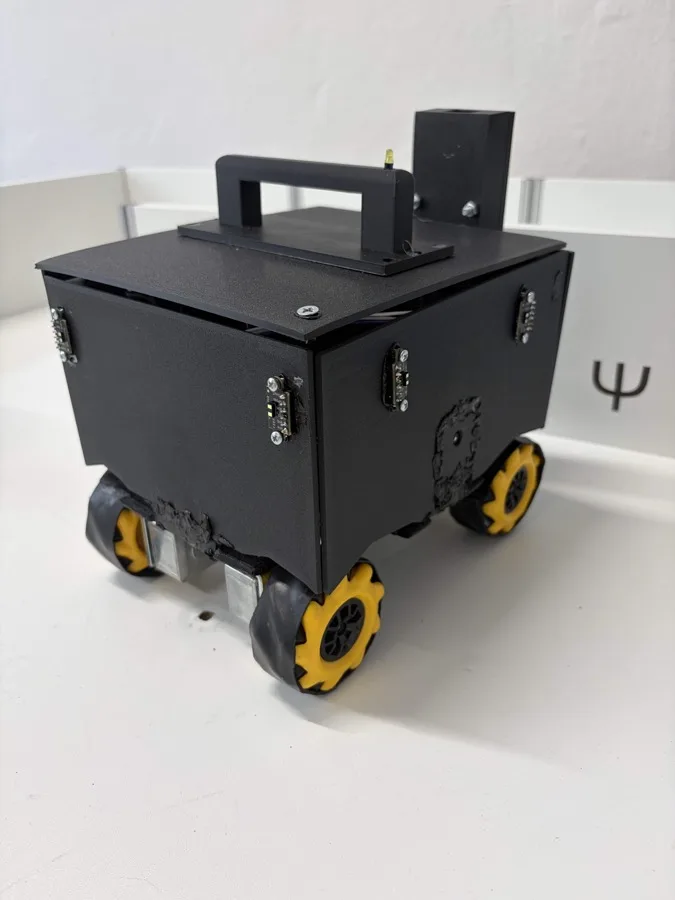
Our robot is a fully autonomous maze-navigating robot designed to locate victims and deploy rescue kits without any human input during a run. It is built around a dual-controller architecture, combining a Raspberry Pi 5 for high-level decision-making with an ESP32-based microcontroller for precise low-level hardware control. The two controllers communicate in real time over a UART serial connection at 115200 baud, with the Raspberry Pi 5 sending movement commands and the ESP32 returning sensor data and execution confirmations.
The chassis was fully designed in-house using 3D modeling software and printed by our team, giving us complete control over the layout, weight distribution, and component placement. Navigation relies on eight VL53L1X laser distance sensors covering all four directions, and an BNO055 gyroscope which tracks heading and actively corrects drift during straight movement. A TCS34725 color sensor on the underside detects floor tile colors to trigger rescue kit deployments automatically. Victim detection runs on the Raspberry Pi 5 using OpenCV, identifying colored ring targets by analyzing concentric color rings and recognizing letter victims by comparing contour shapes against pre-saved references for the Omega, Phi, and Psi symbols.
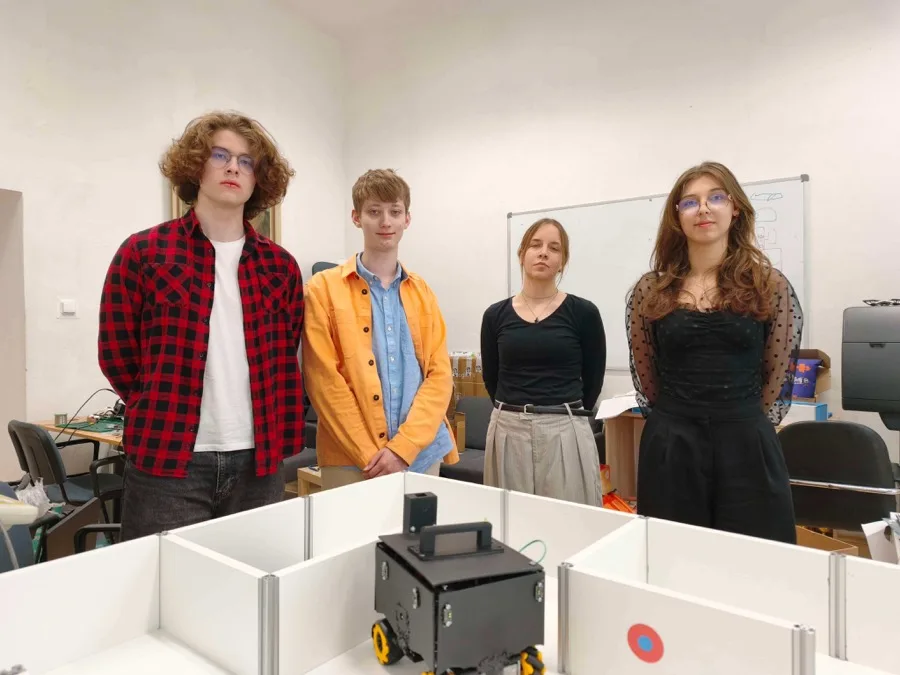
What sets our robot apart is the combination of a fully custom mechanical design, a clean split between high-level and low-level control, and a two-stage computer vision pipeline running entirely on an embedded system. Every part of the robot was built, programmed, and tested by our four-member team.
Poster
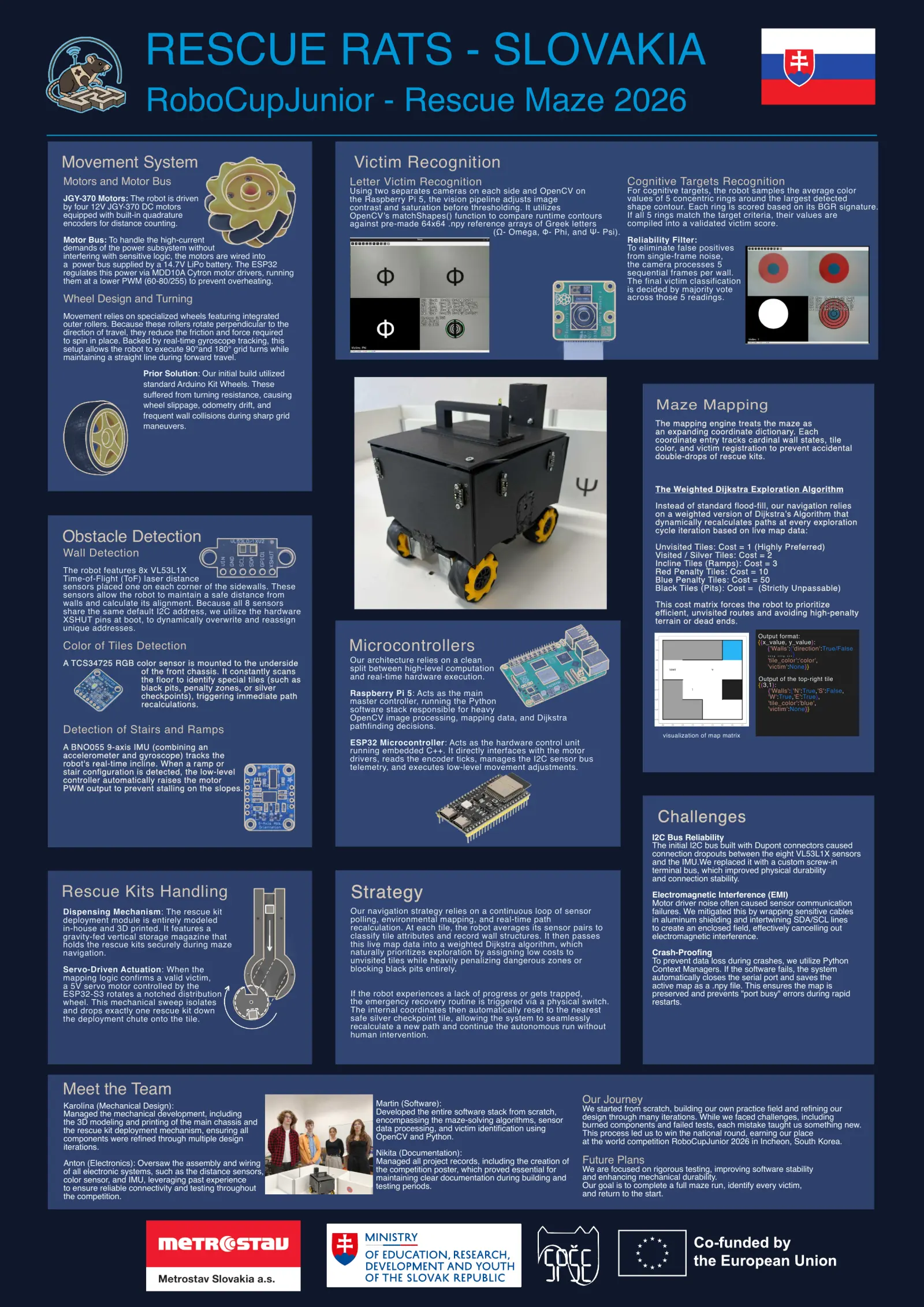
Read the text of this document — 1183 words
RESCUE RATS - SLOVAKIA
RoboCupJunior - Rescue Maze 2026
Movement System Victim Recognition
Motors and Motor Bus Letter Victim Recognition Cognitive Targets Recognition
Using two separates cameras on each side and OpenCV on For cognitive targets, the robot samples the average color
JGY-370 Motors: The robot is driven the Raspberry Pi 5, the vision pipeline adjusts image values of 5 concentric rings around the largest detected
by four 12V JGY-370 DC motors contrast and saturation before thresholding. It utilizes shape contour. Each ring is scored based on its BGR signature.
equipped with built-in quadrature OpenCV’s matchShapes() function to compare runtime contours If all 5 rings match the target criteria, their values are
encoders for distance counting. against pre-made 64x64 .npy reference arrays of Greek letters compiled into a validated victim score.
(Ω- Omega, Φ- Phi, and Ψ- Psi).
Motor Bus: To handle the high-current Reliability Filter:
demands of the power subsystem without To eliminate false positives
interfering with sensitive logic, the motors are wired into from single-frame noise,
a power bus supplied by a 14.7V LiPo battery. The ESP32 the camera processes 5
regulates this power via MDD10A Cytron motor drivers, running sequential frames per wall.
them at a lower PWM (60-80/255) to prevent overheating. The final victim classification
is decided by majority vote
Wheel Design and Turning across those 5 readings.
Movement relies on specialized wheels featuring integrated
outer rollers. Because these rollers rotate perpendicular to the
direction of travel, they reduce the friction and force required
to spin in place. Backed by real-time gyroscope tracking, this
setup allows the robot to execute 90°and 180° grid turns while
maintaining a straight line during forward travel.
Prior Solution: Our initial build utilized
standard Arduino Kit Wheels. These
suffered from turning resistance, causing
wheel slippage, odometry drift, and Maze Mapping
frequent wall collisions during sharp grid
maneuvers. The mapping engine treats the maze as
an expanding coordinate dictionary. Each
coordinate entry tracks cardinal wall states, tile
color, and victim registration to prevent accidental
double-drops of rescue kits.
The Weighted Dijkstra Exploration Algorithm
Instead of standard flood-fill, our navigation relies
on a weighted version of Dijkstra’s Algorithm that
dynamically recalculates paths at every exploration
Obstacle Detection
cycle iteration based on live map data:
Unvisited Tiles: Cost = 1 (Highly Preferred)
Wall Detection Visited / Silver Tiles: Cost = 2
Incline Tiles (Ramps): Cost = 3
The robot features 8x VL53L1X Red Penalty Tiles: Cost = 10
Time-of-Flight (ToF) laser distance Blue Penalty Tiles: Cost = 50
sensors placed one on each corner of the sidewalls. These Black Tiles (Pits): Cost = (Strictly Unpassable)
sensors allow the robot to maintain a safe distance from
walls and calculate its alignment. Because all 8 sensors This cost matrix forces the robot to prioritize
share the same default I2C address, we utilize the hardware efficient, unvisited routes and avoiding high-penalty
XSHUT pins at boot, to dynamically overwrite and reassign terrain or dead ends.
unique addresses.
Output format:
Color of Tiles Detection Microcontrollers {(x_value, y_value):
{'Walls':{'direction':True/False
..., ..., ...}
A TCS34725 RGB color sensor is mounted to the underside Our architecture relies on a clean 'tile_color':'color',
split between high-level computation 'victim':None}}
of the front chassis. It constantly scans
the floor to identify special tiles (such as and real-time hardware execution. Output of the top-right tile
{(3,1):
black pits, penalty zones, or silver {'Walls':{'N':True,'S':False,
checkpoints), triggering immediate path Raspberry Pi 5: Acts as the main 'W':True,'E':True},
recalculations. master controller, running the Python 'tile_color':'blue',
software stack responsible for heavy 'victim':None}}
OpenCV image processing, mapping data, and Dijkstra
pathfinding decisions.
Detection of Stairs and Ramps visualization of map matrix
ESP32 Microcontroller: Acts as the hardware control unit
A BNO055 9-axis IMU (combining an running embedded C++. It directly interfaces with the motor
accelerometer and gyroscope) tracks the drivers, reads the encoder ticks, manages the I2C sensor bus
robot's real-time incline. When a ramp or telemetry, and executes low-level movement adjustments.
stair configuration is detected, the low-level
controller automatically raises the motor
PWM output to prevent stalling on the slopes.
Challenges
I2C Bus Reliability
The initial I2C bus built with Dupont connectors caused
connection dropouts between the eight VL53L1X sensors
and the IMU.We replaced it with a custom screw-in
terminal bus, which improved physical durability
and connection stability.
Rescue Kits Handling Strategy Electromagnetic Interference (EMI)
Motor driver noise often caused sensor communication
Dispensing Mechanism: The rescue kit Our navigation strategy relies on a continuous loop of sensor failures. We mitigated this by wrapping sensitive cables
deployment module is entirely modeled polling, environmental mapping, and real-time path in aluminum shielding and intertwining SDA/SCL lines
in-house and 3D printed. It features a recalculation. At each tile, the robot averages its sensor pairs to to create an enclosed field, effectively cancelling out
gravity-fed vertical storage magazine that classify tile attributes and record wall structures. It then passes electromagnetic interference.
holds the rescue kits securely during maze this live map data into a weighted Dijkstra algorithm, which
navigation. naturally prioritizes exploration by assigning low costs to Crash-Proofing
unvisited tiles while heavily penalizing dangerous zones or To prevent data loss during crashes, we utilize Python
Servo-Driven Actuation: When the blocking black pits entirely. Context Managers. If the software fails, the system
mapping logic confirms a valid victim, automatically closes the serial port and saves the
a 5V servo motor controlled by the active map as a .npy file. This ensures the map is
ESP32-S3 rotates a notched distribution If the robot experiences a lack of progress or gets trapped, preserved and prevents "port busy" errors during rapid
wheel. This mechanical sweep isolates the emergency recovery routine is triggered via a physical switch. restarts.
and drops exactly one rescue kit down The internal coordinates then automatically reset to the nearest
the deployment chute onto the tile. safe silver checkpoint tile, allowing the system to seamlessly
recalculate a new path and continue the autonomous run without
human intervention.
Meet the Team
Karolína (Mechanical Design): Martin (Software): Our Journey
Developed the entire software stack from scratch, We started from scratch, building our own practice field and refining our
Managed the mechanical development, including design through many iterations. While we faced challenges, including
the 3D modeling and printing of the main chassis and encompassing the maze-solving algorithms, sensor
data processing, and victim identification using burned components and failed tests, each mistake taught us something new.
the rescue kit deployment mechanism, ensuring all This process led us to win the national round, earning our place
components were refined through multiple design OpenCV and Python.
at the world competition RoboCupJunior 2026 in Incheon, South Korea.
iterations.
Nikita (Documentation):
Anton (Electronics): Oversaw the assembly and wiring Managed all project records, including the creation of Future Plans
of all electronic systems, such as the distance sensors, the competition poster, which proved essential for We are focused on rigorous testing, improving software stability
color sensor, and IMU, leveraging past experience maintaining clear documentation during building and and enhancing mechanical durability.
to ensure reliable connectivity and testing throughout testing periods. Our goal is to complete a full maze run, identify every victim,
the competition. and return to the start.
1 page, rendered as images so they load quickly. The text above is the document's own, extracted from the PDF.
Presentation video
Hosted on YouTube. The player loads only when you press play.
Bill of materials
Shown as the original PDF, because this one is smaller that way and its text stays selectable and searchable.
Team description paper
Shown as the original PDF, because this one is smaller that way and its text stays selectable and searchable.