
RC UANL
Document register
- Poster1 pagePublished
- Presentation videoYouTubePublished
- Bill of materials97 KBPublished
- Team description paper658 KBPublished
- Engineering journalNot shared
- Source code19 KB · GitHubPublished
Sharing each document is the team's decision. “Not shared” means this team chose not to publish it, or did not submit one — not that it is missing from the archive.
In their words
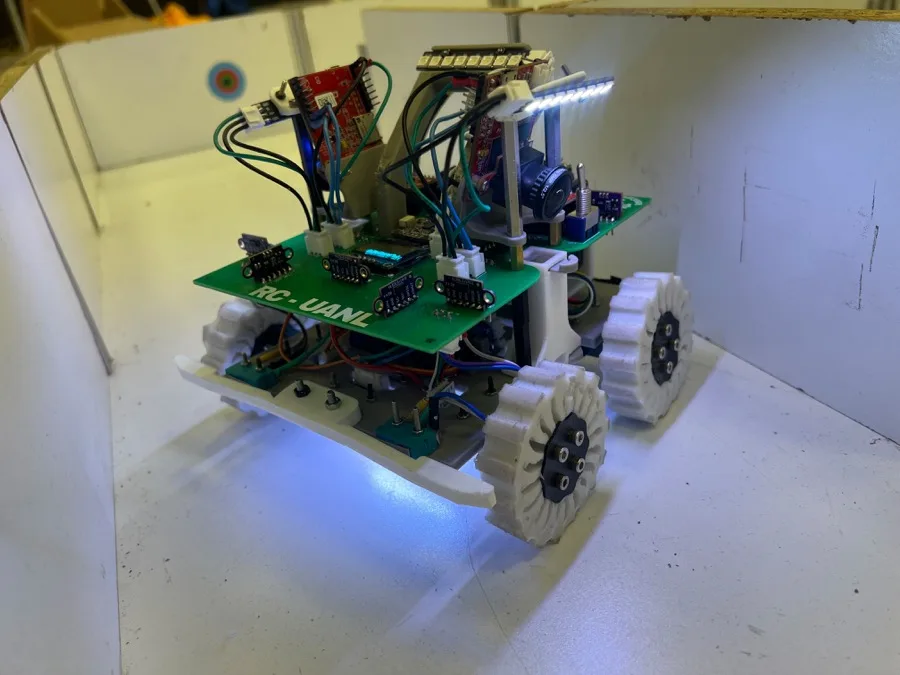
The most important aspect of the system it’s the navigation this incorporates multiple systems in the programming logic this is because we incorporate ways to improve navigation like a constant alignment between the halls of the maze this enables the robot to don’t lose more tiles between the navigation of the maze also improving in some ways the turns of different degrees through the navigation, orientation and general orientation errors, reducing the accumulated errors between the navigation.
In addition to the software solutions, the robot includes several mechanical systems that enhance the navigation of the robot in the maze. These systems include a suspension mechanism as well as alignment mechanisms based on limit switches and the frontal tof of the main board, which help maintain proper positioning throughout navigation.
During operation, the robot can identify various elements within its environment, such as victims and specific tile types, while also detecting and avoiding obstacles that may appear along its navigation, including stairs, bumpers and ramps being helped by custom tires made of silicon.
To integrate all these systems, a custom-designed PCB was developed. This board manages the connections between multiple sensors and electronic systems, including the OpenMV cameras, which are responsible for visual processing. Together with the various electronic and mechanical components, these systems provide the robot with the ability to respond to changes in its surroundings, enabling reliable operation across different maze difficulties.
Poster
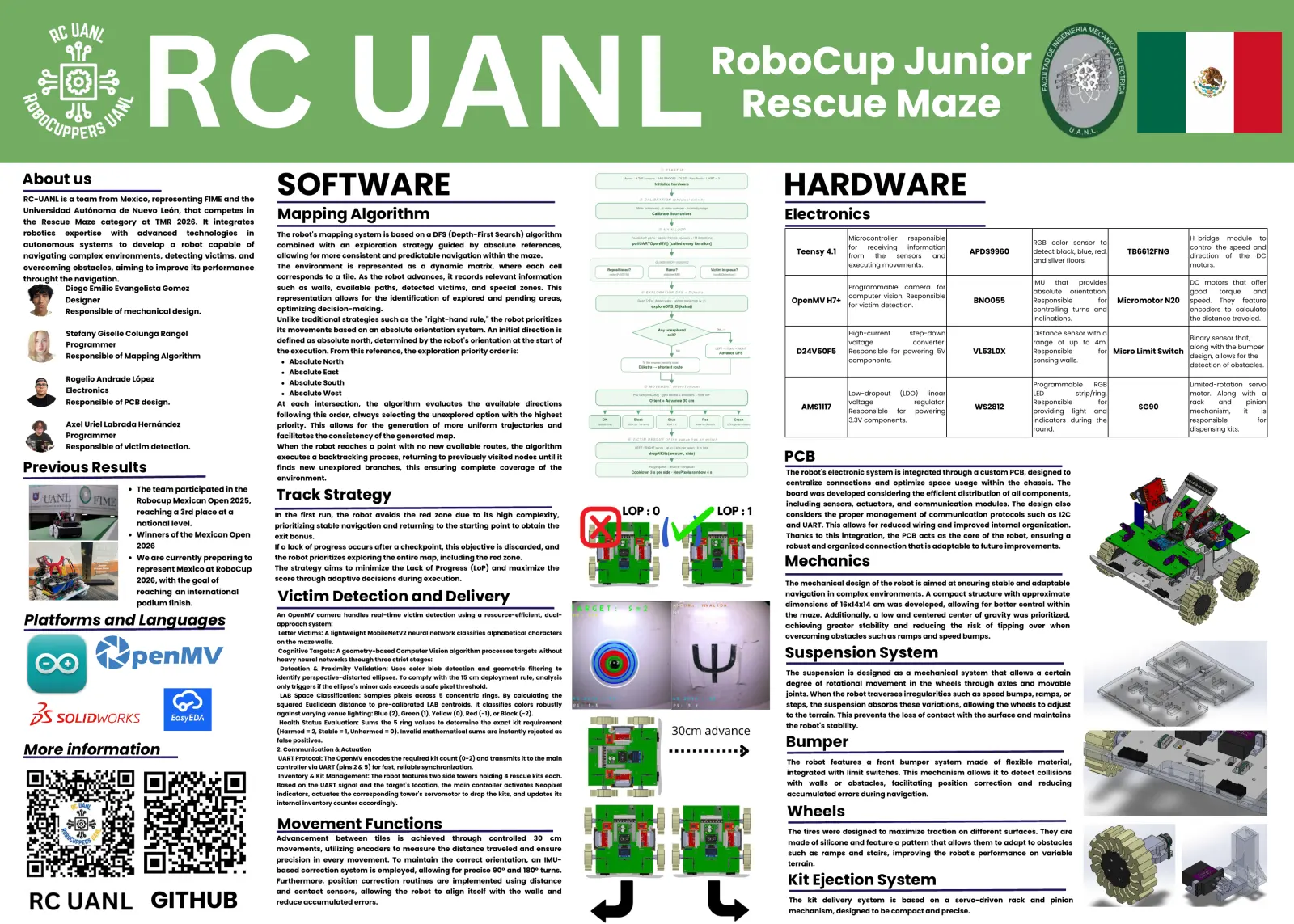
Read the text of this document — 1210 words
RC UANL RoboCup Junior
Rescue Maze
About us
RC-UANL is a team from Mexico, representing FIME and the
SOFTWARE HARDWARE
Universidad Autónoma de Nuevo León, that competes in
the Rescue Maze category at TMR 2026. It integrates
Mapping Algorithm Electronics
robotics expertise with advanced technologies in The robot's mapping system is based on a DFS (Depth-First Search) algorithm Microcontroller responsible H-bridge module to
autonomous systems to develop a robot capable of combined with an exploration strategy guided by absolute references, RGB color sensor to
for receiving information control the speed and
Teensy 4.1 APDS9960 detect black, blue, red, TB6612FNG
navigating complex environments, detecting victims, and allowing for more consistent and predictable navigation within the maze. from the sensors and direction of the DC
and silver floors.
overcoming obstacles, aiming to improve its performance The environment is represented as a dynamic matrix, where each cell executing movements. motors.
throught the navigation. corresponds to a tile. As the robot advances, it records relevant information
IMU that provides DC motors that offer
Diego Emilio Evangelista Gomez such as walls, available paths, detected victims, and special zones. This Programmable camera for
absolute orientation. good torque and
representation allows for the identification of explored and pending areas, computer vision. Responsible
Designer OpenMV H7+ BNO055 Responsible for Micromotor N20 speed. They feature
for victim detection.
Responsible of mechanical design. optimizing decision-making. controlling turns and encoders to calculate
Unlike traditional strategies such as the "right-hand rule," the robot prioritizes inclinations. the distance traveled.
its movements based on an absolute orientation system. An initial direction is
Stefany Giselle Colunga Rangel High-current step-down Distance sensor with a
Binary sensor that,
defined as absolute north, determined by the robot's orientation at the start of voltage converter. range of up to 4m.
Programmer along with the bumper
the execution. From this reference, the exploration priority order is: D24V50F5 Responsible for powering 5V VL53L0X Responsible for Micro Limit Switch
Responsible of Mapping Algorithm components. sensing walls.
design, allows for the
Absolute North detection of obstacles.
Absolute East
Rogelio Andrade López Absolute South Programmable RGB Limited-rotation servo
Electronics Absolute West Low-dropout (LDO) linear LED strip/ring. motor. Along with a
Responsible of PCB design. At each intersection, the algorithm evaluates the available directions voltage regulator. Responsible for rack and pinion
AMS1117 WS2812 SG90
Responsible for powering providing light and mechanism, it is
following this order, always selecting the unexplored option with the highest
3.3V components. indicators during the responsible for
Axel Uriel Labrada Hernández priority. This allows for the generation of more uniform trajectories and
round. dispensing kits.
Programmer facilitates the consistency of the generated map.
Responsible of victim detection. When the robot reaches a point with no new available routes, the algorithm
executes a backtracking process, returning to previously visited nodes until it PCB
Previous Results finds new unexplored branches, this ensuring complete coverage of the
The robot's electronic system is integrated through a custom PCB, designed to
environment.
centralize connections and optimize space usage within the chassis. The
Track Strategy
The team participated in the
board was developed considering the efficient distribution of all components,
Robocup Mexican Open 2025, including sensors, actuators, and communication modules. The design also
reaching a 3rd place at a In the first run, the robot avoids the red zone due to its high complexity, considers the proper management of communication protocols such as I2C
national level. prioritizing stable navigation and returning to the starting point to obtain the and UART. This allows for reduced wiring and improved internal organization.
Winners of the Mexican Open exit bonus. Thanks to this integration, the PCB acts as the core of the robot, ensuring a
2026 If a lack of progress occurs after a checkpoint, this objective is discarded, and robust and organized connection that is adaptable to future improvements.
We are currently preparing to
represent Mexico at RoboCup
the robot prioritizes exploring the entire map, including the red zone.
The strategy aims to minimize the Lack of Progress (LoP) and maximize the
Mechanics
2026, with the goal of score through adaptive decisions during execution.
The mechanical design of the robot is aimed at ensuring stable and adaptable
reaching an international
podium finish.
Victim Detection and Delivery navigation in complex environments. A compact structure with approximate
dimensions of 16x14x14 cm was developed, allowing for better control within
Platforms and Languages
An OpenMV camera handles real-time victim detection using a resource-efficient, dual- the maze. Additionally, a low and centered center of gravity was prioritized,
approach system: achieving greater stability and reducing the risk of tipping over when
Letter Victims: A lightweight MobileNetV2 neural network classifies alphabetical characters
overcoming obstacles such as ramps and speed bumps.
on the maze walls.
Cognitive Targets: A geometry-based Computer Vision algorithm processes targets without
heavy neural networks through three strict stages:
Suspension System
Detection & Proximity Validation: Uses color blob detection and geometric filtering to
The suspension is designed as a mechanical system that allows a certain
identify perspective-distorted ellipses. To comply with the 15 cm deployment rule, analysis
only triggers if the ellipse's minor axis exceeds a safe pixel threshold. degree of rotational movement in the wheels through axles and movable
LAB Space Classification: Samples pixels across 5 concentric rings. By calculating the joints. When the robot traverses irregularities such as speed bumps, ramps, or
squared Euclidean distance to pre-calibrated LAB centroids, it classifies colors robustly steps, the suspension absorbs these variations, allowing the wheels to adjust
against varying venue lighting: Blue (2), Green (1), Yellow (0), Red (-1), or Black (-2). to the terrain. This prevents the loss of contact with the surface and maintains
Health Status Evaluation: Sums the 5 ring values to determine the exact kit requirement
the robot's stability.
(Harmed = 2, Stable = 1, Unharmed = 0). Invalid mathematical sums are instantly rejected as
false positives.
Bumper
More information 2. Communication & Actuation
UART Protocol: The OpenMV encodes the required kit count (0-2) and transmits it to the main
The robot features a front bumper system made of flexible material,
controller via UART (pins 2 & 5) for fast, reliable synchronization.
Inventory & Kit Management: The robot features two side towers holding 4 rescue kits each.
integrated with limit switches. This mechanism allows it to detect collisions
Based on the UART signal and the target's location, the main controller activates Neopixel with walls or obstacles, facilitating position correction and reducing
indicators, actuates the corresponding tower's servomotor to drop the kits, and updates its accumulated errors during navigation.
internal inventory counter accordingly.
Wheels
Movement Functions The tires were designed to maximize traction on different surfaces. They are
Advancement between tiles is achieved through controlled 30 cm
made of silicone and feature a pattern that allows them to adapt to obstacles
movements, utilizing encoders to measure the distance traveled and ensure
such as ramps and stairs, improving the robot's performance on variable
precision in every movement. To maintain the correct orientation, an IMU-
terrain.
based correction system is employed, allowing for precise 90° and 180° turns.
Furthermore, position correction routines are implemented using distance Kit Ejection System
GITHUB
and contact sensors, allowing the robot to align itself with the walls and
reduce accumulated errors. The kit delivery system is based on a servo-driven rack and pinion
mechanism, designed to be compact and precise.
1 page, rendered as images so they load quickly. The text above is the document's own, extracted from the PDF.
Presentation video
Hosted on YouTube. The player loads only when you press play.
Bill of materials
Shown as the original PDF, because this one is smaller that way and its text stays selectable and searchable.
Team description paper
Shown as the original PDF, because this one is smaller that way and its text stays selectable and searchable.
Source code
The team's own source code, 19 KB. It is a download rather than part of this page, because a zip is something you open on your computer. It comes from GitHub, which some school networks block.