
PCMS_ET
Document register
- Poster1 pagePublished
- Presentation videoYouTubePublished
- Bill of materials236 KBPublished
- Team description paperNot shared
- Engineering journal1.5 MBPublished
- Source code14 KB · GitHubPublished
Sharing each document is the team's decision. “Not shared” means this team chose not to publish it, or did not submit one — not that it is missing from the archive.
In their words
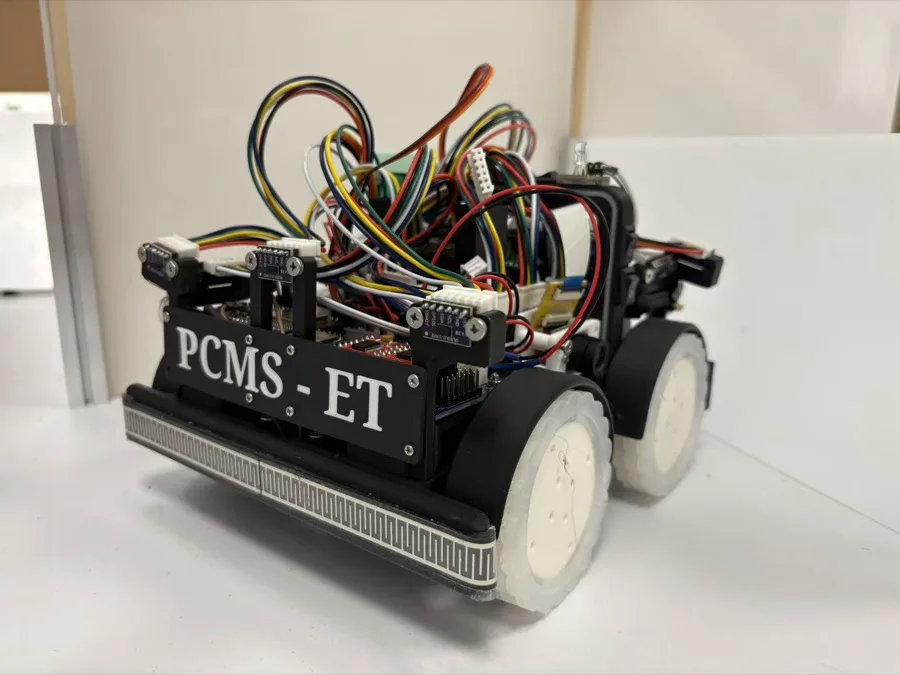
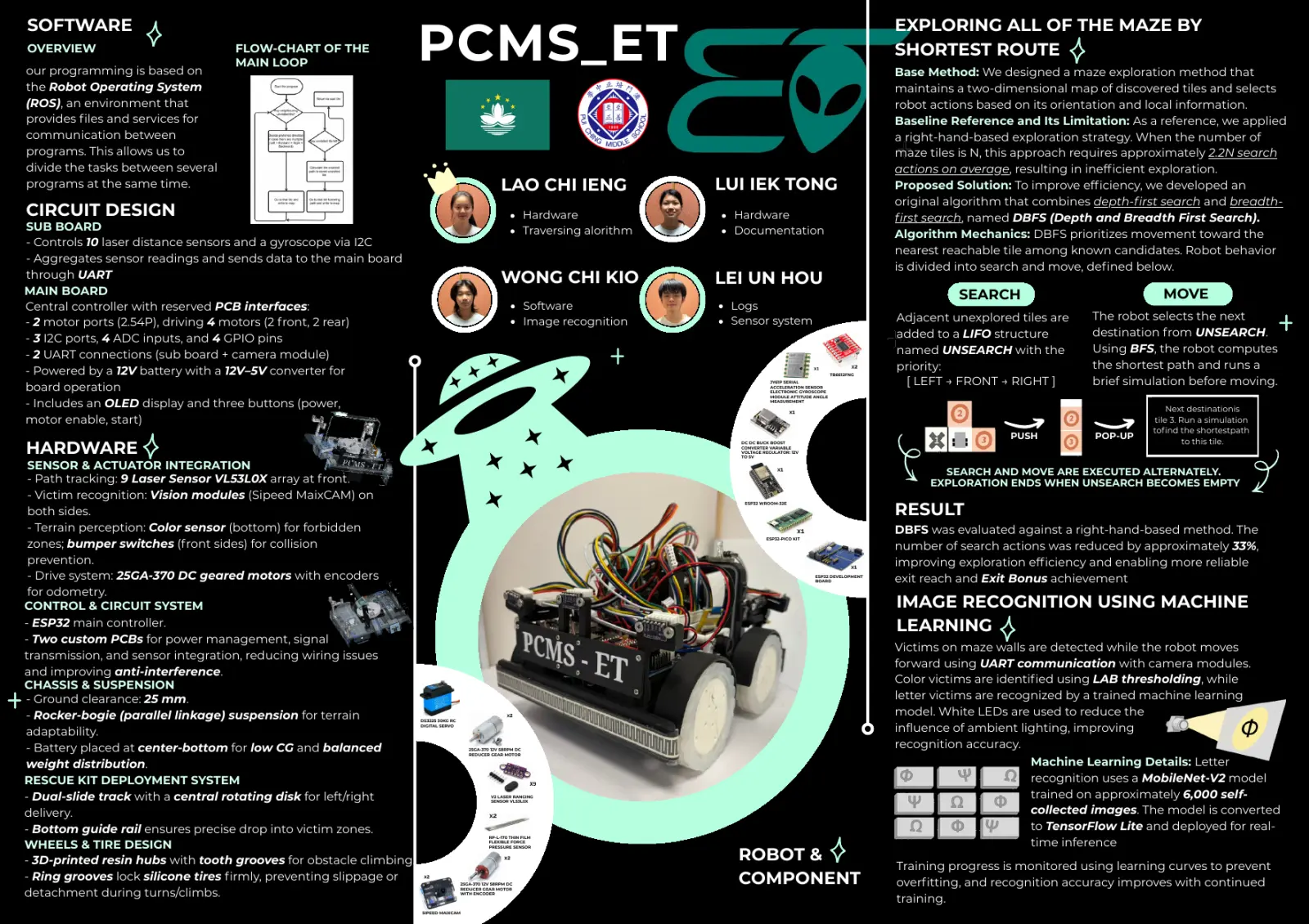
This paper presents PCMS_ET, an advanced autonomous rescue robot engineered for efficient navigation and victim identification within complex maze environments. Evolved through rigorous iterative testing from a first-generation prototype, the second-generation robot features a highly optimized 3D-printed chassis. By replacing the generic control board with a compact ESP-32 microcontroller and integrating two custom-designed PCBs, the robot significantly eliminates circuit clutter and operational latency. For robust mobility, it utilizes GA25-370 micro-motors and custom wheels with annular grooves that prevent silicone tire slippage, while the electronics box is repositioned to the chassis center to achieve a lower center of gravity for stable slope climbing.
Environment sensing is driven by high-precision laser distance sensors for precise obstacle avoidance, coupled with dual K210 camera lenses for millisecond-level wall pattern recognition. Developed using Python in Thonny, the software architecture implements a gyroscope closed-loop turning algorithm that automatically corrects boundary degree calculation discrepancies. It also deploys a high-level maze exploration decision matrix (Left-Turn Priority) that records paths using a coordinate grid and computes the shortest route back to the start.
What sets PCMS_ET apart from its competitors is its exceptional engineering maturity achieved through iterative hardware and software optimization. The integration of laser tracking, custom electronics, and intelligent decision logic delivers a 20% increase in locomotion speed and over 90% accuracy in both victim identification and precise cargo drop-offs via its bidirectional turntable mechanism.
Poster
Read the text of this document — 707 words
PCMS_ET
SOFTWARE EXPLORING ALL OF THE MAZE BY
OVERVIEW FLOW-CHART OF THE SHORTEST ROUTE
MAIN LOOP
our programming is based on Base Method: We designed a maze exploration method that
the Robot Operating System maintains a two-dimensional map of discovered tiles and selects
(ROS), an environment that robot actions based on its orientation and local information.
provides files and services for Baseline Reference and Its Limitation: As a reference, we applied
communication between a right-hand-based exploration strategy. When the number of
programs. This allows us to maze tiles is N, this approach requires approximately 2.2N search
divide the tasks between several actions on average, resulting in inefficient exploration.
programs at the same time. LAO CHI IENG LUI IEK TONG Proposed Solution: To improve efficiency, we developed an
original algorithm that combines depth-first search and breadth-
CIRCUIT DESIGN Hardware Hardware first search, named DBFS (Depth and Breadth First Search).
SUB BOARD Traversing alorithm Documentation Algorithm Mechanics: DBFS prioritizes movement toward the
- Controls 10 laser distance sensors and a gyroscope via I2C
nearest reachable tile among known candidates. Robot behavior
- Aggregates sensor readings and sends data to the main board
is divided into search and move, defined below.
through UART WONG CHI KIO LEI UN HOU
MAIN BOARD SEARCH MOVE
Central controller with reserved PCB interfaces: Software Logs
Image recognition Sensor system Adjacent unexplored tiles are The robot selects the next
- 2 motor ports (2.54P), driving 4 motors (2 front, 2 rear)
added to a LIFO structure destination from UNSEARCH.
- 3 I2C ports, 4 ADC inputs, and 4 GPIO pins
named UNSEARCH with the Using BFS, the robot computes
- 2 UART connections (sub board + camera module)
priority: the shortest path and runs a
- Powered by a 12V battery with a 12V–5V converter for TB6612FNG
[ LEFT → FRONT → RIGHT ] brief simulation before moving.
board operation
JY61P SERIAL
ACCELERATION SENSOR
ELECTRONIC GYROSCOPE
MODULE ATTITUDE ANGLE
- Includes an OLED display and three buttons (power, MEASUREMENT
Next destinationis
motor enable, start) tile 3. Run a simulation
tofind the shortestpath
PUSH POP-UP
to this tile.
HARDWARE
DC DC BUCK BOOST
CONVERTER VARIABLE
VOLTAGE REGULATOR: 12V
TO 5V
SENSOR & ACTUATOR INTEGRATION SEARCH AND MOVE ARE EXECUTED ALTERNATELY.
- Path tracking: 9 Laser Sensor VL53L0X array at front. EXPLORATION ENDS WHEN UNSEARCH BECOMES EMPTY
- Victim recognition: Vision modules (Sipeed MaixCAM) on
RESULT
ESP32 WROOM-32E
both sides.
- Terrain perception: Color sensor (bottom) for forbidden DBFS was evaluated against a right-hand-based method. The
zones; bumper switches (front sides) for collision
ESP32-PICO KIT
number of search actions was reduced by approximately 33%,
prevention. improving exploration efficiency and enabling more reliable
- Drive system: 25GA-370 DC geared motors with encoders ESP32 DEVELOPMENT
BOARD exit reach and Exit Bonus achievement
for odometry.
CONTROL & CIRCUIT SYSTEM IMAGE RECOGNITION USING MACHINE
- ESP32 main controller. LEARNING
- Two custom PCBs for power management, signal
Victims on maze walls are detected while the robot moves
transmission, and sensor integration, reducing wiring issues
forward using UART communication with camera modules.
and improving anti-interference.
CHASSIS & SUSPENSION Color victims are identified using LAB thresholding, while
- Ground clearance: 25 mm. letter victims are recognized by a trained machine learning
- Rocker-bogie (parallel linkage) suspension for terrain model. White LEDs are used to reduce the
DS3225 30KG RC
adaptability.
DIGITAL SERVO
influence of ambient lighting, improving
- Battery placed at center-bottom for low CG and balanced 25GA-370 12V 58RPM DC
recognition accuracy.
REDUCER GEAR MOTOR
weight distribution. Machine Learning Details: Letter
RESCUE KIT DEPLOYMENT SYSTEM X9
recognition uses a MobileNet-V2 model
- Dual-slide track with a central rotating disk for left/right V2 LASER RANGING
SENSOR VL53L0X
trained on approximately 6,000 self-
delivery. collected images. The model is converted
- Bottom guide rail ensures precise drop into victim zones. to TensorFlow Lite and deployed for real-
RP-L-170 THIN FILM
WHEELS & TIRE DESIGN FLEXIBLE FORCE
time inference
ROBOT &
PRESSURE SENSOR
- 3D-printed resin hubs with tooth grooves for obstacle climbing.
Training progress is monitored using learning curves to prevent
- Ring grooves lock silicone tires firmly, preventing slippage or 25GA-370 12V 58RPM DC COMPONENT overfitting, and recognition accuracy improves with continued
detachment during turns/climbs.
REDUCER GEAR MOTOR
training.
WITH ENCODER
SIPEED MAIXCAM
1 page, rendered as images so they load quickly. The text above is the document's own, extracted from the PDF.
Presentation video
Hosted on YouTube. The player loads only when you press play.
Bill of materials
Shown as the original PDF, because this one is smaller that way and its text stays selectable and searchable.
Engineering journal
Shown as the original PDF, because this one is smaller that way and its text stays selectable and searchable.
Source code
The team's own source code, 14 KB. It is a download rather than part of this page, because a zip is something you open on your computer. It comes from GitHub, which some school networks block.