
Gebruder Weiss CRO team
Document register
- Poster1 pagePublished
- Presentation videoNot shared
- Bill of materialsNot shared
- Team description paper756 KBPublished
- Engineering journalNot shared
- Source codeNot shared
Sharing each document is the team's decision. “Not shared” means this team chose not to publish it, or did not submit one — not that it is missing from the archive.
In their words
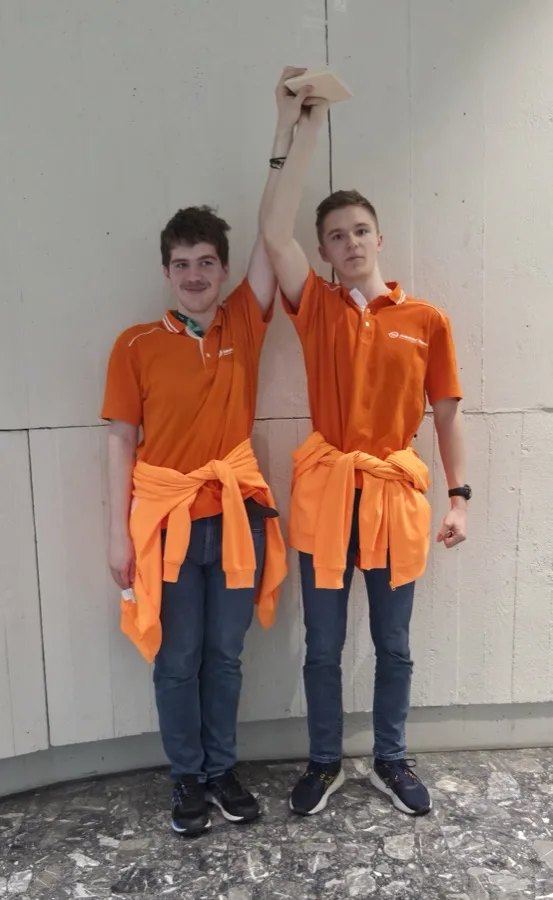
We are Gebruder Weiss Cro Team consisting of 2 members. Our robot for the competition has been developed thought the last 2 years. From the last year World RCJ to this year’s, we increased the precision of our robot movement and decreased the number of victim misidentifications. We also developed a system so that the robot can continue moving after LOP.
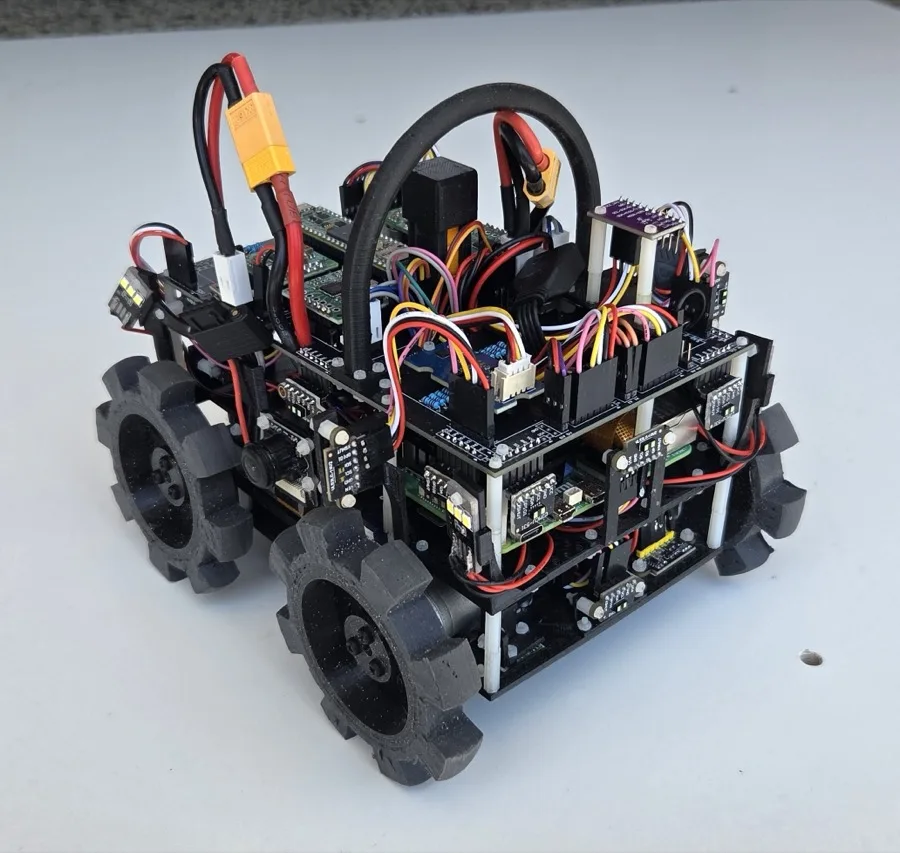
Apart from sensors, our robot was constructed based on the design of our robot from previous years, but also having in mind observed limitations and problems that existed. We designed both 3D printed parts (including Rescue kits), as well as the PCB, which we have been perfectioning over the past 3 years.
The most innovative components of our robot include the kit dispenser, wheels that we designed for the movement over speedbumps, usage of both IR and colour sensor for the coloured tiles detection, communication between teensy and RPi 5, the usage of RPi cameras in contrast to OpenMV used by most other teams and in connected with this, the usage of a combined system using 2 algorithms for victim detection.
Poster
Read the text of this document — 1174 words
Software Mapping and navigation system
Our team
Team mentors Before we constructed our robot, we made the mapping system. While making it, we normalized confusion matrix Our navigation and mapping system and very intertwined. It works as following:
began working on the its system for victims. Those 2 were able to be developed
Marko Pongrac & Jelka Hrnjić independently from each other. 1. Tile current visited was created as an unknown tile in rela-
tionship to the last visited tile.
2. Give the newly explored tile its tile type: blue, black, silver,
Victim detection red, ramp or stairs.
3. Check the surrounding walls:
Cameras – our tools for the detection • if there is a wall mark as a nullptr
Our robot has on RPI Fisheye 160⁰ camera on each of its sides. They allow him to see • if there is no wall check the X, Y and Z difference
almost 16-20 cm of wall space, about 60% the size of one tile. if any of the neighbouring tiles was already explored,
David Pongrac Gregor Klarić •
Victim train batch
connect them together using pointers.
Team captain, programmer Electronic & Mechanic designer Our weapon for victim detection – YOLO algorithm • For the remaining tiles that are both unexplored and
“Being the leader of the team, I “Using the knowledge I’ve gained For the victim detection, our first layer is YOLOv26 algorithm, which allows us to (front tile, right tile, back tile, left tile)
unmapped, create new tile objects as unknown and
made all software parts of our in electronics and mechanics, know whether the victim is Ψ, Φ, Ω or cognitive (will be latter processed). We connect them to the current tile using pointers, we are
robot, from mapping and I made decision about design collected them through the year and now have more then 2000 images, labelling going to explore them latter.
navigation to victim detection.” of the robot.” them and splitÝng into 50-50 split before feeding them into the model. We also took 4. Decide which tile we are going to explore next:
Program flow
pictures of various fake victims (for example, coloured letters) and made our model • Firstly, check neighbouring tiles if we can visit them in
other competitions: other competitions:
Croatia National 2023, Croatia National 2024, not detect them. Due to our experience from last year, we trained fewer models order front → right → left.
Rescue simulation, 1. place Soccer open, 1. place while achieving nearly 0% misidentification rate. • If all surrounding tiles are walled off or they were already
Croatia National 2024, Slovakia Open 2024, explored, use the Dijkstra’s algorithm to find the latest
The second layer is processing of cognitive victims. Using several algorithms tile we labelled as unknown (last added to stack).
Rescue simulation, 2. place Soccer open, 1. place
World RCJ 2023., World RCJ 2024.,
(Gaussian blur, Canny algorithm, Floodfill) we segment the cognitive victims in order • If there are no unexplored tiles and the robot is not
Rescue simulation, participated Soccer open, 4. place to determine the class and weight of each circle. We than multiply the value of each already on the starting tile, use the Dijkstra’s algorithm
World RCJ 2024., European RCJ 2025., color by the width of a circle to get its value. to return back to it.
Rescue simulation, Team spirit award Soccer Lightweight Entry, 2. place
• If the robot is on the start tile, initiate the end protocol:
region of interest combined edges raw Floodfill from midpoints
stop for 10 seconds.
Order of tiles our robot
would visit in this maze
Examples walls
Mapping of victims
Each tile object also has an array that contains
the information about the type of victim on the
wall (absence of victim is said as NONE). With
this system, the robot doesn't waste rescue kits
when it's found again.
Our team’s history of (nullptr, nullptr, back tile, left tile)
participation and awards:
Croatia National 2022, Rescue maze Entry, 3. place
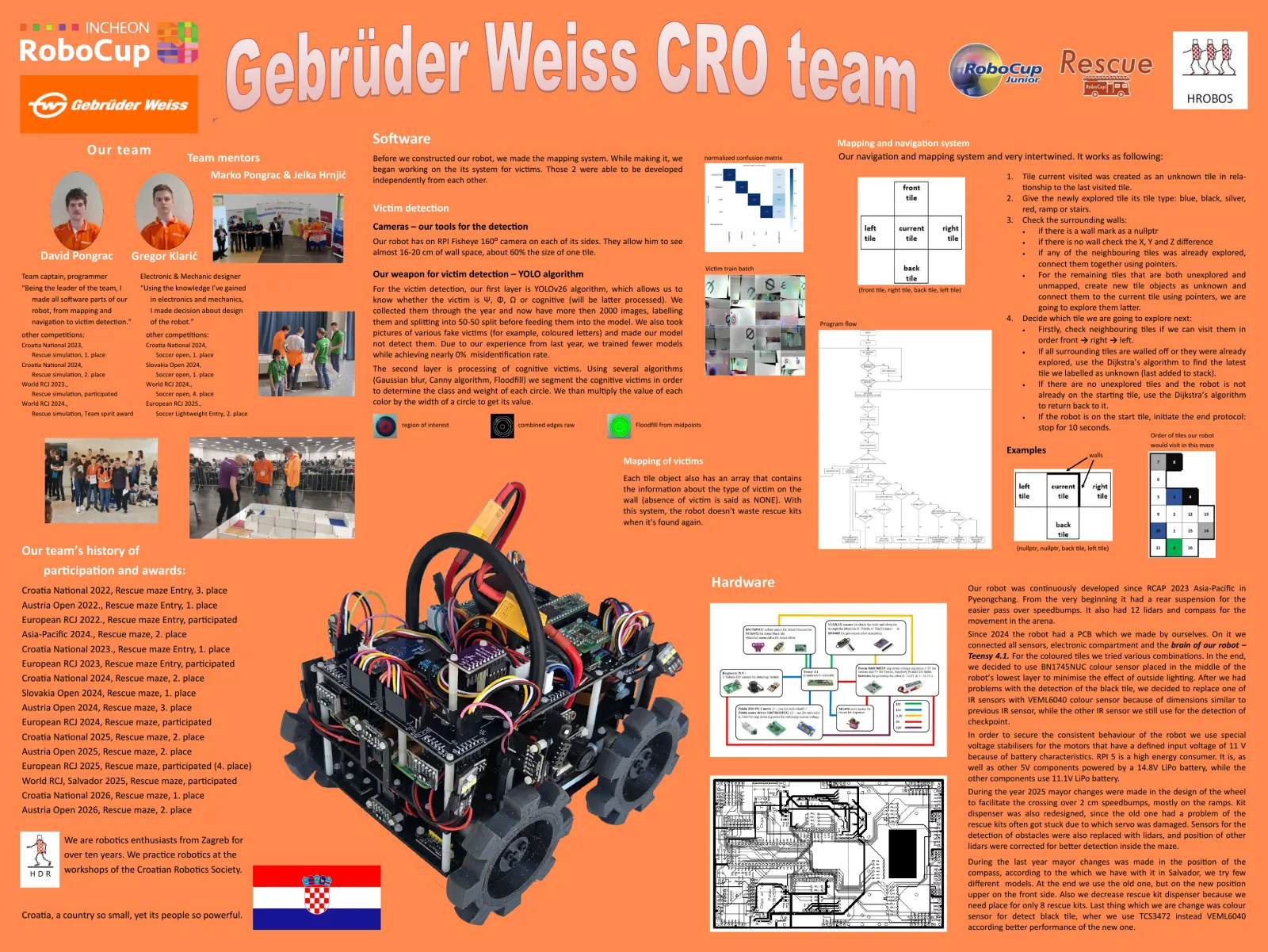
Hardware Our robot was continuously developed since RCAP 2023 Asia-Pacific in
Pyeongchang. From the very beginning it had a rear suspension for the
Austria Open 2022., Rescue maze Entry, 1. place easier pass over speedbumps. It also had 12 lidars and compass for the
European RCJ 2022., Rescue maze Entry, participated movement in the arena.
Asia-Pacific 2024., Rescue maze, 2. place Since 2024 the robot had a PCB which we made by ourselves. On it we
Croatia National 2023., Rescue maze Entry, 1. place connected all sensors, electronic compartment and the brain of our robot –
Teensy 4.1. For the coloured tiles we tried various combinations. In the end,
European RCJ 2023, Rescue maze Entry, participated we decided to use BN1745NUC colour sensor placed in the middle of the
Croatia National 2024, Rescue maze, 2. place robot’s lowest layer to minimise the effect of outside lighting. After we had
problems with the detection of the black tile, we decided to replace one of
Slovakia Open 2024, Rescue maze, 1. place
IR sensors with VEML6040 colour sensor because of dimensions similar to
Austria Open 2024, Rescue maze, 3. place previous IR sensor, while the other IR sensor we still use for the detection of
European RCJ 2024, Rescue maze, participated checkpoint.
Croatia National 2025, Rescue maze, 2. place In order to secure the consistent behaviour of the robot we use special
voltage stabilisers for the motors that have a defined input voltage of 11 V
Austria Open 2025, Rescue maze, 2. place because of battery characteristics. RPI 5 is a high energy consumer. It is, as
European RCJ 2025, Rescue maze, participated (4. place) well as other 5V components powered by a 14.8V LiPo battery, while the
World RCJ, Salvador 2025, Rescue maze, participated other components use 11.1V LiPo battery.
Croatia National 2026, Rescue maze, 1. place During the year 2025 mayor changes were made in the design of the wheel
to facilitate the crossing over 2 cm speedbumps, mostly on the ramps. Kit
Austria Open 2026, Rescue maze, 2. place dispenser was also redesigned, since the old one had a problem of the
rescue kits often got stuck due to which servo was damaged. Sensors for the
detection of obstacles were also replaced with lidars, and position of other
We are robotics enthusiasts from Zagreb for
lidars were corrected for better detection inside the maze.
over ten years. We practice robotics at the
During the last year mayor changes was made in the position of the
workshops of the Croatian Robotics Society. compass, according to the which we have with it in Salvador, we try few
different models. At the end we use the old one, but on the new position
upper on the front side. Also we decrease rescue kit dispenser because we
need place for only 8 rescue kits. Last thing which we are change was colour
Croatia, a country so small, yet its people so powerful. sensor for detect black tile, wher we use TCS3472 instead VEML6040
according better performance of the new one.
1 page, rendered as images so they load quickly. The text above is the document's own, extracted from the PDF.
Team description paper
Shown as the original PDF, because this one is smaller that way and its text stays selectable and searchable.