
CEBELÜ
Document register
- Poster1 pagePublished
- Presentation videoNot shared
- Bill of materials34 KBPublished
- Team description paperNot shared
- Engineering journalNot shared
- Source code8.8 MB · GitHubPublished
Sharing each document is the team's decision. “Not shared” means this team chose not to publish it, or did not submit one — not that it is missing from the archive.
In their words
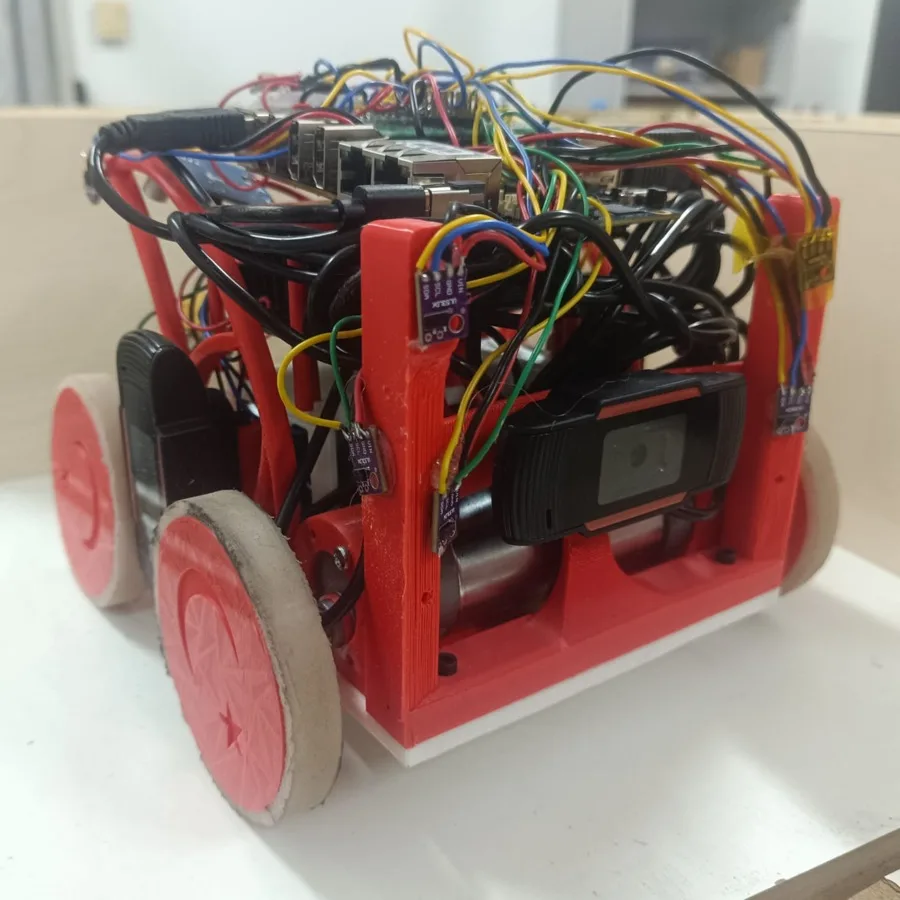
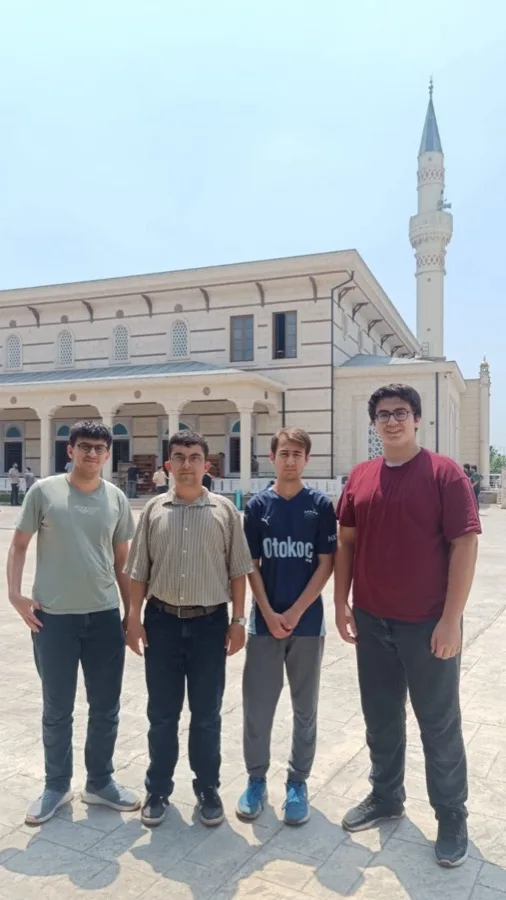
We are team “CEBELÜ” attending RoboCupJunior Rescue Maze from Türkiye. The name of our robot is “Ayla-890” in memory of the Turk martyrs of the Korean War. We will use this name when referring to the robot in later parts of this document.
We figured that for us to navigate throughout the maze with maximum efficiency and speed, we must have a small, compact and agile robot. So we fit all of our hardware into a 132x175mm chassis, therefore Ayla-890 has a total size including tires, reskit mechanism etc. 170x190mm. Combined with a maximum speed of 2,5 tile/s (75 cm/s) Ayla-890 is decent in turns. Moreover, because we encounter sharp turns very often in the maze, this sets us apart from other competitors and saves a lot of time.
After extensive research, we have decided that none of the commercially available wheels met our requirements within our budget. Therefore we decided to cast our own specially designed tires out of 30 ShoreA RTV silicon. This allows us to have a higher road grip and overcome obstacles more easily.
We used 3 cameras on the sides and front to identify victims and a custom designed 3D printed system to deliver kits to both sides of our robot with high accuracy. For aligning the robot, navigating through the maze, detecting ramps and obstacles, we used a total of 8 Time of Flight (ToF) sensors placed; 4 on sides and 2 in front dedicated for ramp detection and better alignment, 2 looking diagonally in front of the vehicle specifically designed and trigonomically calculated for obstacle detection and also used for validation of ramp identification. We also used IMU for more reliable alignment and movement.
Rather than relying on complex path-planning algorithms, Ayla-890 utilizes a lightweight sensor-driven right-hand wall following navigation strategy, enabling fast and reliable exploration of unknown maze environments.
Poster
Read the text of this document — 364 words
CEBELÜ
                                                                                                                                                                                                                                             The Cebelu soldiers were cavalry troops
                                                                                                                                                                                                                                             in the Ottoman Empire. They served
                                                                                                                                                                                                                                             under the timar system and joined the
                                                                                                                                                                                                                                             army during wars. Cebelu soldiers were
                                                                                                                                                                                                                                             equipped with horses and weapons
                                                                                                                                                                                                                                             provided by their timar holders. They

                                                                                                           RoboCupJunior Rescue Maze
                                                                                                                                                                                                                                             played an important role in the Ottoman
                                                                                                                                                                                                                                             military for many years.

                                                                                                           We are a rookie team, we dont have any awards

Hardware                                                                                                                                                                                            Software
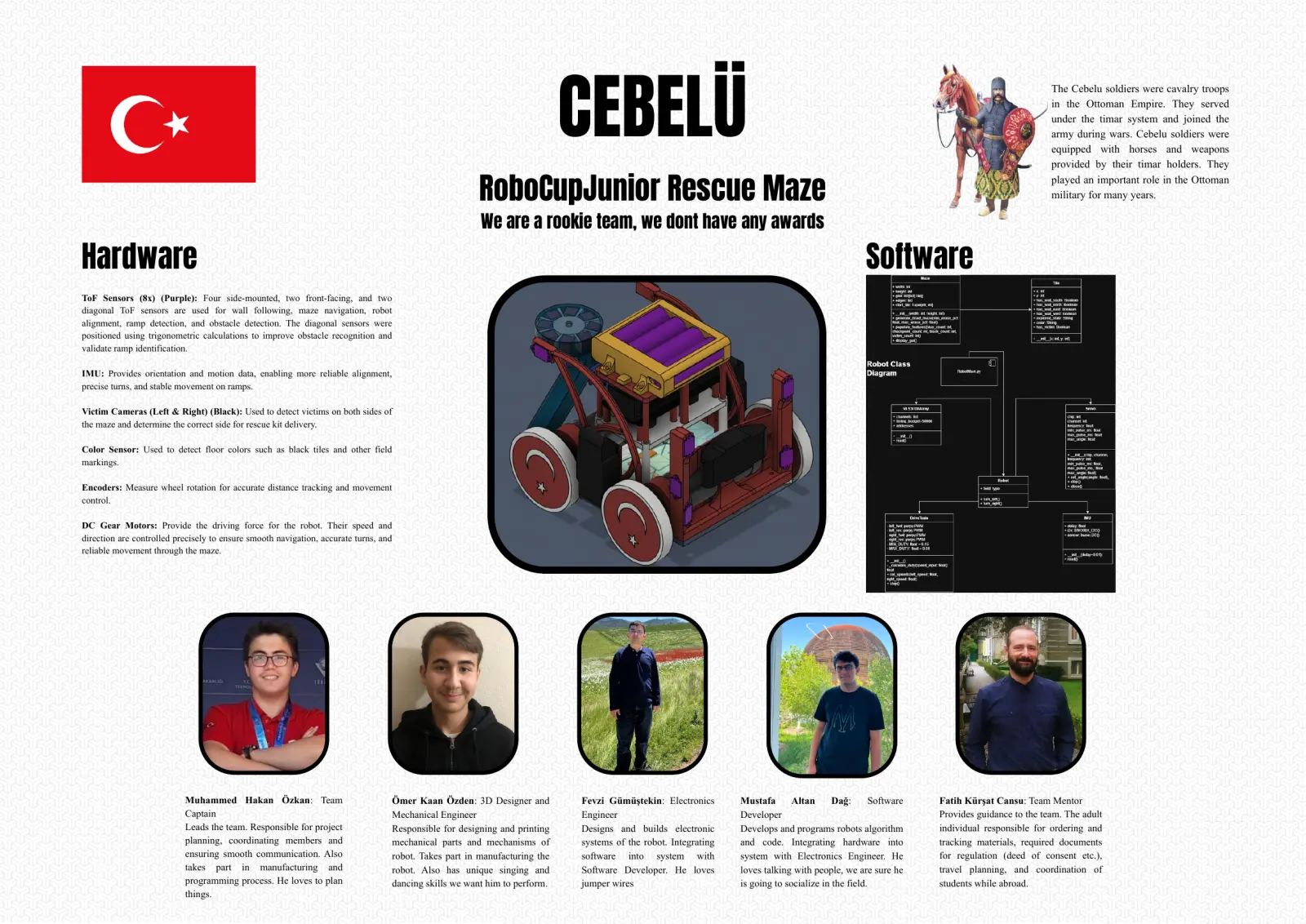
ToF Sensors (8x) (Purple): Four side-mounted, two front-facing, and two
diagonal ToF sensors are used for wall following, maze navigation, robot
alignment, ramp detection, and obstacle detection. The diagonal sensors were
positioned using trigonometric calculations to improve obstacle recognition and
validate ramp identification.

IMU: Provides orientation and motion data, enabling more reliable alignment,
precise turns, and stable movement on ramps.

Victim Cameras (Left & Right) (Black): Used to detect victims on both sides of
the maze and determine the correct side for rescue kit delivery.

Color Sensor: Used to detect floor colors such as black tiles and other field
markings.

Encoders: Measure wheel rotation for accurate distance tracking and movement
control.

DC Gear Motors: Provide the driving force for the robot. Their speed and
direction are controlled precisely to ensure smooth navigation, accurate turns, and
reliable movement through the maze.

                           Muhammed Hakan Özkan: Team                                 Ömer Kaan Özden: 3D Designer and         Fevzi Gümüştekin: Electronics       Mustafa       Altan      Dağ:       Software   Fatih Kürşat Cansu: Team Mentor
                           Captain                                                    Mechanical Engineer                      Engineer                            Developer                                      Provides guidance to the team. The adult
                           Leads the team. Responsible for project                    Responsible for designing and printing   Designs and builds electronic       Develops and programs robots algorithm         individual responsible for ordering and
                           planning, coordinating members and                         mechanical parts and mechanisms of       systems of the robot. Integrating   and code. Integrating hardware into            tracking materials, required documents
                           ensuring smooth communication. Also                        robot. Takes part in manufacturing the   software into system with           system with Electronics Engineer. He           for regulation (deed of consent etc.),
                           takes part in manufacturing and                            robot. Also has unique singing and       Software Developer. He loves        loves talking with people, we are sure he      travel planning, and coordination of
                           programming process. He loves to plan                      dancing skills we want him to perform.   jumper wires                        is going to socialize in the field.            students while abroad.
                           things.
1 page, rendered as images so they load quickly. The text above is the document's own, extracted from the PDF.
Bill of materials
Shown as the original PDF, because this one is smaller that way and its text stays selectable and searchable.
Source code
The team's own source code, 8.8 MB. It is a download rather than part of this page, because a zip is something you open on your computer. It comes from GitHub, which some school networks block.