
B.Robots Seniors
Document register
- Poster1 pagePublished
- Presentation videoYouTubePublished
- Bill of materials42 KBPublished
- Team description paper697 KBPublished
- Engineering journalNot shared
- Source code272 KB · GitHubPublished
Sharing each document is the team's decision. “Not shared” means this team chose not to publish it, or did not submit one — not that it is missing from the archive.
In their words
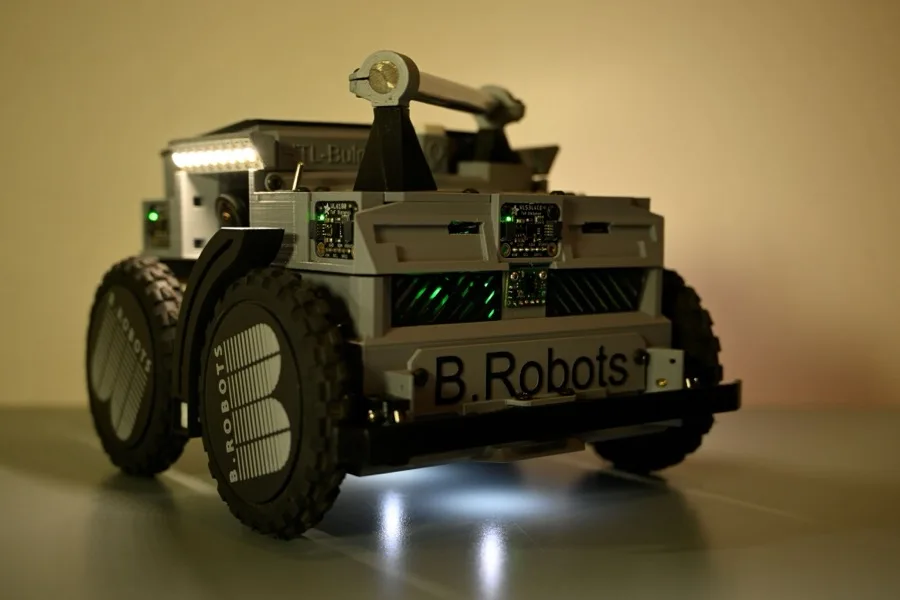
This abstract describes the autonomous rescue robot developed by Team B.Robots Seniors for the 2026 RoboCupJunior Rescue Maze Competition. The design prioritizes high reliability, modular hardware, and a deterministic software architecture. The main navigation controller, an Arduino Giga R1, executes an A* pathfinding algorithm on a weighted 3D tile graph to navigate obstacles and multi-floor ramps dynamically. A Raspberry Pi Compute Module 5 processes dual wide-angle camera streams using custom TensorFlow Lite models and HSV color scans to accurately identify victims.
A key innovation that sets our robot apart is the custom "Inter-Layer Connector." This system uses permanently mounted pin headers to replace messy wiring, enabling the rapid detachment and swap of entire hardware layers without unplugging individual wires. Furthermore, a custom-machined swivel axis ensures that all four wheels maintain constant ground contact over uneven terrain, which significantly improves sensor reliability.
On the software side, a strictly non-blocking C++ architecture maintains a rapid 23 ms control loop. During a run, an interactive touch display renders a live, rotating map for real-time diagnostics. A checkpoint snapshot system allows for seamless map and position restoration following manual interventions.
Poster
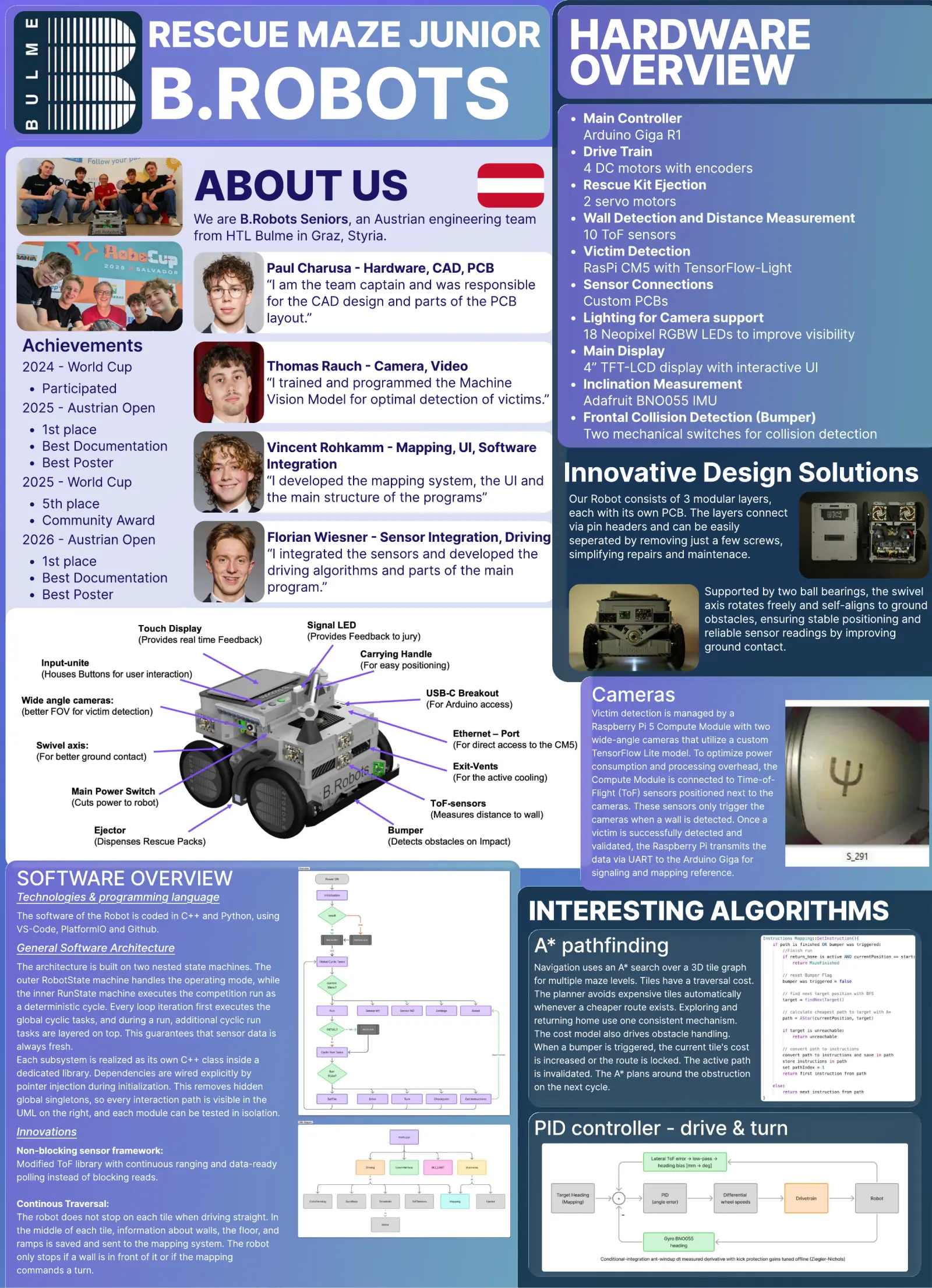
Read the text of this document — 663 words
RESCUE MAZE JUNIOR HARDWARE
B .ROBOTS O VERVIEW
Main Controlleè
Arduino Giga RÅ
Drive Trai
4 DC motors with encodersÉ
ABOUT US Rescue Kit Ejectio
2 servo motor¾
We are B.Robots Seniors, an Austrian engineering team Wall Detection and Distance Measuremen¼
from HTL Bulme in Graz, Styria. 10 ToF sensor¾
Victim Detectio
Paul Charusa - Hardware, CAD, PCÔ RasPi CM5 with TensorFlow-LighÀ
“I am the team captain and was responsible Sensor Connection
for the CAD design and parts of the PCB Custom PCB¾
layout.” Lighting for Camera suppor¼
18 Neopixel RGBW LEDs to improve visibilitÌ
Achievements Main Displaì
2024 - World Cup Thomas Rauch - Camera, Vide) 4” TFT-LCD display with interactive U
“I trained and programmed the Machine Inclination Measuremen¼
Participated
2025 - Austrian Open
Vision Model for optimal detection of victims.” Adafruit BNO055 IM
Frontal Collision Detection (Bumperä
1st plac7 Two mechanical switches for collision detection
Best Documentatio= Vincent Rohkamm - Mapping, UI, Software
Best Poster
2025 - World Cup
IntegratioS
“I developed the mapping system, the UI and Innovative Design Solutions
the main structure of the programs” Our Robot consists of 3 modular layers,
5th plac7
each with its own PCB. The layers connect
Community Award
ia pin headers and can be easily
Florian Wiesner - Sensor Integration, Drivinn
v
2026 - Austrian Open seperated by removing just a few screws,
“I integrated the sensors and developed the simplifying repairs and maintenace.
1st plac7
driving algorithms and parts of the main
Best Documentatio=
program.” upported by two ball bearings, the swivel
Best Poster S
axis rotates freely and self-aligns to ground
obstacles, ensuring stable positioning and
reliable sensor readings by improving
ground contact.
Cameras
V ictim detection is managed by a
R aspberry Pi 5 Compute Module with two
wide-angle cameras that utilize a custom
TensorFlow Lite model. To optimize power
consumption and processing overhead, the
Compute Module is connected to Time-of-
Flight (ToF) sensors positioned next to the
cameras. These sensors only trigger the
cameras when a wall is detected. Once a
victim is successfully detected and
validated, the Raspberry Pi transmits the
data via UART to the Arduino G iga for
signaling and mapping reference.
SOFTWARE OVERVIEW
I TERESTI G ALGORITH S
Technologies & programming language
T he software of the Robot is coded in C++ and Python, using N N M
VS -Code, PlatformIO and G ithub.
General Software Architecture A * pathfinding
T he architecture is built on two nested state machines. The Navigation uses an A* search over a 3D tile graph
outer RobotState machine handles the operating mode, while for multiple maze levels. Tiles have a traversal cost.
the inner RunState machine executes the competition run as T he planner avoids expensive tiles automatically
a deterministic cycle. Every loop iteration first executes the whenever a cheaper route exists. Exploring and
g lobal cyclic tasks, and during a run, additional cyclic run returning home use one consistent mechanism.
tasks are layered on top. This guarantees that sensor data is T he cost model also drives obstacle handling.
always fresh® When a bumper is triggered, the current tile's cost
Each subsystem is realized as its own C++ class inside a is increased or the route is locked. The active path
dedicated library. Dependencies are wired explicitly by is invalidated. The A* plans around the obstruction
pointer injection during initialization. This removes hidden on the next cycle.
g lobal singletons, so every interaction path is visible in the
UML on the right, and each module can be tested in isolation.
Innovations PID controller - drive & turn
Non-blocking sensor framework
Modified ToF library with continuous ranging and data-ready
polling instead of blocking reads)
Continous Traversal
T he robot does not stop on each tile when driving straight. In
the middle of each tile, information about walls, the floor, and
ramps is saved and sent to the mapping system. The robot
only stops if a wall is in front of it or if the mapping
commands a turn.
1 page, rendered as images so they load quickly. The text above is the document's own, extracted from the PDF.
Presentation video
Hosted on YouTube. The player loads only when you press play.
Bill of materials
Shown as the original PDF, because this one is smaller that way and its text stays selectable and searchable.
Team description paper
Shown as the original PDF, because this one is smaller that way and its text stays selectable and searchable.
Source code
The team's own source code, 272 KB. It is a download rather than part of this page, because a zip is something you open on your computer. It comes from GitHub, which some school networks block.