1 Community Award

TOKAI Ghost

Line league · Japan · RoboCup 2026 · 1st place

Document register

  1. Poster1 pagePublished
  2. Presentation videoYouTubePublished
  3. Bill of materials3 pagesPublished
  4. Team description paperNot shared
  5. Engineering journalNot shared
  6. Source code24.7 MB · GitHubPublished

Sharing each document is the team's decision. “Not shared” means this team chose not to publish it, or did not submit one — not that it is missing from the archive.
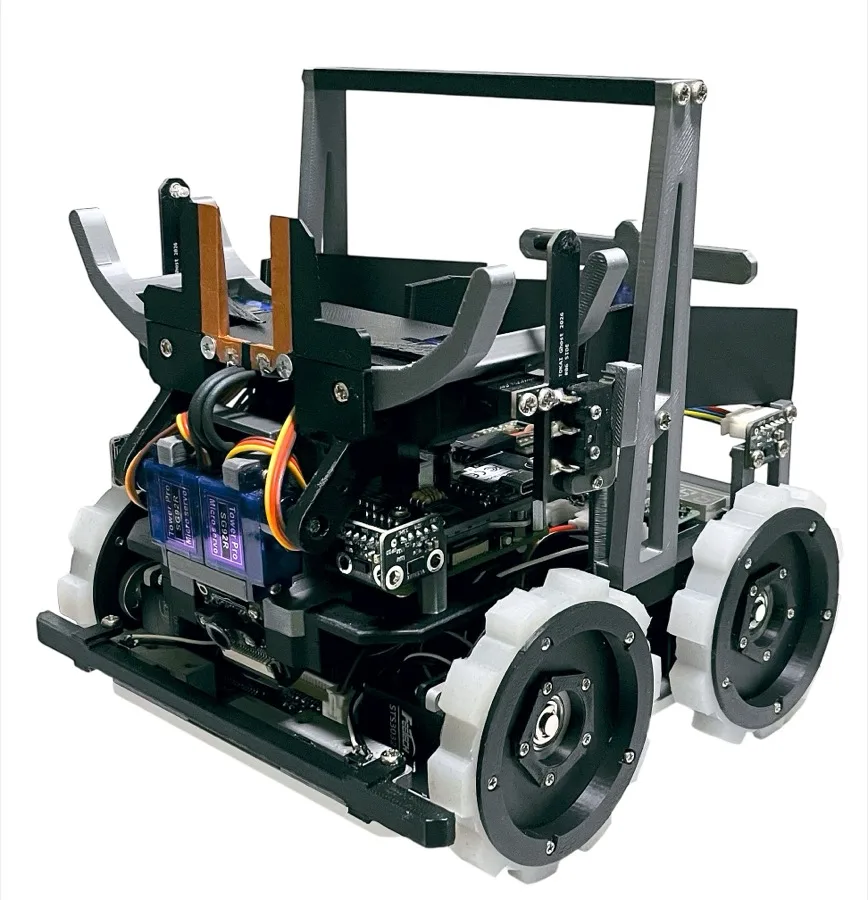
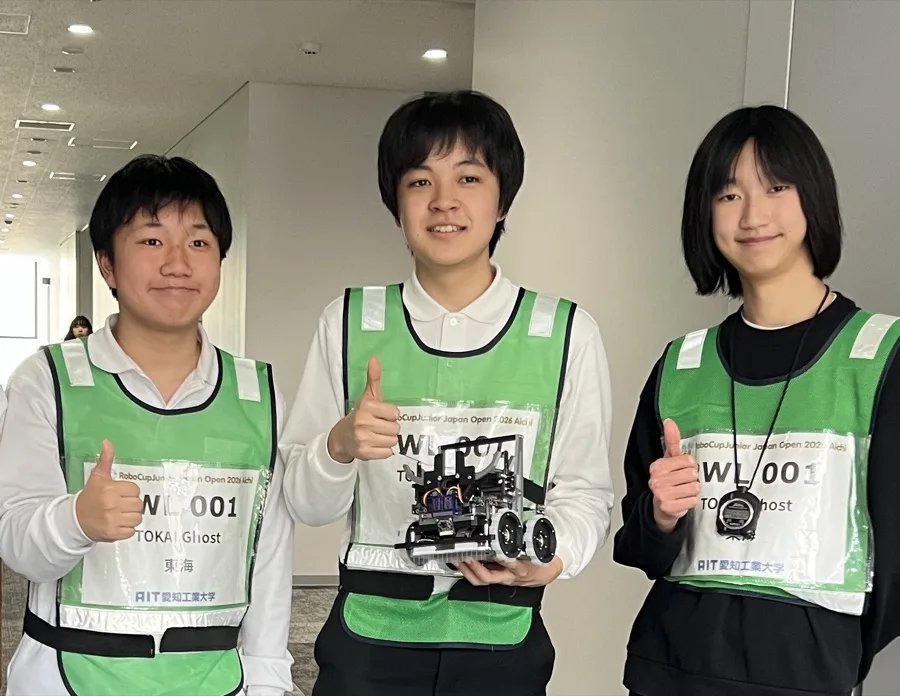
TOKAI Ghost's robot
The TOKAI Ghost team

In their words

We are TOKAI Ghost, a team from Japan. Our new robot for this competition is a rescue robot designed to consistently achieve high scores in all situations. At Japan Open 2026, we achieved full marks in every round.

This robot is entirely self-built. Unlike our robot from last season, we didn’t use any kits such as LEGO for this robot. We also designed all the electronic components.

Our robot has many innovative features. We developed silicone wheels and a twisting mechanism to navigate difficult ramps and bumps. For line following, we use not only sensors but also a camera this year, enabling more stable tracking. In the evacuation zone, the robot can reliably pick up and efficiently carry victims with its multifunctional rescue mechanism.

For victim detection, we trained a YOLOv8-based model on a dataset annotated using Label Studio. Since it was designed for inference on a Raspberry Pi 5, we were able to develop a highly accurate model.

By combining the strengths of a camera and multiple sensors, the robot improves both speed and stability in line following and in rescue tasks.

Poster
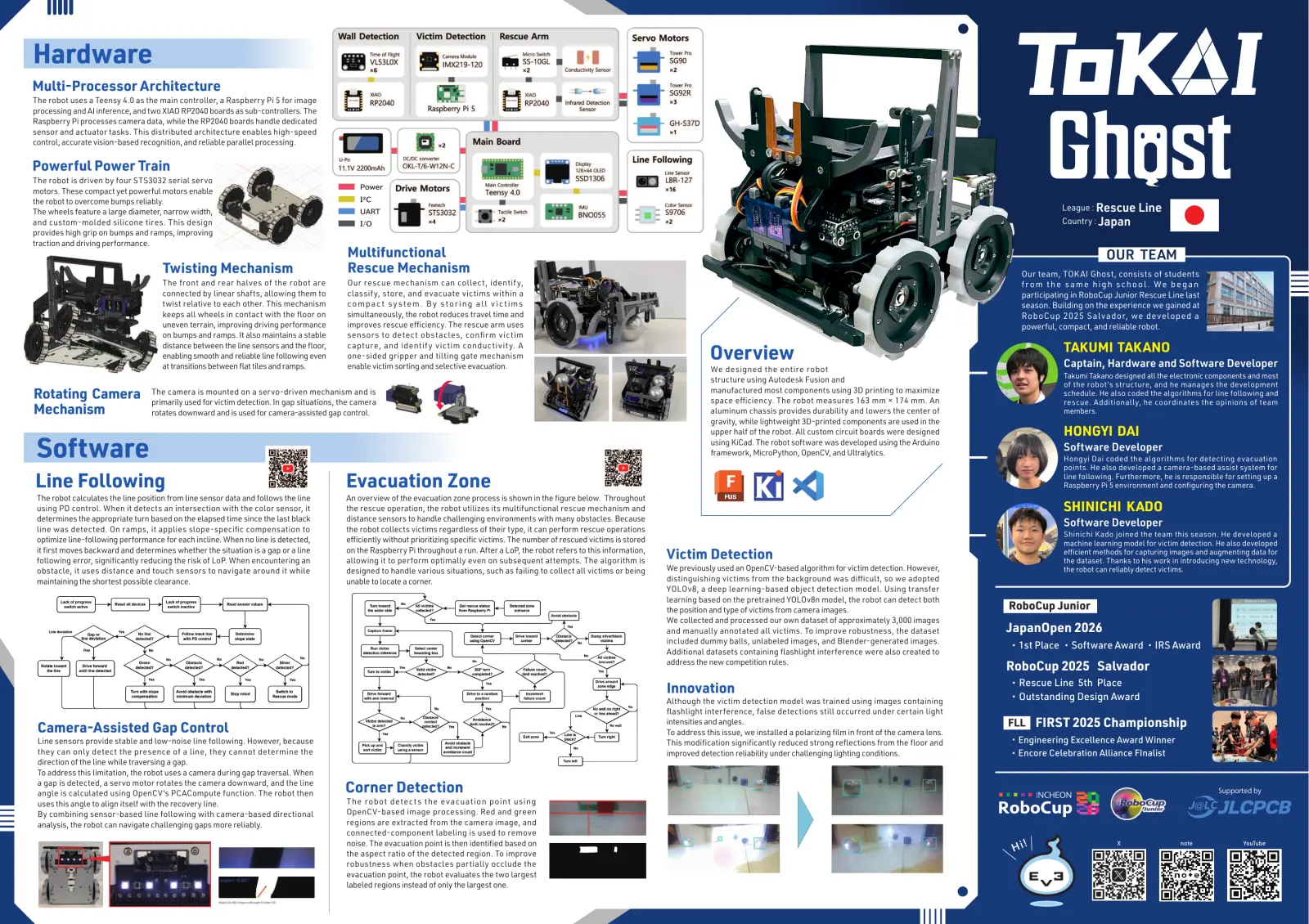
Read the text of this document — 1109 words
Hardware
Multi-Processor Architecture
The robot uses a Teensy 4.0 as the main controller, a Raspberry Pi 5 for image
processing and AI inference, and two XIAO RP2040 boards as sub-controllers. The
Raspberry Pi processes camera data, while the RP2040 boards handle dedicated
sensor and actuator tasks. This distributed architecture enables high-speed
control, accurate vision-based recognition, and reliable parallel processing.

Powerful Power Train
The robot is driven by four STS3032 serial servo
motors. These compact yet powerful motors enable
the robot to overcome bumps reliably.
The wheels feature a large diameter, narrow width,
                                                                                                                                                                                                                                                                                         League : Rescue Line
and custom-molded silicone tires. This design                                                                                                                                                                                                                                            Country : Japan
provides high grip on bumps and ramps, improving
traction and driving performance.
                                                                                           Multifunctional                                                                                                                                                                                            OUR TEAM
                                      Twisting Mechanism                                   Rescue Mechanism                                                                                                                                                                    Our team, TOK AI Ghost, consists of students
                                      The front and rear halves of the robot are           Our rescue mechanism can collect, identif y,                                                                                                                                        from the s ame high school . We began
                                      connected by linear shafts, allowing them to         classify, store, and evacuate victims within a                                                                                                                                      participating in RoboCup Junior Rescue Line last
                                      twist relative to each other. This mechanism         compac t system. B y stor ing all vic tims                                                                                                                                          season. Building on the experience we gained at
                                      keeps all wheels in contact with the floor on        simultaneously, the robot reduces travel time and                                                                                                                                   RoboCup 2025 S alvador, we developed a
                                      uneven terrain, improving driving performance        improves rescue efficiency. The rescue arm uses                                                                                                                                     powerful, compact, and reliable robot.
                                      on bumps and ramps. It also maintains a stable       sensors to detect obstacles, confirm victim
                                      distance between the line sensors and the floor,     capture, and identif y victim conductivity. A                                                                                                                                                  TAKUMI TAKANO
                                      enabling smooth and reliable line following even
                                      at transitions between flat tiles and ramps.
                                                                                           one-sided gripper and tilting gate mechanism
                                                                                           enable victim sorting and selective evacuation.
                                                                                                                                                                                                    Overview                                                                              Captain, Hardware and Software Developer
                                                                                                                                                                                                     We designed the entire robot
                                                                                                                                                                                                                                                                                          Takumi Takano designed all the electronic components and most
                                                                                                                                                                                                     structure using Autodesk Fusion and
                                                                                                                                                                                                                                                                                          of the robot’s structure, and he manages the development
                                                                                                                                                                                                     manufactured most components using 3D printing to maximize
Rotating Camera                   The camera is mounted on a servo-driven mechanism and is
                                  primarily used for victim detection. In gap situations, the camera                                                                                                 space efficiency. The robot measures 163 mm × 174 mm. An
                                                                                                                                                                                                                                                                                          schedule. He also coded the algorithms for line following and
                                                                                                                                                                                                                                                                                          rescue. Additionally, he coordinates the opinions of team
Mechanism                         rotates downward and is used for camera-assisted gap control.                                                                                                      aluminum chassis provides durability and lowers the center of                        members.
                                                                                                                                                                                                     gravity, while lightweight 3D-printed components are used in the
                                                                                                                                                                                                     upper half of the robot. All custom circuit boards were designed                     HONGYI DAI
 Software                                                                                                                                                                                            using KiCad. The robot software was developed using the Arduino
                                                                                                                                                                                                     framework, MicroPython, OpenCV, and Ultralytics.
                                                                                                                                                                                                                                                                                          Software Developer
                                                                                                                                                                                                                                                                                          Hongyi Dai coded the algorithms for detecting evacuation
                                                                                                                                                                                                                                                                                          points. He also developed a camera-based assist system for

Line Following                                                                             Evacuation Zone                                                                                                                                                                                line following. Furthermore, he is responsible for setting up a
                                                                                                                                                                                                                                                                                          Raspberry Pi 5 environment and configuring the camera.
 The robot calculates the line position from line sensor data and follows the line         An overview of the evacuation zone process is shown in the figure below. Throughout
 using PD control. When it detects an intersection with the color sensor, it               the rescue operation, the robot utilizes its multifunctional rescue mechanism and                                                                                                              SHINICHI KADO
 determines the appropriate turn based on the elapsed time since the last black            distance sensors to handle challenging environments with many obstacles. Because
                                                                                                                                                                                                                                                                                          Software Developer
 line was detected. On ramps, it applies slope-specific compensation to                    the robot collects victims regardless of their type, it can perform rescue operations
                                                                                                                                                                                                                                                                                          Shinichi Kado joined the team this season. He developed a
 optimize line-following performance for each incline. When no line is detected,           efficiently without prioritizing specific victims. The number of rescued victims is stored                                                                                                     machine learning model for victim detection. He also developed
 it first moves backward and determines whether the situation is a gap or a line           on the Raspberry Pi throughout a run. After a LoP, the robot refers to this information,
 following error, significantly reducing the risk of LoP. When encountering an             allowing it to perform optimally even on subsequent attempts. The algorithm is
                                                                                                                                                                                        Victim Detection                                                                                  efficient methods for capturing images and augmenting data for
                                                                                                                                                                                                                                                                                          the dataset. Thanks to his work in introducing new technology,
 obstacle, it uses distance and touch sensors to navigate around it while                  designed to handle various situations, such as failing to collect all victims or being       We previously used an OpenCV-based algorithm for victim detection. However,                       the robot can reliably detect victims.
 maintaining the shortest possible clearance.                                              unable to locate a corner.                                                                   distinguishing victims from the background was difficult, so we adopted
                                                                                                                                                                                        YOLOv8, a deep learning-based object detection model. Using transfer
                                                                                                                                                                                        learning based on the pretrained YOLOv8n model, the robot can detect both
                                                                                                                                                                                        the position and type of victims from camera images.                                 RoboCup Junior
                                                                                                                                                                                        We collected and processed our own dataset of approximately 3,000 images
                                                                                                                                                                                        and manually annotated all victims. To improve robustness, the dataset               JapanOpen 2026
                                                                                                                                                                                        included dummy balls, unlabeled images, and Blender-generated images.
                                                                                                                                                                                                                                                                             ・1st Place ・Software Award ・IRS Award
                                                                                                                                                                                        Additional datasets containing flashlight interference were also created to
                                                                                                                                                                                        address the new competition rules.
                                                                                                                                                                                                                                                                             RoboCup 2025 Salvador
                                                                                                                                                                                                                                                                             ・Rescue Line 5th Place
                                                                                                                                                                                        Innovation
                                                                                                                                                                                        Although the victim detection model was trained using images containing              ・Outstanding Design Award
                                                                                                                                                                                        flashlight interference, false detections still occurred under certain light

 Camera-Assisted Gap Control
                                                                                                                                                                                        intensities and angles.                                                              FLL    FIRST 2025 Championship
                                                                                                                                                                                        To address this issue, we installed a polarizing film in front of the camera lens.
 Line sensors provide stable and low-noise line following. However, because                                                                                                             This modification significantly reduced strong reflections from the floor and        ・Engineering Excellence Award Winner
 they can only detect the presence of a line, they cannot determine the                                                                                                                 improved detection reliability under challenging lighting conditions.                ・Encore Celebration Alliance FInalist
 direction of the line while traversing a gap.
 To address this limitation, the robot uses a camera during gap traversal. When
 a gap is detected, a servo motor rotates the camera downward, and the line
 angle is calculated using OpenCV's PCACompute function. The robot then                   Corner Detection                                                                                                                                                                                                                             Supported by
 uses this angle to align itself with the recovery line.                                   The robot detec t s the evacuation point using
 By combining sensor-based line following with camera-based directional                    OpenCV-based image processing. Red and green
 analysis, the robot can navigate challenging gaps more reliably.                          regions are extracted from the camera image, and
                                                                                           connected-component labeling is used to remove
                                                                                                                                                                                                                                                                              Hi!
                                                                                           noise. The evacuation point is then identified based on                                                                                                                                                       X                  note              YouTube
                                                                                           the aspect ratio of the detected region. To improve
                                                                                           robustness when obstacles partially occlude the
                                                                                           evacuation point, the robot evaluates the two largest
                                                                                           labeled regions instead of only the largest one.

Open as plain text

1 page, rendered as images so they load quickly. The text above is the document's own, extracted from the PDF.

Download the original PDF (1.7 MB) from GitHub

Presentation video

Hosted on YouTube. The player loads only when you press play.

Open in YouTube

Bill of materials

Read the text of this document — 902 words
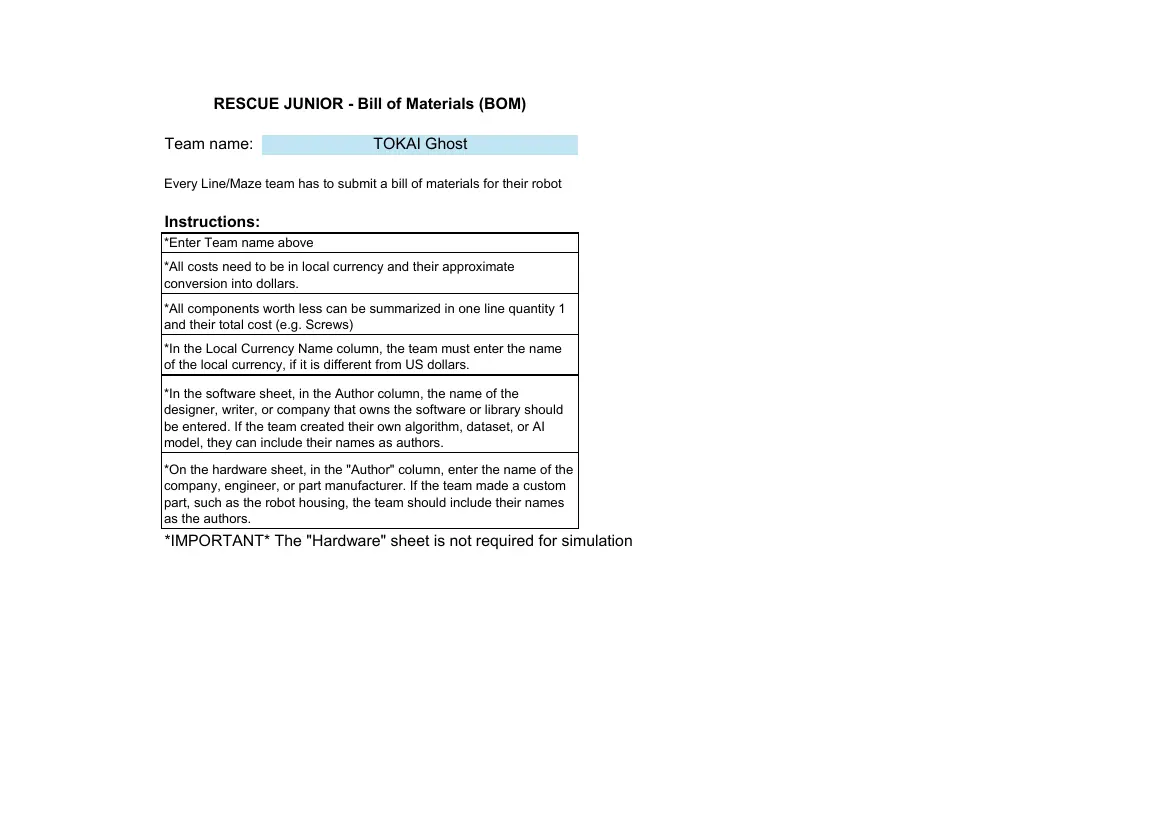
RESCUE JUNIOR - Bill of Materials (BOM)

Team name:                          TOKAI Ghost

Every Line/Maze team has to submit a bill of materials for their robot

Instructions:
*Enter Team name above
*All costs need to be in local currency and their approximate
conversion into dollars.
*All components worth less can be summarized in one line quantity 1
and their total cost (e.g. Screws)
*In the Local Currency Name column, the team must enter the name
of the local currency, if it is different from US dollars.

*In the software sheet, in the Author column, the name of the
designer, writer, or company that owns the software or library should
be entered. If the team created their own algorithm, dataset, or AI
model, they can include their names as authors.

*On the hardware sheet, in the "Author" column, enter the name of the
company, engineer, or part manufacturer. If the team made a custom
part, such as the robot housing, the team should include their names
as the authors.
*IMPORTANT* The "Hardware" sheet is not required for simulation
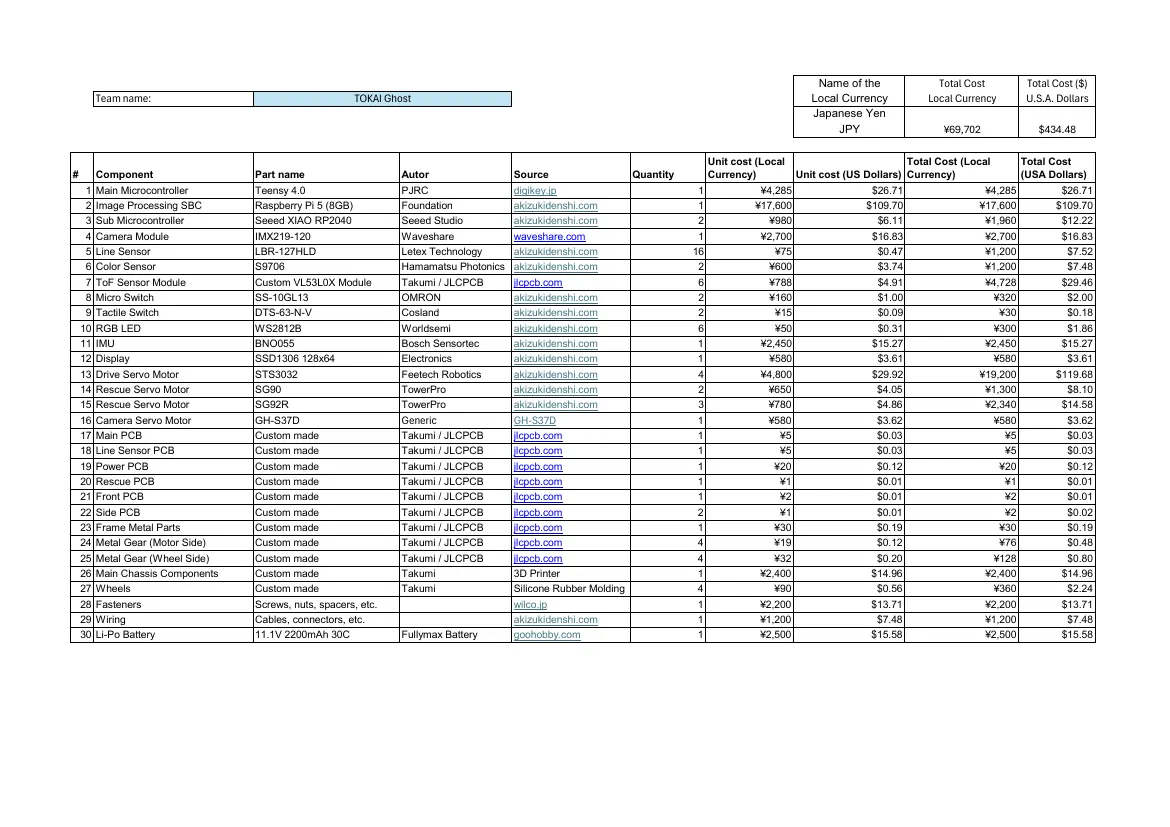
                                                                                                                                                   Name of the             Total Cost        Total Cost ($)
      Team name:                                      TOKAI Ghost                                                                                 Local Currency         Local Currency      U.S.A. Dollars
                                                                                                                                                  Japanese Yen
                                                                                                                                                       JPY                  ¥69,702             $434.48

                                                                                                                             Unit cost (Local                         Total Cost (Local      Total Cost
#      Component                 Part name                     Autor                 Source                    Quantity      Currency)         Unit cost (US Dollars) Currency)              (USA Dollars)
     1 Main Microcontroller      Teensy 4.0                    PJRC
                                                               Raspberry Pi          digikey.jp                            1            ¥4,285                $26.71                  ¥4,285         $26.71
     2 Image Processing SBC      Raspberry Pi 5 (8GB)          Foundation            akizukidenshi.com                     1           ¥17,600               $109.70                 ¥17,600        $109.70
     3 Sub Microcontroller       Seeed XIAO RP2040             Seeed Studio          akizukidenshi.com                     2              ¥980                 $6.11                  ¥1,960         $12.22
     4 Camera Module             IMX219-120                    Waveshare             waveshare.com                         1            ¥2,700                $16.83                  ¥2,700         $16.83
     5 Line Sensor               LBR-127HLD                    Letex Technology      akizukidenshi.com                    16               ¥75                 $0.47                  ¥1,200          $7.52
     6 Color Sensor              S9706                         Hamamatsu Photonics   akizukidenshi.com                     2              ¥600                 $3.74                  ¥1,200          $7.48
     7 ToF Sensor Module         Custom VL53L0X Module         Takumi / JLCPCB       jlcpcb.com                            6              ¥788                 $4.91                  ¥4,728         $29.46
     8 Micro Switch              SS-10GL13                     OMRON                 akizukidenshi.com                     2              ¥160                 $1.00                    ¥320          $2.00
     9 Tactile Switch            DTS-63-N-V                    Cosland               akizukidenshi.com                     2               ¥15                 $0.09                     ¥30          $0.18
    10 RGB LED                   WS2812B                       Worldsemi             akizukidenshi.com                     6               ¥50                 $0.31                    ¥300          $1.86
    11 IMU                       BNO055                        Bosch  Sensortec
                                                               SUNHOKEY              akizukidenshi.com                     1            ¥2,450                $15.27                  ¥2,450         $15.27
    12 Display                   SSD1306 128x64                Electronics           akizukidenshi.com                     1              ¥580                 $3.61                    ¥580          $3.61
    13 Drive Servo Motor         STS3032                       Feetech Robotics      akizukidenshi.com                     4            ¥4,800                $29.92                 ¥19,200        $119.68
    14 Rescue Servo Motor        SG90                          TowerPro              akizukidenshi.com                     2              ¥650                 $4.05                  ¥1,300          $8.10
    15 Rescue Servo Motor        SG92R                         TowerPro              akizukidenshi.com                     3              ¥780                 $4.86                  ¥2,340         $14.58
    16 Camera Servo Motor        GH-S37D                       Generic               GH-S37D                               1              ¥580                 $3.62                    ¥580          $3.62
    17 Main PCB                  Custom made                   Takumi / JLCPCB       jlcpcb.com                            1                ¥5                 $0.03                      ¥5          $0.03
    18 Line Sensor PCB           Custom made                   Takumi / JLCPCB       jlcpcb.com                            1                ¥5                 $0.03                      ¥5          $0.03
    19 Power PCB                 Custom made                   Takumi / JLCPCB       jlcpcb.com                            1               ¥20                 $0.12                     ¥20          $0.12
    20 Rescue PCB                Custom made                   Takumi / JLCPCB       jlcpcb.com                            1                ¥1                 $0.01                      ¥1          $0.01
    21 Front PCB                 Custom made                   Takumi / JLCPCB       jlcpcb.com                            1                ¥2                 $0.01                      ¥2          $0.01
    22 Side PCB                  Custom made                   Takumi / JLCPCB       jlcpcb.com                            2                ¥1                 $0.01                      ¥2          $0.02
    23 Frame Metal Parts         Custom made                   Takumi / JLCPCB       jlcpcb.com                            1               ¥30                 $0.19                     ¥30          $0.19
    24 Metal Gear (Motor Side)   Custom made                   Takumi / JLCPCB       jlcpcb.com                            4               ¥19                 $0.12                     ¥76          $0.48
    25 Metal Gear (Wheel Side)   Custom made                   Takumi / JLCPCB       jlcpcb.com                            4               ¥32                 $0.20                    ¥128          $0.80
    26 Main Chassis Components   Custom made                   Takumi                3D Printer                            1            ¥2,400                $14.96                  ¥2,400         $14.96
    27 Wheels                    Custom made                   Takumi                Silicone Rubber Molding               4               ¥90                 $0.56                    ¥360          $2.24
    28 Fasteners                 Screws, nuts, spacers, etc.                         wilco.jp                              1            ¥2,200                $13.71                  ¥2,200         $13.71
    29 Wiring                    Cables, connectors, etc.                            akizukidenshi.com                     1            ¥1,200                 $7.48                  ¥1,200          $7.48
    30 Li-Po Battery             11.1V 2200mAh 30C             Fullymax Battery      goohobby.com                          1            ¥2,500                $15.58                  ¥2,500         $15.58
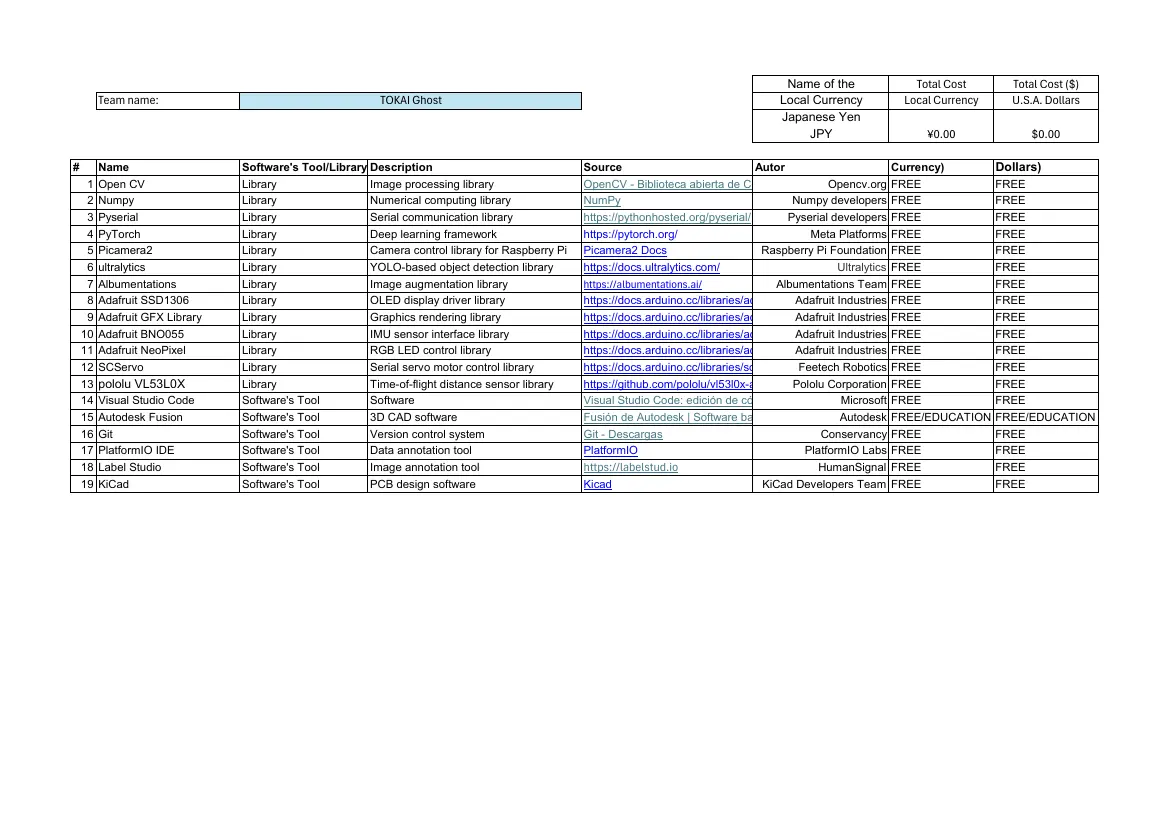
                                                                                                                                    Name of the             Total Cost       Total Cost ($)
       Team name:                                       TOKAI Ghost                                                                Local Currency         Local Currency     U.S.A. Dollars
                                                                                                                                   Japanese Yen
                                                                                                                                        JPY                   ¥0.00              $0.00
                                                                                                                                                                Cost (LocalCost (USA
#      Name                   Software's Tool/Library Description                               Source                              Autor                       Currency)  Dollars)
     1 Open CV                Library                 Image processing library                  OpenCV - Biblioteca abierta de Com                Opencv.org FREE              FREE
     2 Numpy                  Library                 Numerical computing library               NumPy                                      Numpy developers FREE               FREE
     3 Pyserial               Library                 Serial communication library              https://pythonhosted.org/pyserial/        Pyserial developers FREE             FREE
     4 PyTorch                Library                 Deep learning framework                   https://pytorch.org/                          Meta Platforms FREE              FREE
     5 Picamera2              Library                 Camera control library for Raspberry Pi   Picamera2 Docs                       Raspberry Pi Foundation FREE              FREE
     6 ultralytics            Library                 YOLO-based object detection library       https://docs.ultralytics.com/                       Ultralytics FREE           FREE
     7 Albumentations         Library                 Image augmentation library                https://albumentations.ai/             Albumentations Team FREE                FREE
     8 Adafruit SSD1306       Library                 OLED display driver library               https://docs.arduino.cc/libraries/ada      Adafruit Industries FREE            FREE
     9 Adafruit GFX Library   Library                 Graphics rendering library                https://docs.arduino.cc/libraries/ada      Adafruit Industries FREE            FREE
    10 Adafruit BNO055        Library                 IMU sensor interface library              https://docs.arduino.cc/libraries/ada      Adafruit Industries FREE            FREE
    11 Adafruit NeoPixel      Library                 RGB LED control library                   https://docs.arduino.cc/libraries/ada      Adafruit Industries FREE            FREE
    12 SCServo                Library                 Serial servo motor control library        https://docs.arduino.cc/libraries/scse      Feetech Robotics FREE              FREE
    13 pololu VL53L0X         Library                 Time-of-flight distance sensor library    https://github.com/pololu/vl53l0x-ardu     Pololu Corporation FREE             FREE
    14 Visual Studio Code     Software's Tool         Software                                  Visual Studio Code: edición de cód                   Microsoft FREE            FREE
    15 Autodesk Fusion        Software's Tool         3D CAD software                           Fusión de Autodesk | Software basad                  Autodesk
                                                                                                                                           Software Freedom     FREE/EDUCATION FREE/EDUCATION
    16 Git                    Software's Tool         Version control system                    Git - Descargas                                 Conservancy FREE               FREE
    17 PlatformIO IDE         Software's Tool         Data annotation tool                      PlatformIO                                   PlatformIO Labs FREE              FREE
    18 Label Studio           Software's Tool         Image annotation tool                     https://labelstud.io                            HumanSignal FREE               FREE
    19 KiCad                  Software's Tool         PCB design software                       Kicad                                KiCad Developers Team FREE                FREE

Open as plain text

3 pages, rendered as images so they load quickly. The text above is the document's own, extracted from the PDF.

Download the original PDF (182 KB) from GitHub

Source code

The team's own source code, 24.7 MB. It is a download rather than part of this page, because a zip is something you open on your computer. It comes from GitHub, which some school networks block.

Download TOKAI Ghost's source code