
Titãs da Robótica - Ligeirinho
Document register
- Poster1 pagePublished
- Presentation videoYouTubePublished
- Bill of materials60 KBPublished
- Team description paperNot shared
- Engineering journalNot shared
- Source code58 KB · GitHubPublished
Sharing each document is the team's decision. “Not shared” means this team chose not to publish it, or did not submit one — not that it is missing from the archive.
In their words
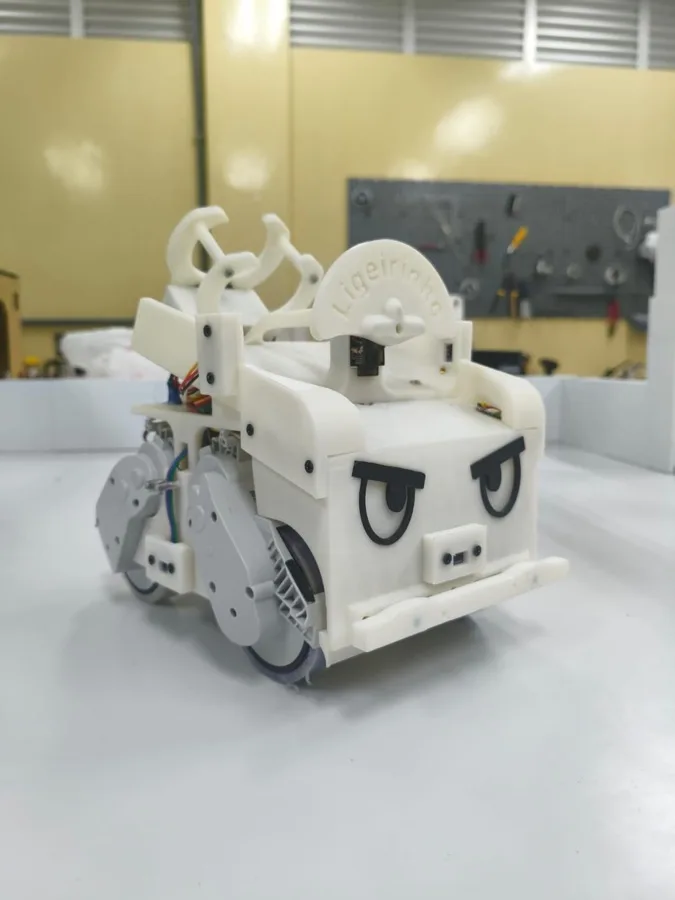
This article introduces "Ligeirinho", an autonomous rescue robot developed by the Titãs da Robótica team to compete in the RoboCup Junior Rescue Line category at RoboCup 2026 Incheon. Ligeirinho features an innovative dual-front mechanical architecture designed to address the challenges of the competition through distinct and dedicated operational modes. The chassis structure is almost entirely 3D printed, utilizing custom cured silicone tires mounted on plastic rims adapted from vacuum cleaner wheels to maximize traction. The robot's entire software and control system was developed in Python, running locally on the mainboard. One of the robot's fronts is designed exclusively for high-speed line following; it has a ground-facing camera housed within a completely sealed cover to eliminate variations in external light. This vision system feeds a PID control loop that identifies paths and green, red, or silver markers. The opposite front is dedicated entirely to operations in the Rescue Area, integrating a front camera for real-time victim detection and triangles. This side features an automated mechanical claw that collects victims and dynamically separates them into a two-sided bin (live and dead victims). Safe navigation is achieved through lateral distance sensors, a front sensor, and a line-following bumper on the lid for collision avoidance. A central battery drawer ensures optimal weight distribution and quick maintenance.
Poster
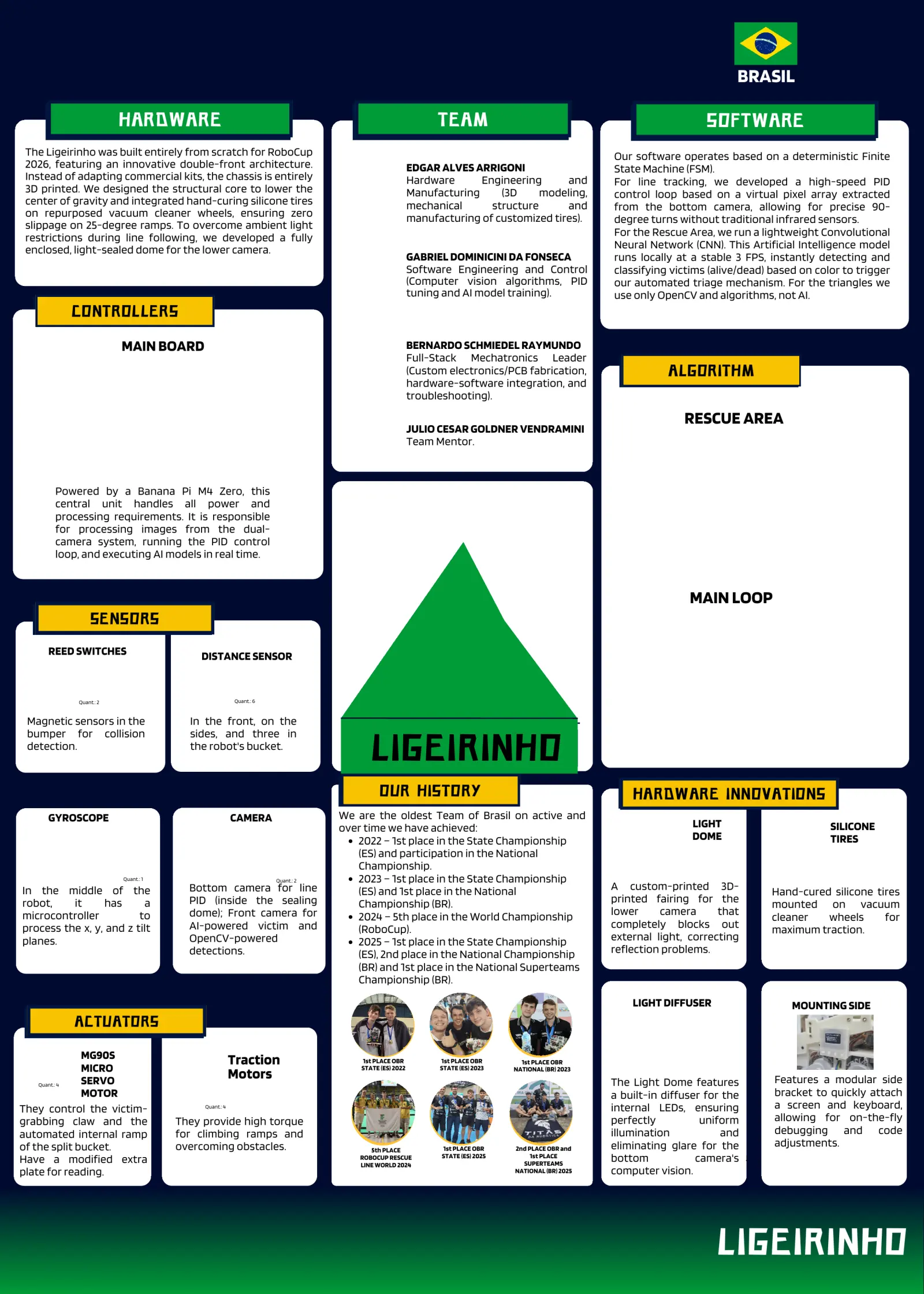
Read the text of this document — 600 words
BRASIL
HARDWARE
HARDWARE TEAM
HARDWARE SOFTWARE
HARDWARE
The Ligeirinho was built entirely from scratch for RoboCup Our software operates based on a deterministic Finite
2026, featuring an innovative double-front architecture. EDGAR ALVES ARRIGONI State Machine (FSM).
Instead of adapting commercial kits, the chassis is entirely Hardware Engineering and For line tracking, we developed a high-speed PID
3D printed. We designed the structural core to lower the Manufacturing (3D modeling, control loop based on a virtual pixel array extracted
center of gravity and integrated hand-curing silicone tires mechanical structure and from the bottom camera, allowing for precise 90-
on repurposed vacuum cleaner wheels, ensuring zero manufacturing of customized tires). degree turns without traditional infrared sensors.
slippage on 25-degree ramps. To overcome ambient light
restrictions during line following, we developed a fully For the Rescue Area, we run a lightweight Convolutional
enclosed, light-sealed dome for the lower camera. Neural Network (CNN). This Artificial Intelligence model
GABRIEL DOMINICINI DA FONSECA runs locally at a stable 3 FPS, instantly detecting and
Software Engineering and Control classifying victims (alive/dead) based on color to trigger
(Computer vision algorithms, PID our automated triage mechanism. For the triangles we
tuning and AI model training). use only OpenCV and algorithms, not AI.
CONTROLLERS
CONTROLADORES
MAIN BOARD BERNARDO SCHMIEDEL RAYMUNDO
Full-Stack Mechatronics Leader
(Custom electronics/PCB fabrication, ALGORITHM
CONTROLADORES
hardware-software integration, and
troubleshooting).
RESCUE AREA
JULIO CESAR GOLDNER VENDRAMINI
Team Mentor.
Powered by a Banana Pi M4 Zero, this
central unit handles all power and
processing requirements. It is responsible
for processing images from the dual-
camera system, running the PID control
loop, and executing AI models in real time.
MAIN LOOP
SENSORS
CONTROLADORES
REED SWITCHES DISTANCE SENSOR
Quant.: 2 Quant.: 6
Magnetic sensors in the In the front, on the
LIGEIRINHO
bumper for collision sides, and three in
detection. the robot's bucket. HARDWARE
OUR HISTORY
CONTROLADORES HARDWARE INNOVATIONS
SOLUÇÕES DE HARDWARE
GYROSCOPE CAMERA We are the oldest Team of Brasil on active and
over time we have achieved: LIGHT SILICONE
2022 – 1st place in the State Championship DOME TIRES
(ES) and participation in the National
Championship.
Quant.: 1 Quant.: 2 2023 – 1st place in the State Championship
In the middle of the Bottom camera for line (ES) and 1st place in the National A custom-printed 3D- Hand-cured silicone tires
robot, it has a PID (inside the sealing Championship (BR). printed fairing for the mounted on vacuum
microcontroller to dome); Front camera for 2024 – 5th place in the World Championship lower camera that cleaner wheels for
process the x, y, and z tilt AI-powered victim and (RoboCup). completely blocks out maximum traction.
planes. OpenCV-powered 2025 – 1st place in the State Championship external light, correcting
detections. (ES), 2nd place in the National Championship reflection problems.
(BR) and 1st place in the National Superteams
Championship (BR).
LIGHT DIFFUSER MOUNTING SIDE
ACTUATORS
CONTROLADORES
MG90S Traction 1st PLACE OBR 1st PLACE OBR 1st PLACE OBR
MICRO STATE (ES) 2022 STATE (ES) 2023 NATIONAL (BR) 2023
SERVO Motors Features a modular side
Quant.: 4 The Light Dome features
MOTOR a built-in diffuser for the bracket to quickly attach
They control the victim- Quant.: 4 internal LEDs, ensuring a screen and keyboard,
grabbing claw and the They provide high torque perfectly uniform allowing for on-the-fly
automated internal ramp for climbing ramps and illumination and debugging and code
of the split bucket. overcoming obstacles. 1st PLACE OBR 2nd PLACE OBR and eliminating glare for the adjustments.
5th PLACE
Have a modified extra ROBOCUP RESCUE
LINE WORLD 2024
STATE (ES) 2025 1st PLACE
SUPERTEAMS
bottom camera's
plate for reading. NATIONAL (BR) 2025 computer vision.
LIGEIRINHO
1 page, rendered as images so they load quickly. The text above is the document's own, extracted from the PDF.
Presentation video
Hosted on YouTube. The player loads only when you press play.
Bill of materials
Shown as the original PDF, because this one is smaller that way and its text stays selectable and searchable.
Source code
The team's own source code, 58 KB. It is a download rather than part of this page, because a zip is something you open on your computer. It comes from GitHub, which some school networks block.