Pharaoh
Document register
- Poster1 pagePublished
- Presentation videoYouTubePublished
- Bill of materials1 pagePublished
- Team description paper7 pagesPublished
- Engineering journalNot shared
- Source code13 KB · GitHubPublished
Sharing each document is the team's decision. “Not shared” means this team chose not to publish it, or did not submit one — not that it is missing from the archive.
In their words
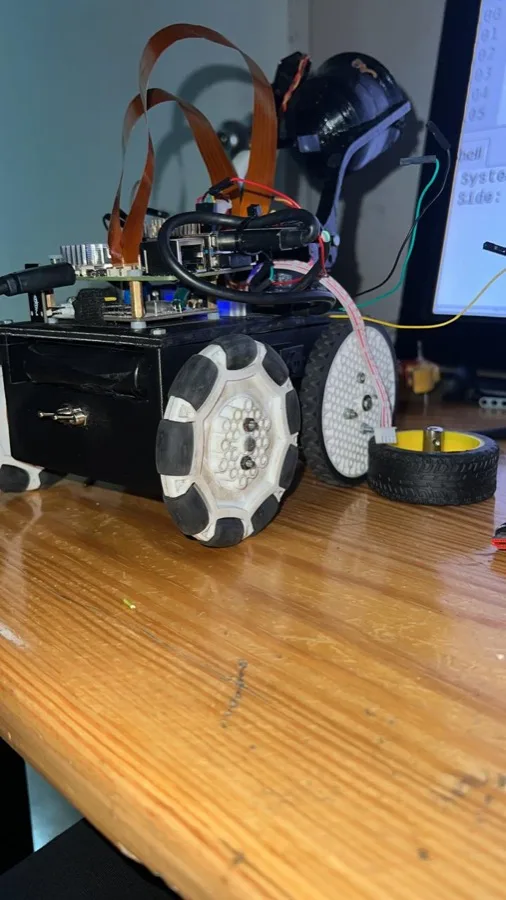
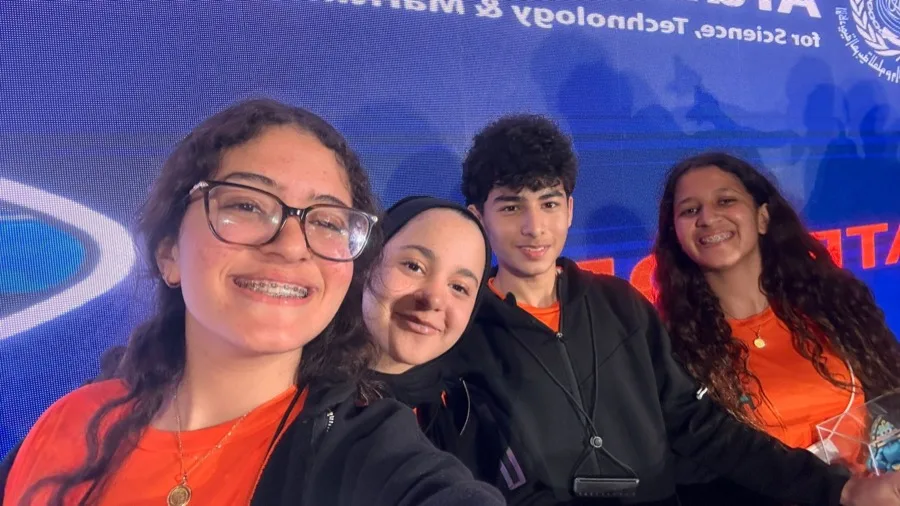
The Egypt Pharaoh team has developed a highly autonomous, robust rescue robot utilizing a distributed computing architecture designed specifically to tackle the complexities of the RoboCup Junior Rescue Line challenge. Our robot's core processing is handled by a Raspberry Pi 5 running Python and OpenCV for environmental perception, coupled with a Google Coral USB Accelerator running a custom-trained YOLOv8 AI model for real-time victim detection. Low-level hardware actuation is synchronously controlled by an Arduino Nano via a custom C++ library (RCJBot). Mechanically, the robot features a custom-designed chassis with high ground clearance for speed bumps, REV DUO motion wheels for superior traction, and a rapid-deployment dual-micro-servo victim retrieval mechanism. To ensure absolute electrical stability, we engineered a custom Printed Circuit Board (PCB) using Altium Designer that isolates power delivery between the drive systems and the logic boards. This paper details our progressive engineering methodology, system integration, and rigorous testing protocols that led to our qualification for the World Finals.
Poster
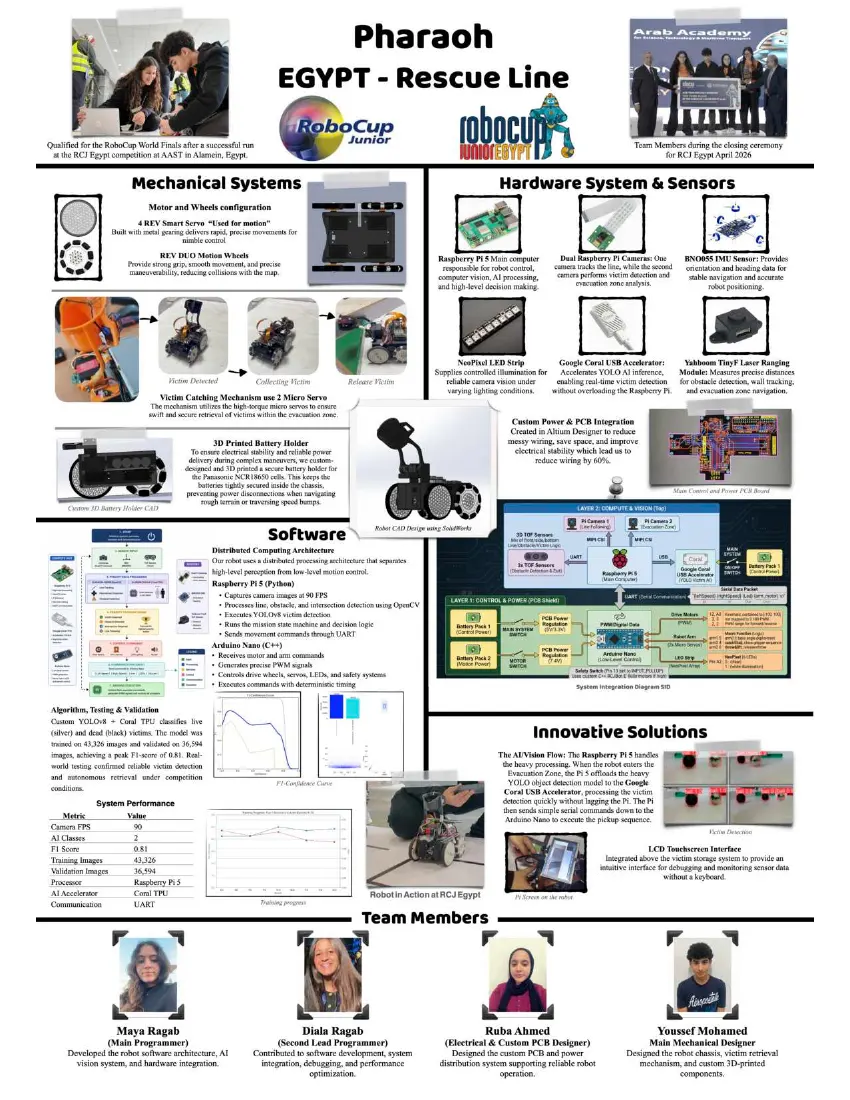
1 page, rendered as images so they load quickly. This document has no text layer — the words in it are part of the image.
Presentation video
Hosted on YouTube. The player loads only when you press play.
Bill of materials
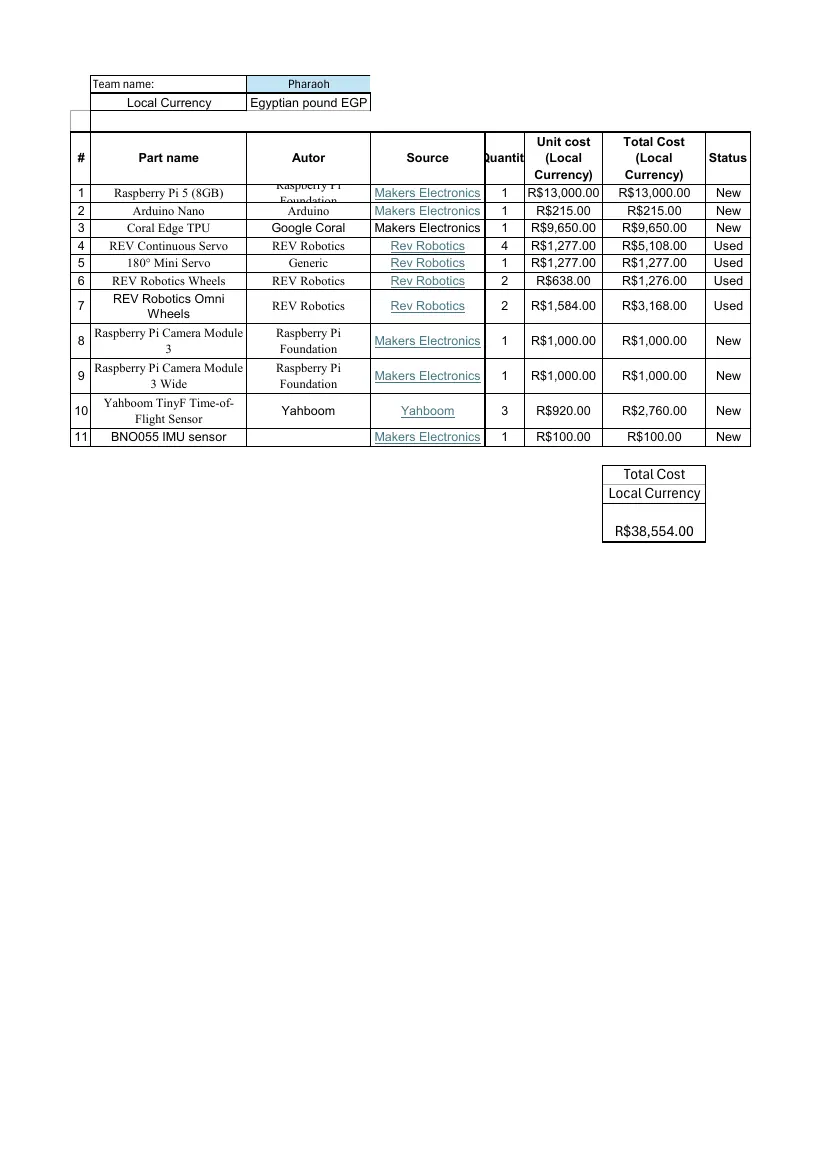
Read the text of this document — 165 words
Team name:                         Pharaoh
           Local Currency         Egyptian pound EGP

                                                                                   Unit cost      Total Cost
#           Part name                   Autor               Source      Quantity    (Local          (Local       Status
                                                                                   Currency)      Currency)
                                     Raspberry Pi
1    Raspberry Pi 5 (8GB)                              Makers Electronics   1   R$13,000.00      R$13,000.00     New
                                      Foundation
2       Arduino Nano                   Arduino         Makers Electronics   1    R$215.00         R$215.00       New
3      Coral Edge TPU                Google Coral      Makers Electronics   1   R$9,650.00       R$9,650.00      New
4   REV Continuous Servo             REV Robotics        Rev Robotics       4   R$1,277.00       R$5,108.00      Used
5      180° Mini Servo                 Generic           Rev Robotics       1   R$1,277.00       R$1,277.00      Used
6    REV Robotics Wheels             REV Robotics        Rev Robotics       2    R$638.00        R$1,276.00      Used
     REV Robotics Omni
7                                    REV Robotics        Rev Robotics       2      R$1,584.00     R$3,168.00     Used
            Wheels
  Raspberry Pi Camera Module         Raspberry Pi
8                                                      Makers Electronics   1      R$1,000.00     R$1,000.00      New
               3                     Foundation
     Raspberry Pi Camera Module      Raspberry Pi
9                                                      Makers Electronics   1      R$1,000.00     R$1,000.00      New
               3 Wide                Foundation
      Yahboom TinyF Time-of-
10                                    Yahboom              Yahboom          3      R$920.00       R$2,760.00      New
           Flight Sensor
11     BNO055 IMU sensor                               Makers Electronics   1      R$100.00       R$100.00        New

                                                                                                  Total Cost
                                                                                                Local Currency

                                                                                                R$38,554.00
1 page, rendered as images so they load quickly. The text above is the document's own, extracted from the PDF.
Team description paper
Show the remaining 4 pages
Read the text of this document — 1388 words
ROBOCUPJUNIOR RESCUE (LINE) 2026
                          TEAM DESCRIPTION PAPER
                                           Pharaoh
Abstract
The Egypt Pharaoh team has developed a highly autonomous, robust rescue robot utilizing a distributed
computing architecture designed specifically to tackle the complexities of the RoboCup Junior Rescue
Line challenge. Our robot's core processing is handled by a Raspberry Pi 5 running Python and OpenCV
for environmental perception, coupled with a Google Coral USB Accelerator running a custom-trained
YOLOv8 AI model for real-time victim detection. Low-level hardware actuation is synchronously
controlled by an Arduino Nano via a custom C++ library (RCJBot). Mechanically, the robot features a
custom-designed chassis with high ground clearance for speed bumps, REV DUO motion wheels for
superior traction, and a rapid-deployment dual-micro-servo victim retrieval mechanism. To ensure
absolute electrical stability, we engineered a custom Printed Circuit Board (PCB) using Altium Designer
that isolates power delivery between the drive systems and the logic boards. This paper details our
progressive engineering methodology, system integration, and rigorous testing protocols that led to our
qualification for the World Finals.

1. Introduction
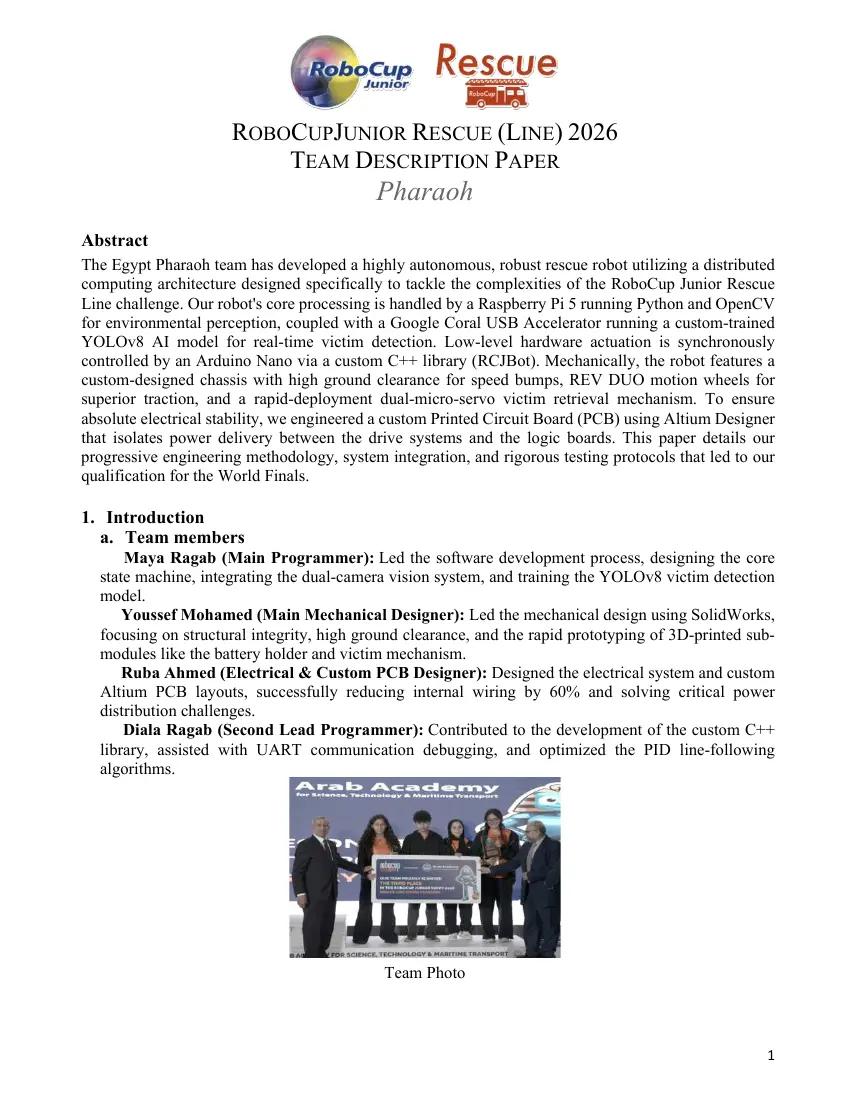
  a. Team members
      Maya Ragab (Main Programmer): Led the software development process, designing the core
  state machine, integrating the dual-camera vision system, and training the YOLOv8 victim detection
  model.
      Youssef Mohamed (Main Mechanical Designer): Led the mechanical design using SolidWorks,
  focusing on structural integrity, high ground clearance, and the rapid prototyping of 3D-printed sub-
  modules like the battery holder and victim mechanism.
      Ruba Ahmed (Electrical & Custom PCB Designer): Designed the electrical system and custom
  Altium PCB layouts, successfully reducing internal wiring by 60% and solving critical power
  distribution challenges.
      Diala Ragab (Second Lead Programmer): Contributed to the development of the custom C++
  library, assisted with UART communication debugging, and optimized the PID line-following
  algorithms.

                                             Team Photo

                                                                                                     1
2. Project Planning
  a. Overall Project Plan
  Our primary objective was to build a highly reliable robot capable
  of seamlessly transitioning between precise line-following and
  autonomous search-and-rescue within the evacuation zone. Based
  on competition constraints, we defined strict requirements:
     1. Physical: Must traverse speed bumps without bottoming out
        or losing power.
     2. Computational: Must process complex AI vision at high
        frame rates (30+ FPS) without thermal throttling.
     3. Electrical: Must guarantee clean power to logic controllers
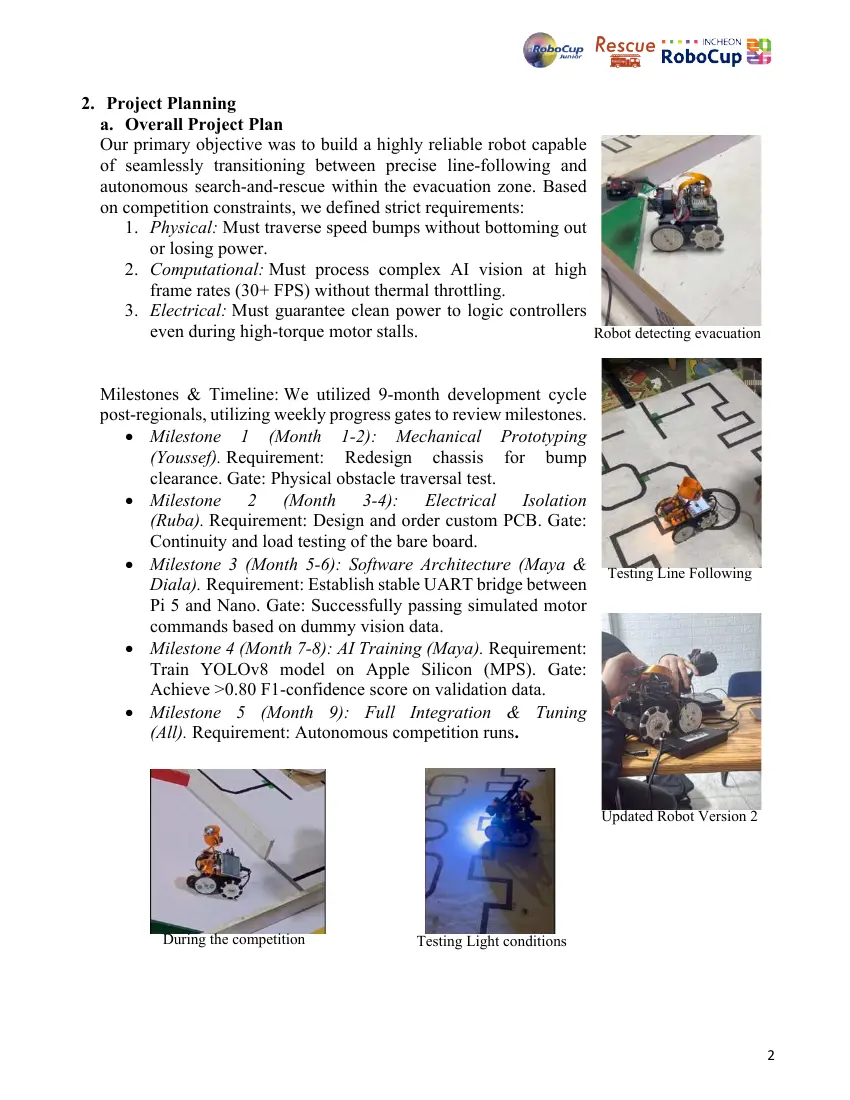
        even during high-torque motor stalls.                        Robot detecting evacuation

  Milestones & Timeline: We utilized 9-month development cycle
  post-regionals, utilizing weekly progress gates to review milestones.
     ¥ Milestone 1 (Month 1-2): Mechanical Prototyping
         (Youssef). Requirement: Redesign chassis for bump
         clearance. Gate: Physical obstacle traversal test.
     ¥ Milestone 2 (Month 3-4): Electrical Isolation
         (Ruba). Requirement: Design and order custom PCB. Gate:
         Continuity and load testing of the bare board.
     ¥ Milestone 3 (Month 5-6): Software Architecture (Maya &             Testing Line Following
         Diala). Requirement: Establish stable UART bridge between
         Pi 5 and Nano. Gate: Successfully passing simulated motor
         commands based on dummy vision data.
     ¥ Milestone 4 (Month 7-8): AI Training (Maya). Requirement:
         Train YOLOv8 model on Apple Silicon (MPS). Gate:
         Achieve >0.80 F1-confidence score on validation data.
     ¥ Milestone 5 (Month 9): Full Integration & Tuning
         (All). Requirement: Autonomous competition runs.

                                                                          Updated Robot Version 2

           During the competition             Testing Light conditions

                                                                                                    2
  b. Integration Plan
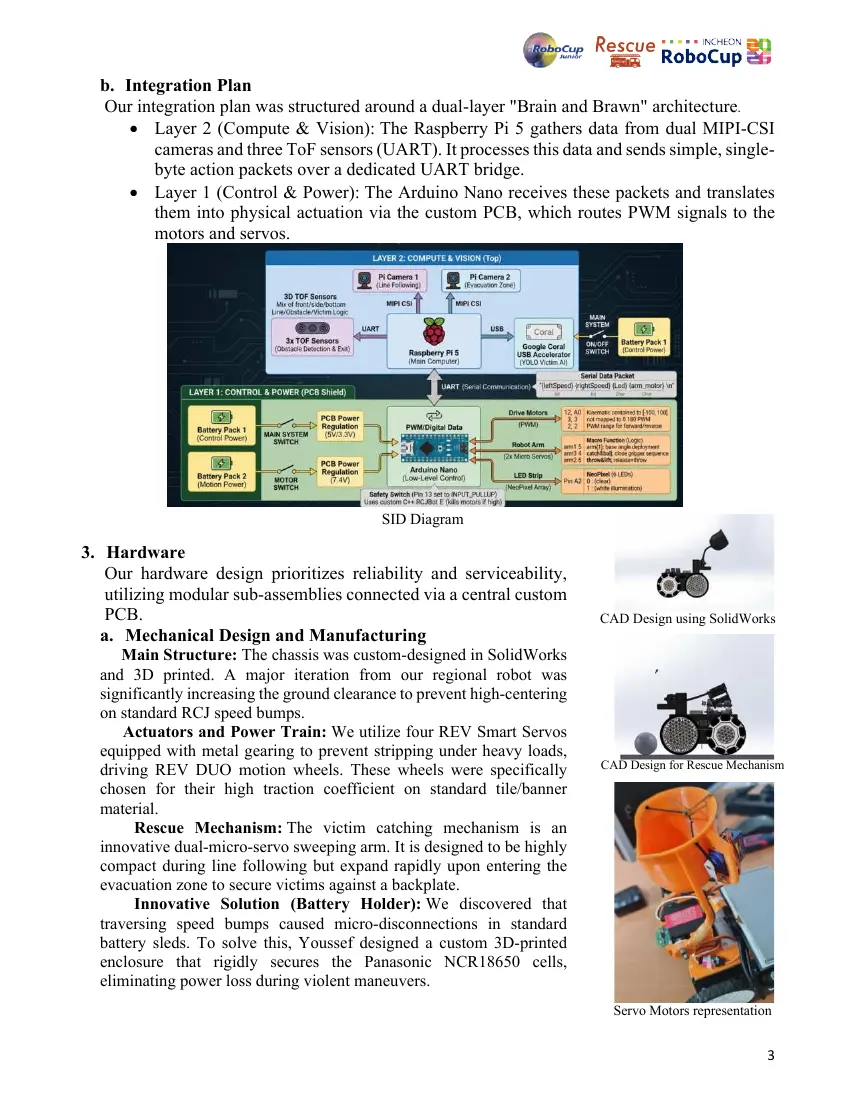
  Our integration plan was structured around a dual-layer "Brain and Brawn" architecture.
      ¥ Layer 2 (Compute & Vision): The Raspberry Pi 5 gathers data from dual MIPI-CSI
         cameras and three ToF sensors (UART). It processes this data and sends simple, single-
         byte action packets over a dedicated UART bridge.
      ¥ Layer 1 (Control & Power): The Arduino Nano receives these packets and translates
         them into physical actuation via the custom PCB, which routes PWM signals to the
         motors and servos.

                                            SID Diagram

3. Hardware
   Our hardware design prioritizes reliability and serviceability,
   utilizing modular sub-assemblies connected via a central custom
   PCB.                                                                     CAD Design using SolidWorks
  a. Mechanical Design and Manufacturing
     Main Structure: The chassis was custom-designed in SolidWorks
  and 3D printed. A major iteration from our regional robot was
  significantly increasing the ground clearance to prevent high-centering
  on standard RCJ speed bumps.
      Actuators and Power Train: We utilize four REV Smart Servos
  equipped with metal gearing to prevent stripping under heavy loads,
                                                                            CAD Design for Rescue Mechanism
  driving REV DUO motion wheels. These wheels were specifically
  chosen for their high traction coefficient on standard tile/banner
  material.
       Rescue Mechanism: The victim catching mechanism is an
  innovative dual-micro-servo sweeping arm. It is designed to be highly
  compact during line following but expand rapidly upon entering the
  evacuation zone to secure victims against a backplate.
       Innovative Solution (Battery Holder): We discovered that
  traversing speed bumps caused micro-disconnections in standard
  battery sleds. To solve this, Youssef designed a custom 3D-printed
  enclosure that rigidly secures the Panasonic NCR18650 cells,
  eliminating power loss during violent maneuvers.
                                                                              Servo Motors representation

                                                                                                        3
b. Electronic Design and Manufacturing
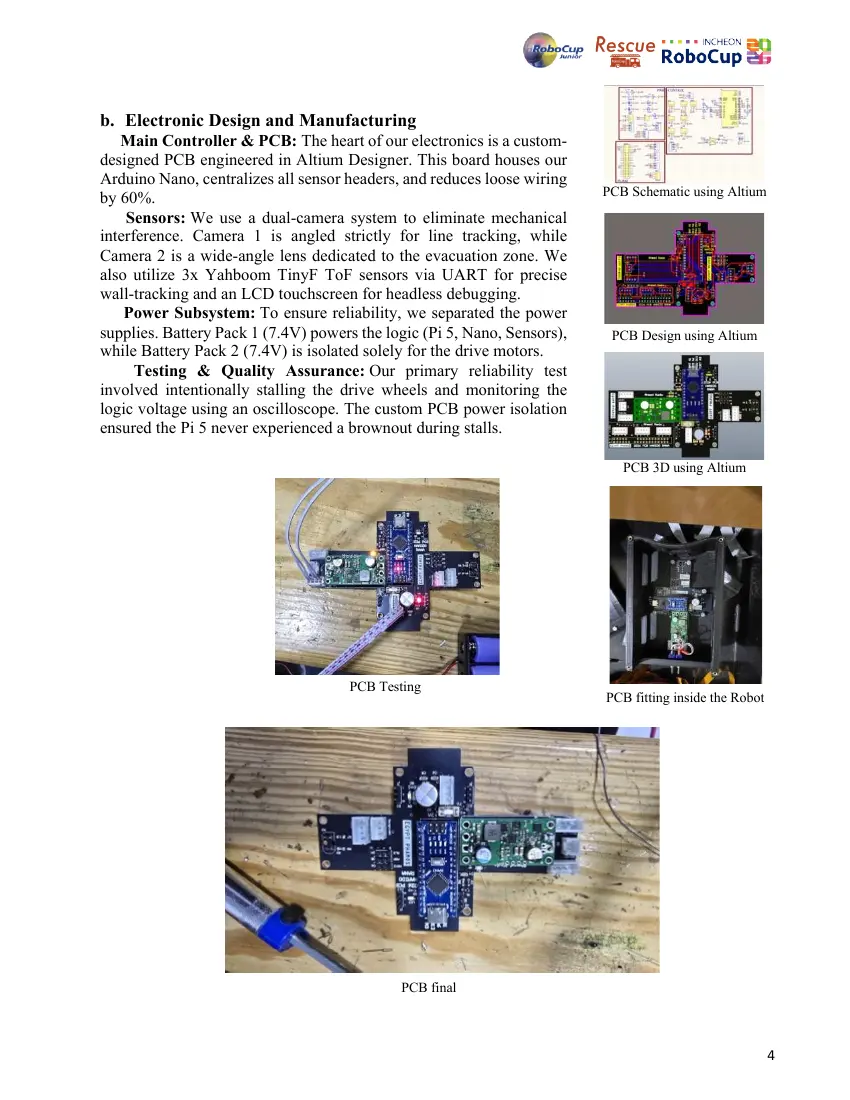
   Main Controller & PCB: The heart of our electronics is a custom-
designed PCB engineered in Altium Designer. This board houses our
Arduino Nano, centralizes all sensor headers, and reduces loose wiring
                                                                          PCB Schematic using Altium
by 60%.
    Sensors: We use a dual-camera system to eliminate mechanical
interference. Camera 1 is angled strictly for line tracking, while
Camera 2 is a wide-angle lens dedicated to the evacuation zone. We
also utilize 3x Yahboom TinyF ToF sensors via UART for precise
wall-tracking and an LCD touchscreen for headless debugging.
    Power Subsystem: To ensure reliability, we separated the power
supplies. Battery Pack 1 (7.4V) powers the logic (Pi 5, Nano, Sensors),    PCB Design using Altium
while Battery Pack 2 (7.4V) is isolated solely for the drive motors.
      Testing & Quality Assurance: Our primary reliability test
involved intentionally stalling the drive wheels and monitoring the
logic voltage using an oscilloscope. The custom PCB power isolation
ensured the Pi 5 never experienced a brownout during stalls.

                                                                             PCB 3D using Altium

                                     PCB Testing
                                                                          PCB fitting inside the Robot

                                             PCB final

                                                                                                         4
4. Software
  a. General software architecture

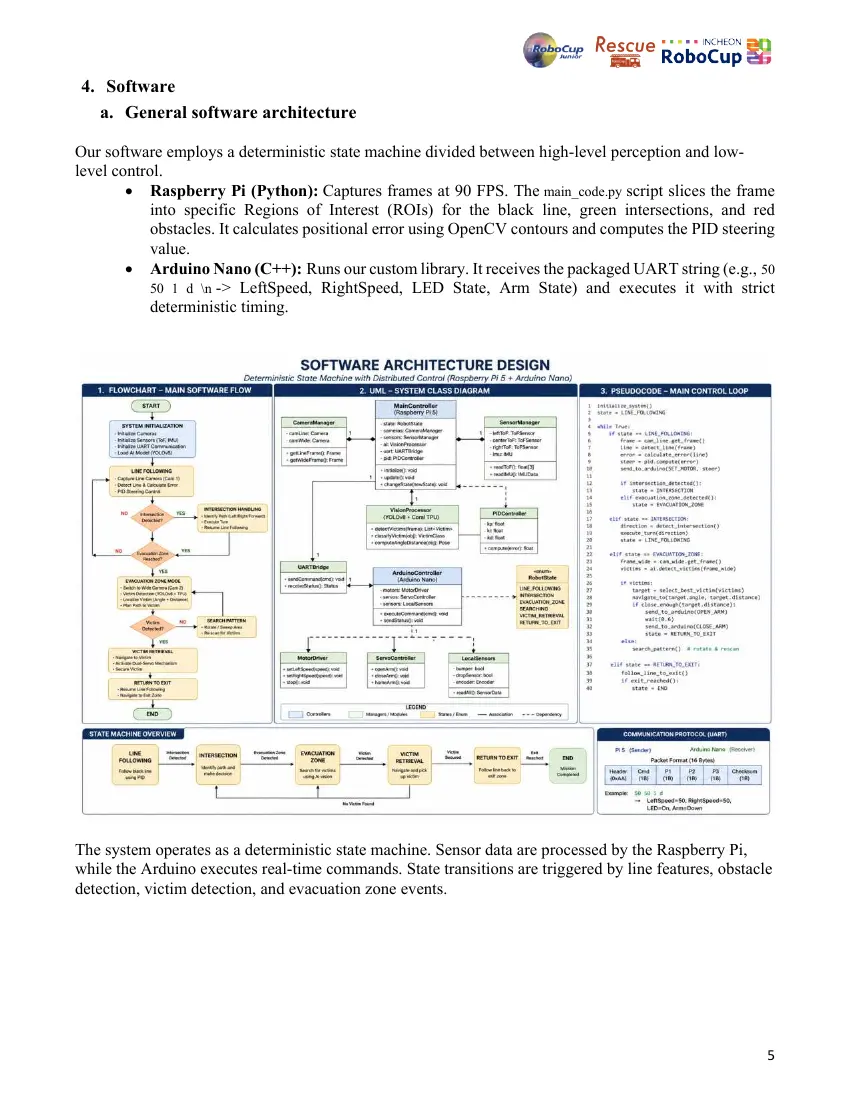
Our software employs a deterministic state machine divided between high-level perception and low-
level control.
        ¥ Raspberry Pi (Python): Captures frames at 90 FPS. The main_code.py script slices the frame
            into specific Regions of Interest (ROIs) for the black line, green intersections, and red
            obstacles. It calculates positional error using OpenCV contours and computes the PID steering
            value.
        ¥ Arduino Nano (C++): Runs our custom library. It receives the packaged UART string (e.g., 50
            50 1 d \n -> LeftSpeed, RightSpeed, LED State, Arm State) and executes it with strict
            deterministic timing.

The system operates as a deterministic state machine. Sensor data are processed by the Raspberry Pi,
while the Arduino executes real-time commands. State transitions are triggered by line features, obstacle
detection, victim detection, and evacuation zone events.

                                                                                                        5
b. Innovative solutions
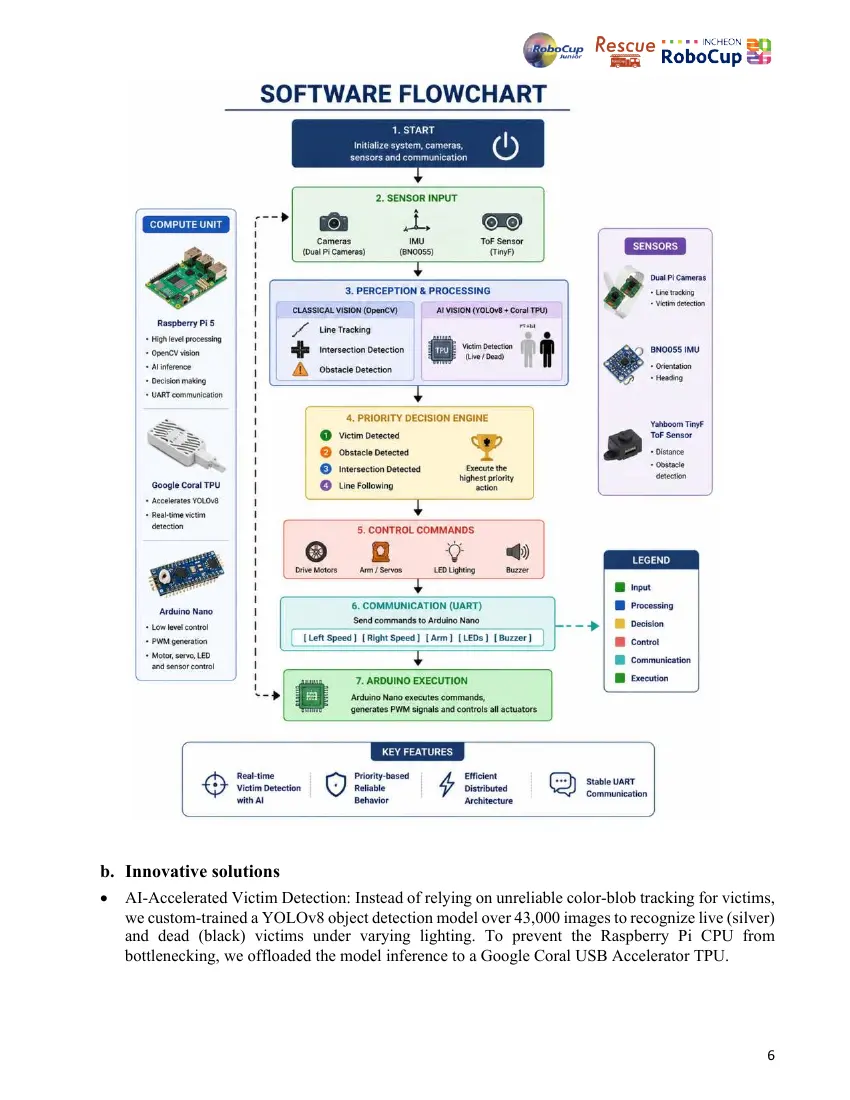
¥   AI-Accelerated Victim Detection: Instead of relying on unreliable color-blob tracking for victims,
    we custom-trained a YOLOv8 object detection model over 43,000 images to recognize live (silver)
    and dead (black) victims under varying lighting. To prevent the Raspberry Pi CPU from
    bottlenecking, we offloaded the model inference to a Google Coral USB Accelerator TPU.

                                                                                                    6
5. Performance evaluation
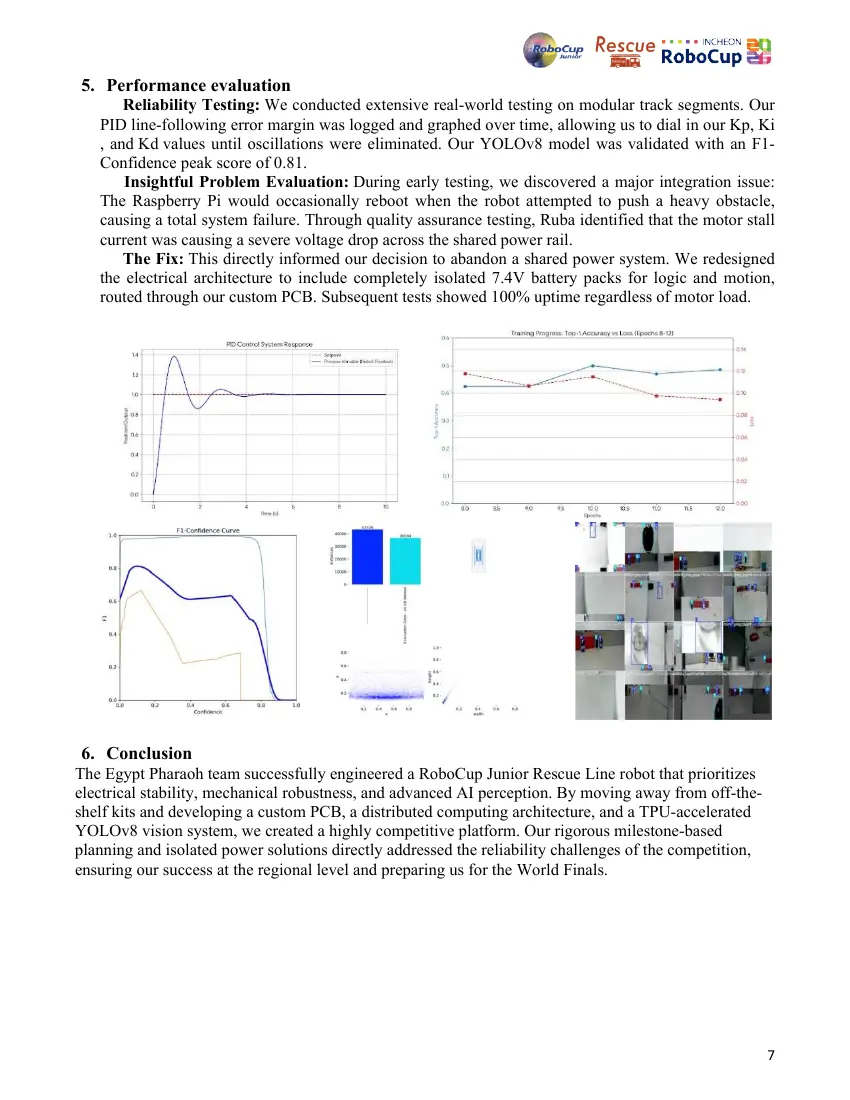
       Reliability Testing: We conducted extensive real-world testing on modular track segments. Our
   PID line-following error margin was logged and graphed over time, allowing us to dial in our Kp, Ki
   , and Kd values until oscillations were eliminated. Our YOLOv8 model was validated with an F1-
   Confidence peak score of 0.81.
       Insightful Problem Evaluation: During early testing, we discovered a major integration issue:
   The Raspberry Pi would occasionally reboot when the robot attempted to push a heavy obstacle,
   causing a total system failure. Through quality assurance testing, Ruba identified that the motor stall
   current was causing a severe voltage drop across the shared power rail.
       The Fix: This directly informed our decision to abandon a shared power system. We redesigned
   the electrical architecture to include completely isolated 7.4V battery packs for logic and motion,
   routed through our custom PCB. Subsequent tests showed 100% uptime regardless of motor load.

6. Conclusion
The Egypt Pharaoh team successfully engineered a RoboCup Junior Rescue Line robot that prioritizes
electrical stability, mechanical robustness, and advanced AI perception. By moving away from off-the-
shelf kits and developing a custom PCB, a distributed computing architecture, and a TPU-accelerated
YOLOv8 vision system, we created a highly competitive platform. Our rigorous milestone-based
planning and isolated power solutions directly addressed the reliability challenges of the competition,
ensuring our success at the regional level and preparing us for the World Finals.

                                                                                                          7
7 pages, rendered as images so they load quickly. The text above is the document's own, extracted from the PDF.
Source code
The team's own source code, 13 KB. It is a download rather than part of this page, because a zip is something you open on your computer. It comes from GitHub, which some school networks block.