
Mittens
Document register
- Poster1 pagePublished
- Presentation videoYouTubePublished
- Bill of materials2 pagesPublished
- Team description paperNot shared
- Engineering journalNot shared
- Source code2 KB · GitHubPublished
Sharing each document is the team's decision. “Not shared” means this team chose not to publish it, or did not submit one — not that it is missing from the archive.
In their words
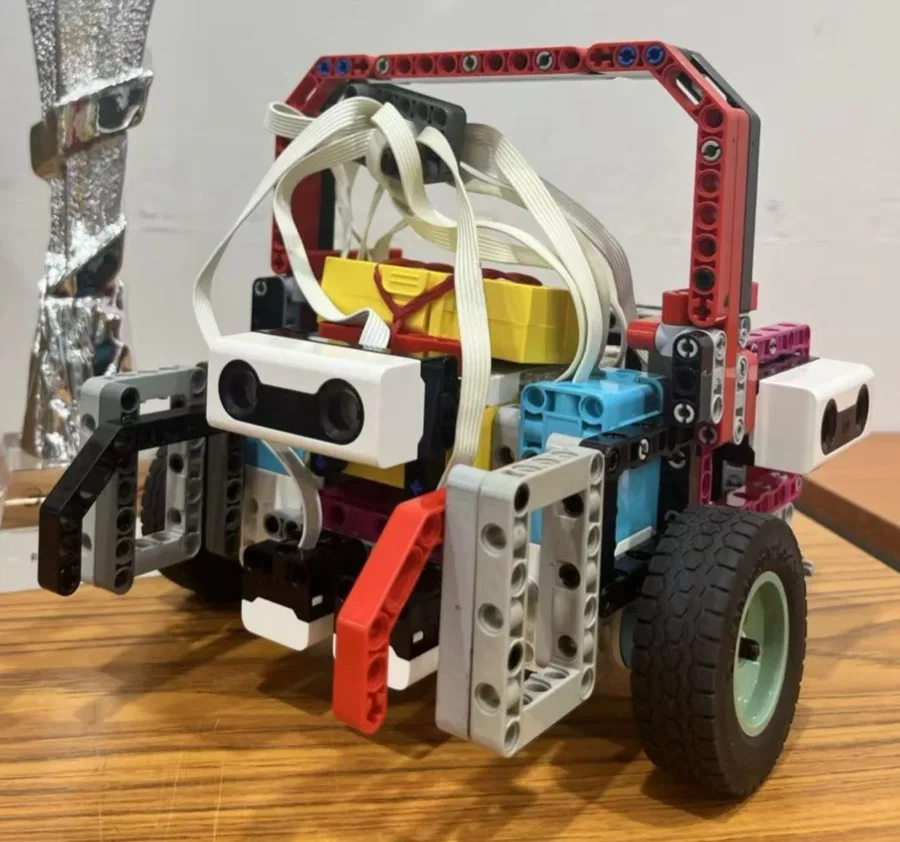
Our robot is a compact, highly adaptable rescue platform built on a robust LEGO SPIKE Prime chassis, designed to handle the full range of challenges present in the RoboCup Junior Rescue competition. Its most distinctive feature is its modular, reconfigurable architecture — components can be added, removed, or repositioned on-the-fly to dynamically shift the centre of gravity depending on track conditions. The wide wheel stance and front stabiliser arms allow the robot to traverse speed bumps and descend ramps smoothly without tipping, while high-grip drive wheels and slim blade-profiled rear elements maximise traction and enable tight, precise turns. On the software side, the robot runs a PID control algorithm for accurate and consistent line following, paired with a distance sensor for reliable obstacle detection and avoidance. The codebase has been extensively tested and proven to perform stably and consistently across the vast majority of runs attempted, reflecting the team's rigorous approach to software reliability. Together, these hardware and software design choices produce a robot that balances stability, manoeuvrability, and adaptability.
Poster
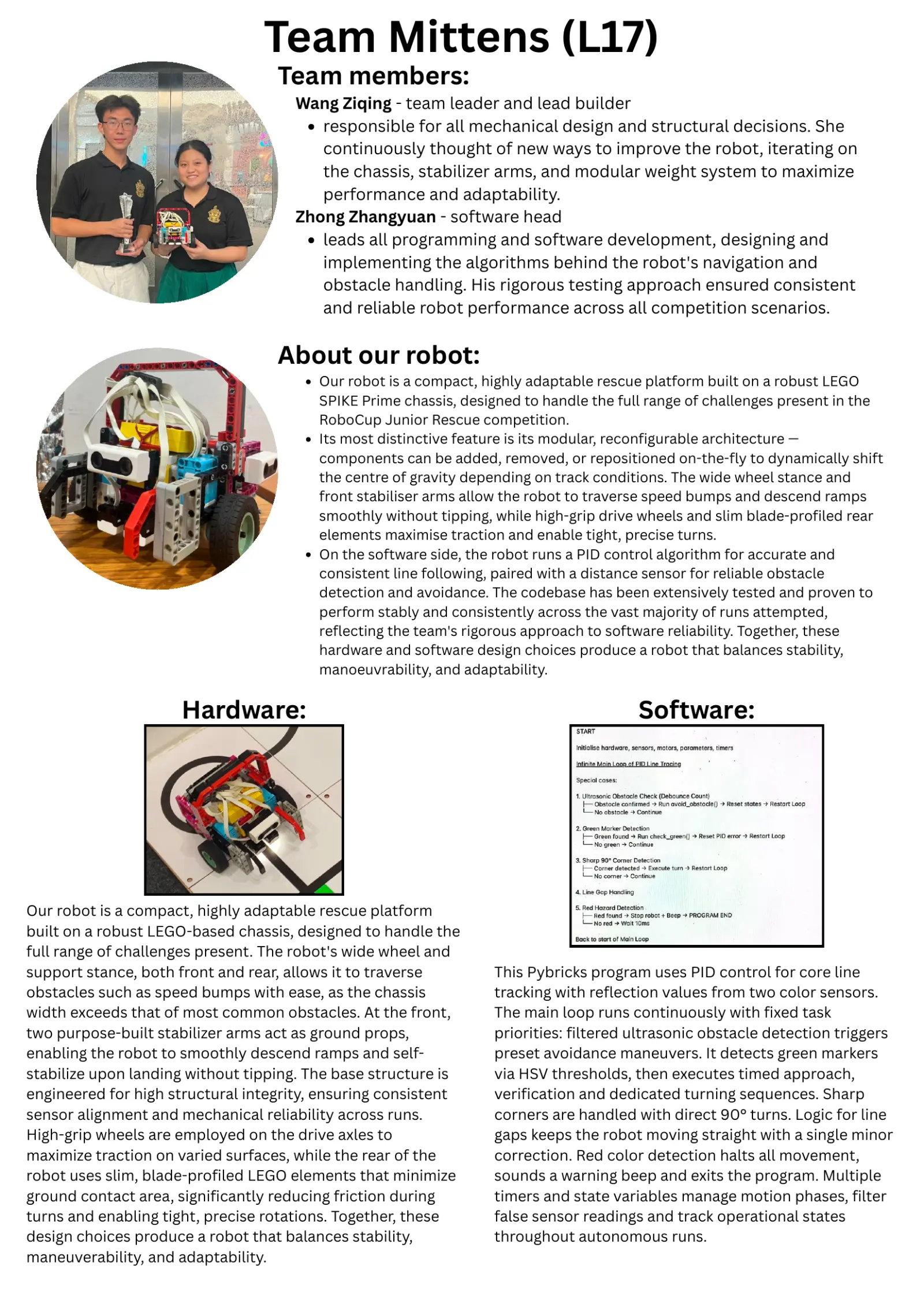
Read the text of this document — 515 words
Team Mittens (L17)
                                   Team members:
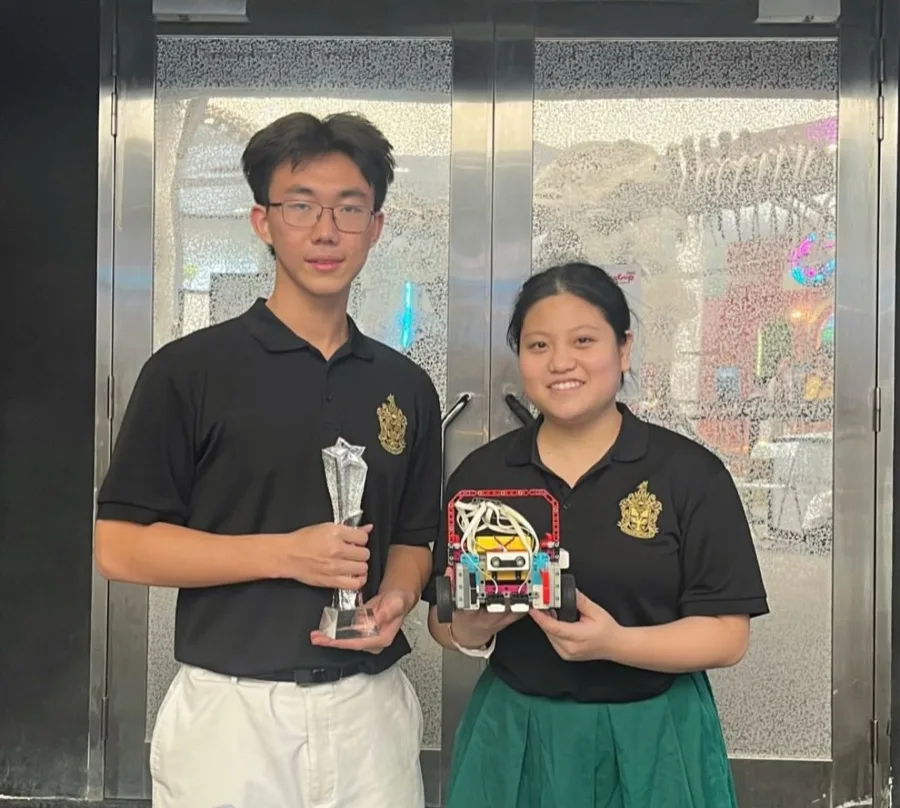
                                     Wang Ziqing - team leader and lead builder
                                        responsible for all mechanical design and structural decisions. She
                                        continuously thought of new ways to improve the robot, iterating on
                                        the chassis, stabilizer arms, and modular weight system to maximize
                                        performance and adaptability.
                                     Zhong Zhangyuan - software head
                                        leads all programming and software development, designing and
                                        implementing the algorithms behind the robot's navigation and
                                        obstacle handling. His rigorous testing approach ensured consistent
                                        and reliable robot performance across all competition scenarios.

                                   About our robot:
                                         Our robot is a compact, highly adaptable rescue platform built on a robust LEGO
                                         SPIKE Prime chassis, designed to handle the full range of challenges present in the
                                         RoboCup Junior Rescue competition.
                                         Its most distinctive feature is its modular, reconfigurable architecture —
                                         components can be added, removed, or repositioned on-the-fly to dynamically shift
                                         the centre of gravity depending on track conditions. The wide wheel stance and
                                         front stabiliser arms allow the robot to traverse speed bumps and descend ramps
                                         smoothly without tipping, while high-grip drive wheels and slim blade-profiled rear
                                         elements maximise traction and enable tight, precise turns.
                                         On the software side, the robot runs a PID control algorithm for accurate and
                                         consistent line following, paired with a distance sensor for reliable obstacle
                                         detection and avoidance. The codebase has been extensively tested and proven to
                                         perform stably and consistently across the vast majority of runs attempted,
                                         reflecting the team's rigorous approach to software reliability. Together, these
                                         hardware and software design choices produce a robot that balances stability,
                                         manoeuvrability, and adaptability.

                     Hardware:                                                          Software:

Our robot is a compact, highly adaptable rescue platform
built on a robust LEGO-based chassis, designed to handle the
full range of challenges present. The robot's wide wheel and
support stance, both front and rear, allows it to traverse        This Pybricks program uses PID control for core line
obstacles such as speed bumps with ease, as the chassis           tracking with reflection values from two color sensors.
width exceeds that of most common obstacles. At the front,        The main loop runs continuously with fixed task
two purpose-built stabilizer arms act as ground props,            priorities: filtered ultrasonic obstacle detection triggers
enabling the robot to smoothly descend ramps and self-            preset avoidance maneuvers. It detects green markers
stabilize upon landing without tipping. The base structure is     via HSV thresholds, then executes timed approach,
engineered for high structural integrity, ensuring consistent     verification and dedicated turning sequences. Sharp
sensor alignment and mechanical reliability across runs.          corners are handled with direct 90° turns. Logic for line
High-grip wheels are employed on the drive axles to               gaps keeps the robot moving straight with a single minor
maximize traction on varied surfaces, while the rear of the       correction. Red color detection halts all movement,
robot uses slim, blade-profiled LEGO elements that minimize       sounds a warning beep and exits the program. Multiple
ground contact area, significantly reducing friction during       timers and state variables manage motion phases, filter
turns and enabling tight, precise rotations. Together, these      false sensor readings and track operational states
design choices produce a robot that balances stability,           throughout autonomous runs.
maneuverability, and adaptability.
1 page, rendered as images so they load quickly. The text above is the document's own, extracted from the PDF.
Presentation video
Hosted on YouTube. The player loads only when you press play.
Bill of materials
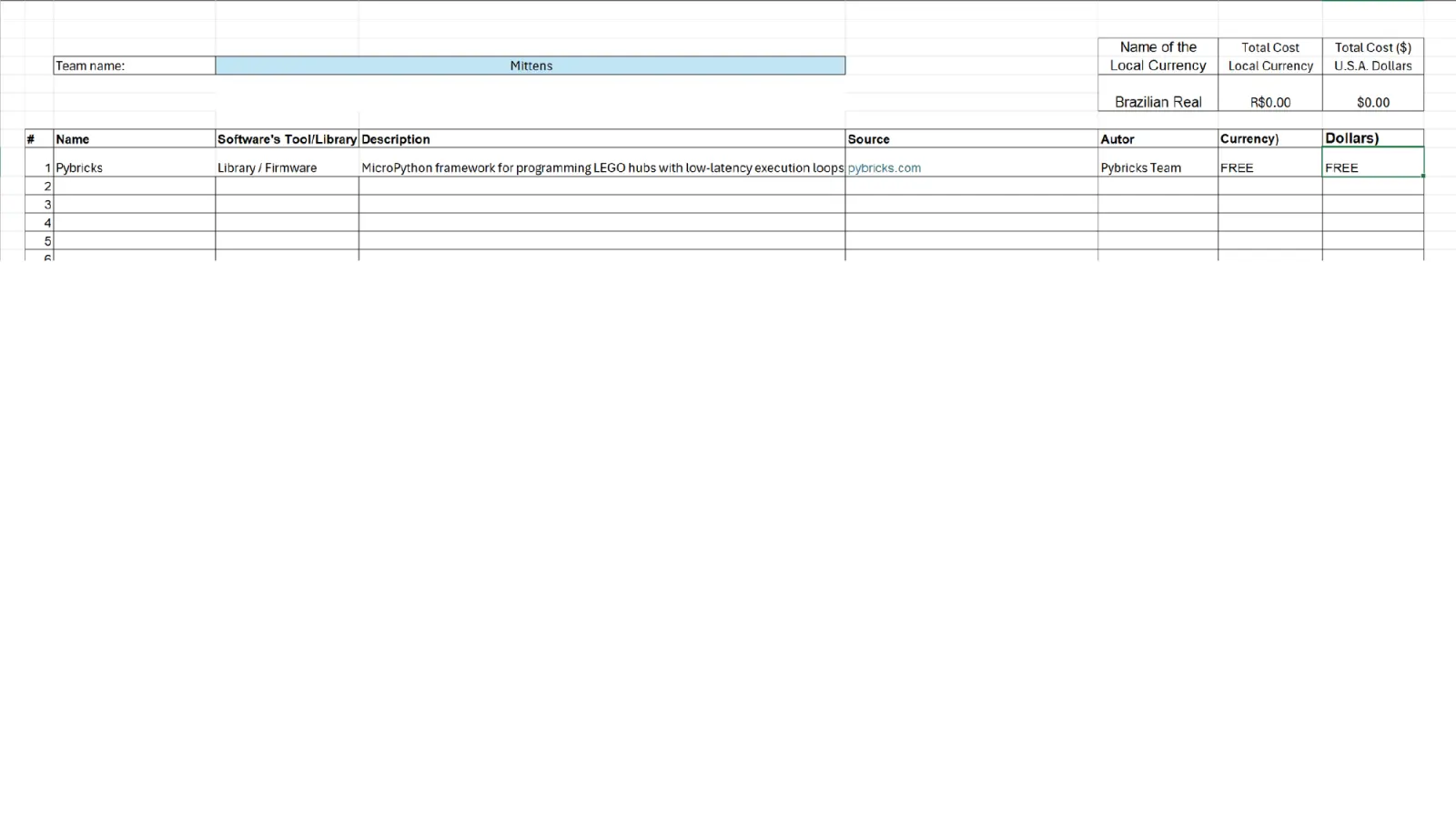
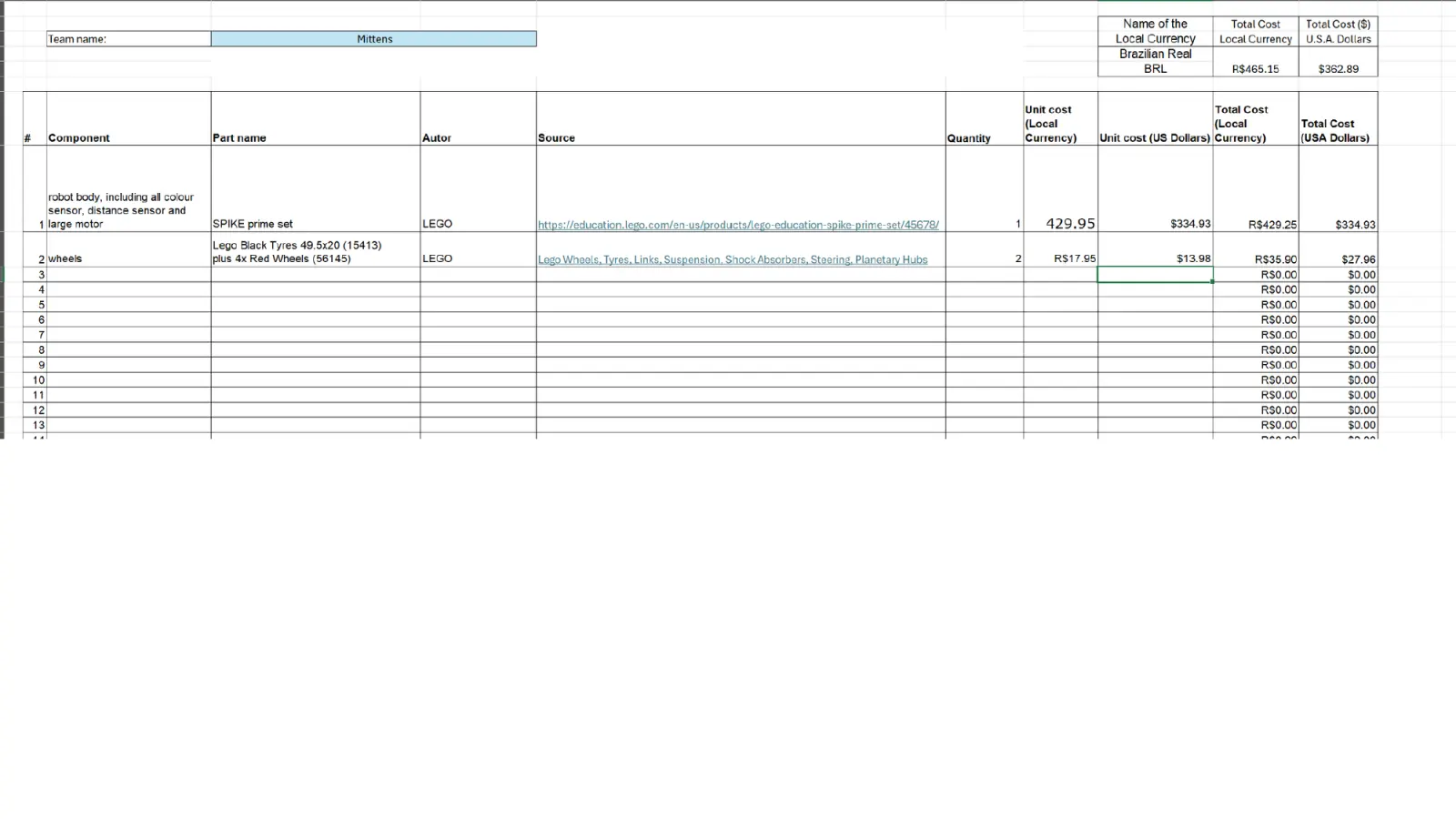
2 pages, rendered as images so they load quickly. This document has no text layer — the words in it are part of the image.
Source code
The team's own source code, 2 KB. It is a download rather than part of this page, because a zip is something you open on your computer. It comes from GitHub, which some school networks block.