Inžinieri
Document register
- Poster1 pagePublished
- Presentation videoYouTubePublished
- Bill of materials31 KBPublished
- Team description paperNot shared
- Engineering journalNot shared
- Source code17 KB · GitHubPublished
Sharing each document is the team's decision. “Not shared” means this team chose not to publish it, or did not submit one — not that it is missing from the archive.
In their words
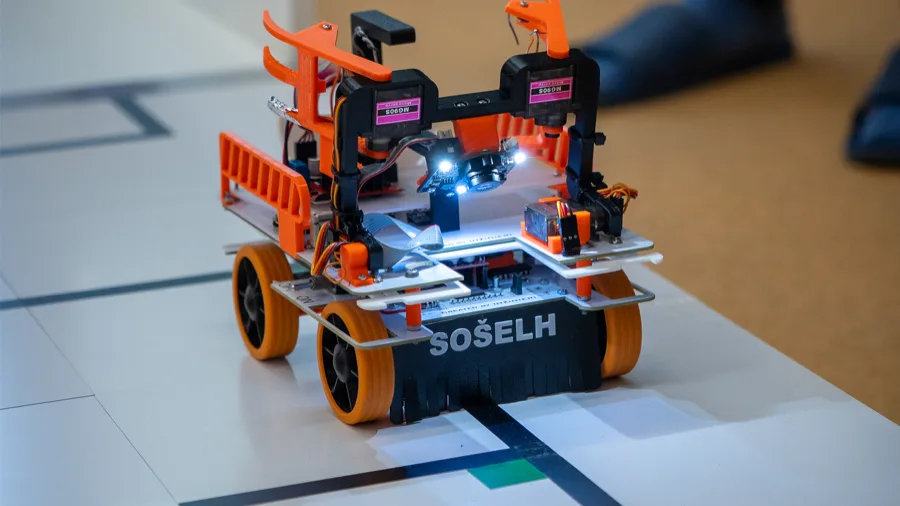
The robot features a swing axle that helps maintain equal weight distribution across all four wheels. We also utilize a gathering mechanism driven by a servo motor. The gathering mechanism includes additional servos that control mechanical arms used to collect victims. After collection, the mechanism transfers the victims to a dedicated storage area located at the rear of the robot.
Our robot consists of two stacked levels, both of which serve as printed circuit boards. The first level contains all the electronics required for the line-following section of the program, while the second level houses the brain of the robot—a Raspberry Pi Pico 2—along with a Pixy2 camera and the complete victim collection system.
The entire robot was designed in Fusion 360, a process that took approximately six months. The design is based on a previous version that we used at our most recent RoboCup competition. We focused on optimizing the model for efficient 3D printing and precise component placement.
What truly distinguishes our robot from many competitors is its custom-designed printed circuit board.
Poster
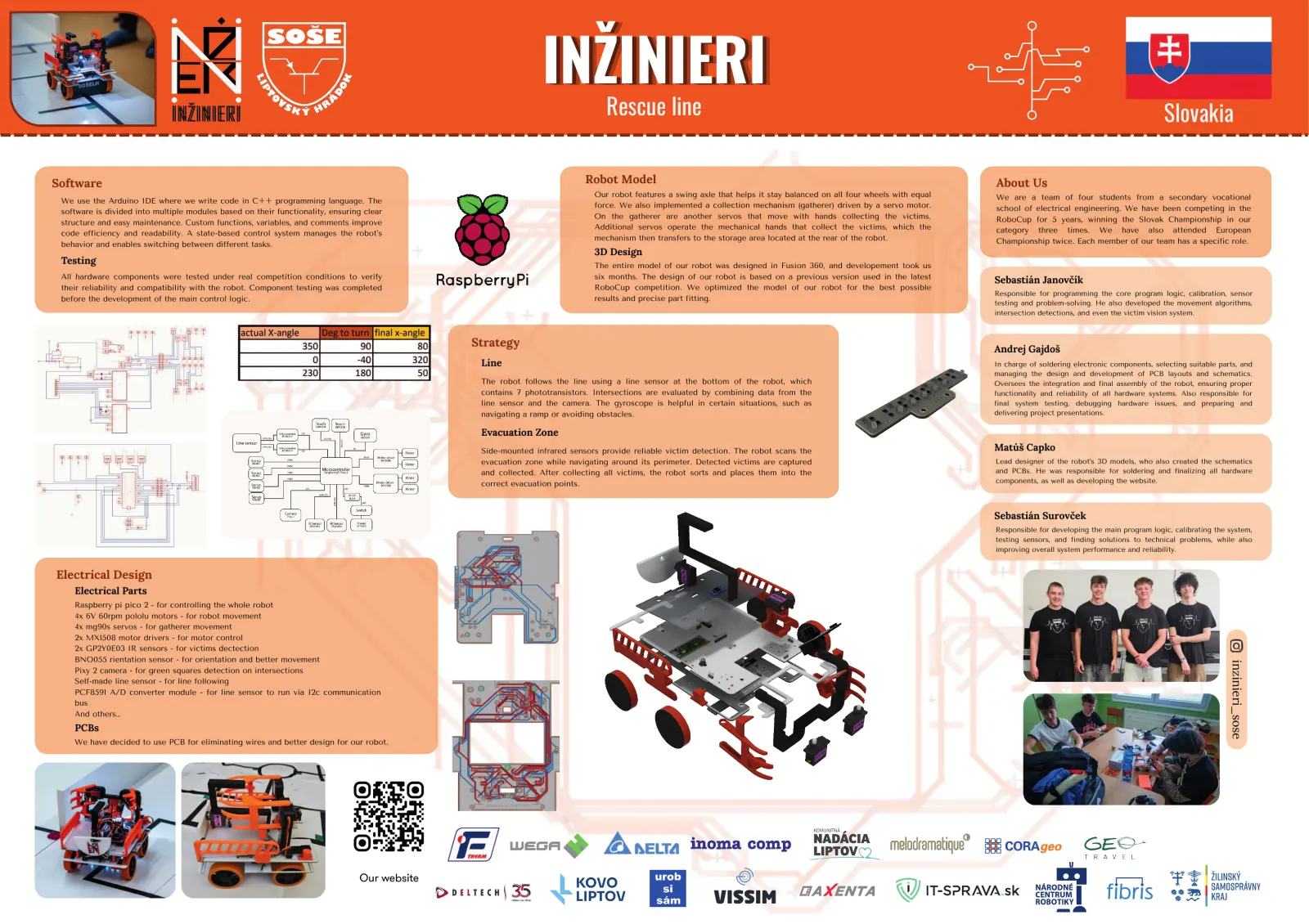
Read the text of this document — 604 words
INŽINIERI
INŽINIERI
Rescue line Slovakia
Software Robot Model About Us
Our robot features a swing axle that helps it stay balanced on all four wheels with equal We are a team of four students from a secondary vocational
We use the Arduino IDE where we write code in C++ programming language. The
force. We also implemented a collection mechanism (gatherer) driven by a servo motor. school of electrical engineering. We have been competing in the
software is divided into multiple modules based on their functionality, ensuring clear
On the gatherer are another servos that move with hands collecting the victims. RoboCup for 5 years, winning the Slovak Championship in our
structure and easy maintenance. Custom functions, variables, and comments improve
Additional servos operate the mechanical hands that collect the victims, which the category three times. We have also attended European
code efficiency and readability. A state-based control system manages the robot’s
mechanism then transfers to the storage area located at the rear of the robot. Championship twice. Each member of our team has a specific role.
behavior and enables switching between different tasks.
3D Design
Testing The entire model of our robot was designed in Fusion 360, and developement took us
All hardware components were tested under real competition conditions to verify six months. The design of our robot is based on a previous version used in the latest
Sebastián Janovčík
their reliability and compatibility with the robot. Component testing was completed RoboCup competition. We optimized the model of our robot for the best possible
Responsible for programming the core program logic, calibration, sensor
before the development of the main control logic. results and precise part fitting.
testing and problem-solving. He also developed the movement algorithms,
intersection detections, and even the victim vision system.
Strategy
Andrej Gajdoš
Line In charge of soldering electronic components, selecting suitable parts, and
managing the design and development of PCB layouts and schematics.
The robot follows the line using a line sensor at the bottom of the robot, which Oversees the integration and final assembly of the robot, ensuring proper
contains 7 phototransistors. Intersections are evaluated by combining data from the functionality and reliability of all hardware systems. Also responsible for
line sensor and the camera. The gyroscope is helpful in certain situations, such as final system testing, debugging hardware issues, and preparing and
navigating a ramp or avoiding obstacles. delivering project presentations.
Evacuation Zone
Side-mounted infrared sensors provide reliable victim detection. The robot scans the Matúš Capko
evacuation zone while navigating around its perimeter. Detected victims are captured Lead designer of the robot’s 3D models, who also created the schematics
and collected. After collecting all victims, the robot sorts and places them into the and PCBs. He was responsible for soldering and finalizing all hardware
correct evacuation points. components, as well as developing the website.
Sebastián Surovček
Responsible for developing the main program logic, calibrating the system,
testing sensors, and finding solutions to technical problems, while also
improving overall system performance and reliability.
Electrical Design
Electrical Parts
Raspberry pi pico 2 - for controlling the whole robot
4x 6V 60rpm pololu motors - for robot movement
4x mg90s servos - for gatherer movement
2x MX1508 motor drivers - for motor control
2x GP2Y0E03 IR sensors - for victims dectection
BNO055 rientation sensor - for orientation and better movement
inzinieri_sose
Pixy 2 camera - for green squares detection on intersections
Self-made line sensor - for line following
PCF8591 A/D converter module - for line sensor to run via I2c communication
bus
And others…
PCBs
We have decided to use PCB for eliminating wires and better design for our robot.
1 page, rendered as images so they load quickly. The text above is the document's own, extracted from the PDF.
Presentation video
Hosted on YouTube. The player loads only when you press play.
Bill of materials
Shown as the original PDF, because this one is smaller that way and its text stays selectable and searchable.
Source code
The team's own source code, 17 KB. It is a download rather than part of this page, because a zip is something you open on your computer. It comes from GitHub, which some school networks block.