
IITA Rescuebot
Document register
- Poster1 pagePublished
- Presentation videoYouTubePublished
- Bill of materials3 pagesPublished
- Team description paperNot shared
- Engineering journalNot shared
- Source code23.2 MB · GitHubPublished
Sharing each document is the team's decision. “Not shared” means this team chose not to publish it, or did not submit one — not that it is missing from the archive.
In their words
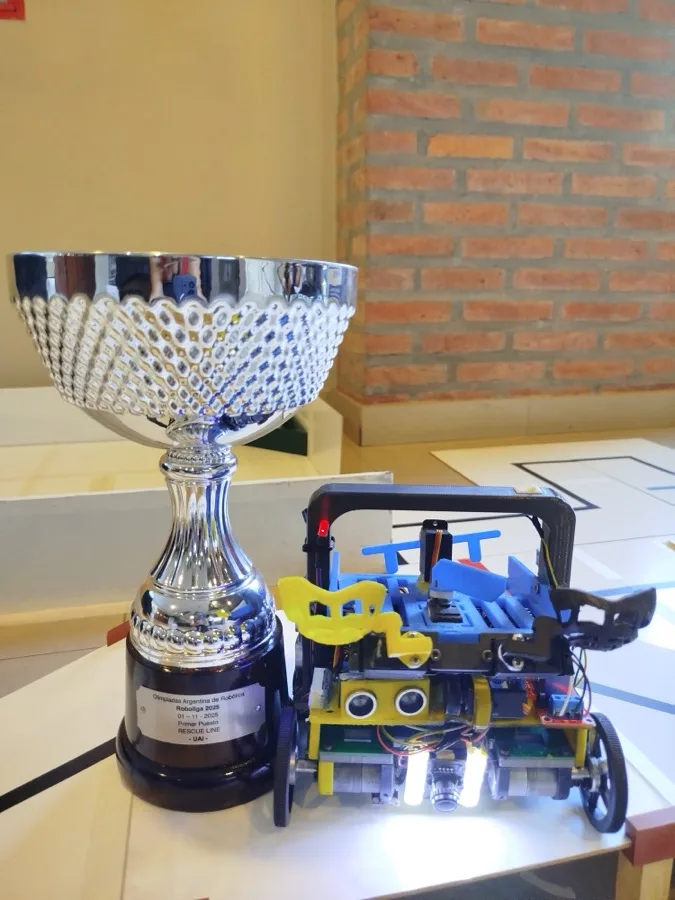
RescueBot IITA is a fully autonomous RoboCupJunior Rescue Line robot built to complete the whole mission: line following, green-marker decisions, obstacle handling, rescue-zone entry, victim collection, sorting, evacuation-zone deposit and exit. It uses a dual-controller architecture: a Raspberry Pi 4B runs camera processing, high-level state decisions and AI object detection, while a Teensy 4.1 handles deterministic motor control, sensors, servos, serial parsing and safety routines. The robot combines a custom Fusion 360 3D-printed chassis, four encoder motors, a five-servo rescue mechanism, a team-designed PCB, separated power rails, a wide-angle camera, ToF and ultrasonic sensors, a BNO055 IMU and APDS9960 floor sensing. Its competitive advantage is integration: classical vision gives fast, deterministic line and marker decisions; an exported TFLite detector handles the rescue zone; and the Teensy keeps low-level movement and fail-safe behavior alive even while the Pi is under heavy vision load. For 2026 the team prioritized robustness, serviceability, documented testing and evidence-based iteration, validated against the 2026 rules (including the new LED-wall) and our own measured test log.
Poster
Read the text of this document — 2095 words
IITA
IITA
TEAM SONG Rescue-BOT
Rescue-BOT
Teensy 4.1
SOFTWARE
The motor control system uses encoder
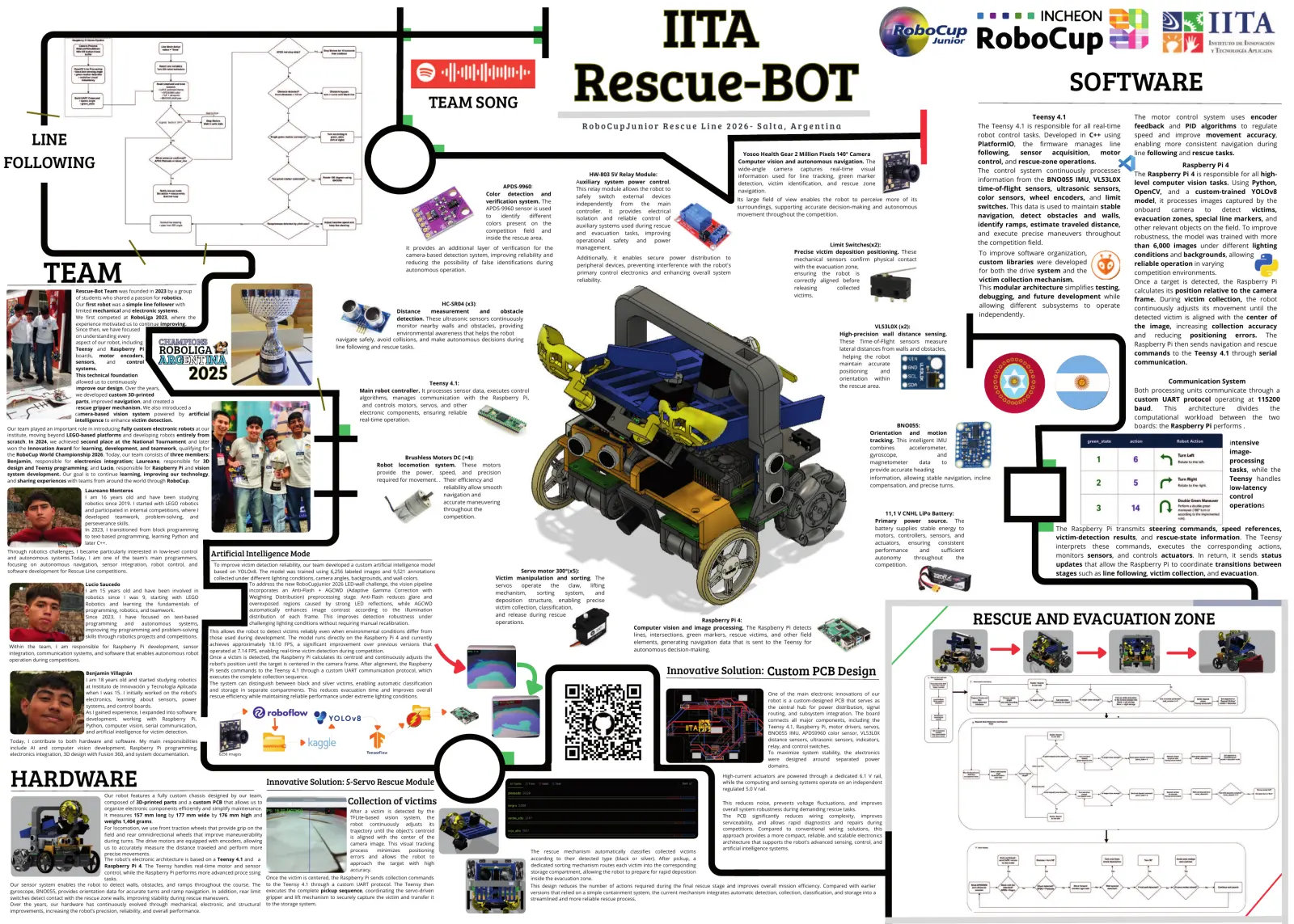
R ob o Cup Ju n i o r R e s cu e L i n e 2 0 26 - S a lt a , A r g e nt i n a The Teensy 4.1 is responsible for all real-time feedback and PID algorithms to regulate
LINE robot control tasks. Developed in C++ using
PlatformIO, the firmware manages line
speed and improve movement accuracy,
enabling more consistent navigation during
following, sensor acquisition, motor line following and rescue tasks.
FOLLOWING
Yosoo Health Gear 2 Million Pixels 140° Camera
Computer vision and autonomous navigation. The control, and rescue-zone operations. Raspberry Pi 4
wide-angle camera captures real-time visual The control system continuously processes
HW-803 5V Relay Module: information used for line tracking, green marker The Raspberry Pi 4 is responsible for all high-
Auxiliary system power control. information from the BNO055 IMU, VL53L0X level computer vision tasks. Using Python,
detection, victim identification, and rescue zone
APDS-9960: This relay module allows the robot to time-of-flight sensors, ultrasonic sensors,
navigation. OpenCV, and a custom-trained YOLOv8
Color detection and safely switch external devices
Its large field of view enables the robot to perceive more of its color sensors, wheel encoders, and limit model, it processes images captured by the
verification system. The independently from the main
APDS-9960 sensor is used surroundings, supporting accurate decision-making and autonomous switches. This data is used to maintain stable onboard camera to detect victims,
controller. It provides electrical
to identify different movement throughout the competition. navigation, detect obstacles and walls,
isolation and reliable control of evacuation zones, special line markers, and
colors present on the auxiliary systems used during rescue identify ramps, estimate traveled distance,
competition field and other relevant objects on the field. To improve
and evacuation tasks, improving and execute precise maneuvers throughout robustness, the model was trained with more
inside the rescue area. operational safety and power
Limit Switches(x2): the competition field. than 6,000 images under different lighting
It provides an additional layer of verification for the management.
Precise victim deposition positioning. These To improve software organization, conditions and backgrounds, allowing
TEAM
camera-based detection system, improving reliability and
Additionally, it enables secure power distribution to mechanical sensors confirm physical contact
reducing the possibility of false identifications during
peripheral devices, preventing interference with the robot's
custom libraries were developed reliable operation in varying
with the evacuation zone,
autonomous operation. for both the drive system and the
primary control electronics and enhancing overall system ensuring the robot is competition environments.
reliability. correctly aligned before victim collection mechanism. Once a target is detected, the Raspberry Pi
releasing collected This modular architecture simplifies testing, calculates its position relative to the camera
Rescue-Bot Team was founded in 2023 by a group
of students who shared a passion for robotics.
victims. debugging, and future development while frame. During victim collection, the robot
Our first robot was a simple line follower with HC-SR04 (x3): allowing different subsystems to operate
limited mechanical and electronic systems. Distance measurement and obstacle continuously adjusts its movement until the
We first competed at RoboLiga 2023, where the
independently. detected victim is aligned with the center of
detection. These ultrasonic sensors continuously
experience motivated us to continue improving.
Since then, we have focused
monitor nearby walls and obstacles, providing VL53L0X (x2): the image, increasing collection accuracy
on understanding every
environmental awareness that helps the robot High-precision wall distance sensing. and reducing positioning errors. The
aspect of our robot, including CHAMPIONS navigate safely, avoid collisions, and make autonomous decisions during These Time-of-Flight sensors measure
Raspberry Pi then sends navigation and rescue
Teensy and Raspberry Pi
ROBOLIGA line following and rescue tasks. lateral distances from walls and obstacles,
commands to the Teensy 4.1 through serial
ARGENT INA
boards, motor encoders, helping the robot
sensors, and control communication.
2025
maintain accurate
systems.
positioning and
This technical foundation
orientation within
allowed us to continuously Teensy 4.1: Communication System
improve our design. Over the years, the rescue area.
Main robot controller. It processes sensor data, executes control Both processing units communicate through a
we developed custom 3D-printed
algorithms, manages communication with the Raspberry Pi, custom UART protocol operating at 115200
parts, improved navigation, and created a
. and controls motors, servos, and other
rescue gripper mechanism. We also introduced a baud. This architecture divides the
camera-based vision system powered by artificial electronic components, ensuring reliable
intelligence to enhance victim detection. real-time operation. computational workload between the two
Our team played an important role in introducing fully custom electronic robots at our
BNO055: boards: the Raspberry Pi performs .
institute, moving beyond LEGO-based platforms and developing robots entirely from Orientation and motion
tracking. This intelligent IMU
scratch. In 2024, we achieved second place at the National Tournament and later intensive
won the Innovation Award for learning, development, and teamwork, qualifying for combines accelerometer,
the RoboCup World Championship 2026. Today, our team consists of three members: gyroscope, and
image-
Brushless Motors DC (×4):
Benjamin, responsible for electronics integration; Laureano, responsible for 3D magnetometer data to processing
design and Teensy programming; and Lucio, responsible for Raspberry Pi and vision
Robot locomotion system. These motors
provide the power, speed, and precision
provide accurate heading tasks, while the
system development. Our goal is to continue learning, improving our technology,
and sharing experiences with teams from around the world through RoboCup. required for movement. . Their efficiency and information, allowing stable navigation, incline Teensy handles
reliability allow smooth compensation, and precise turns. low-latency
Laureano Monteros
I am 16 years old and have been studying navigation and control
robotics since 2019. I started with LEGO robotics accurate maneuvering
operations.
and participated in internal competitions, where I throughout the
11,1 V CNHL LiPo Battery:
developed teamwork, problem-solving, and competition.
perseverance skills. Primary power source. The
In 2023, I transitioned from block programming battery supplies stable energy to The Raspberry Pi transmits steering commands, speed references,
to text-based programming, learning Python and motors, controllers, sensors, and victim-detection results, and rescue-state information. The Teensy
later C++. actuators, ensuring consistent
interprets these commands, executes the corresponding actions,
performance and sufficient
Through robotics challenges, I became particularly interested in low-level control
and autonomous systems.Today, I am one of the team's main programmers,
Artificial Intelligence Mode autonomy throughout the monitors sensors, and controls actuators. In return, it sends status
focusing on autonomous navigation, sensor integration, robot control, and To improve victim detection reliability, our team developed a custom artificial intelligence model competition. updates that allow the Raspberry Pi to coordinate transitions between
software development for Rescue Line competitions. based on YOLOv8. The model was trained using 6,256 labeled images and 9,521 annotations Servo motor 300°(x5):
stages such as line following, victim collection, and evacuation.
collected under different lighting conditions, camera angles, backgrounds, and wall colors. Victim manipulation and sorting. The
Lucio Saucedo To address the new RoboCupJunior 2026 LED-wall challenge, the vision pipeline servos operate the claw, lifting
I am 15 years old and have been involved in incorporates an Anti-Flash + AGCWD (Adaptive Gamma Correction with
mechanism, sorting system, and
robotics since I was 9, starting with LEGO Weighting Distribution) preprocessing stage. Anti-Flash reduces glare and
deposition structure, enabling precise
Robotics and learning the fundamentals of overexposed regions caused by strong LED reflections, while AGCWD
victim collection, classification,
RESCUE AND EVACUATION ZONE
programming, robotics, and teamwork. automatically enhances image contrast according to the illumination
Since 2023, I have focused on text-based distribution of each frame. This improves detection robustness under and release during rescue
challenging lighting conditions without requiring manual recalibration. operations. Raspberry Pi 4:
programming and autonomous systems,
improving my programming and problem-solving Computer vision and image processing. The Raspberry Pi detects
This allows the robot to detect victims reliably even when environmental conditions differ from
skills through robotics projects and competitions. those used during development. The model runs directly on the Raspberry Pi 4 and currently
lines, intersections, green markers, rescue victims, and other field
achieves approximately 18.10 FPS, a significant improvement over previous versions that elements, generating navigation data that is sent to the Teensy for
Within the team, I am responsible for Raspberry Pi development, sensor
operated at 7.14 FPS, enabling real-time victim detection during competition. autonomous decision-making.
integration, communication systems, and software that enables autonomous robot
Once a victim is detected, the Raspberry Pi calculates its centroid and continuously adjusts the
operation during competitions.
robot's position until the target is centered in the camera frame. After alignment, the Raspberry
Benjamin Villagrán
Pi sends commands to the Teensy 4.1 through a custom UART communication protocol, which
executes the complete collection sequence.
Innovative Solution: Custom PCB Design
I am 18 years old and started studying robotics
The system can distinguish between black and silver victims, enabling automatic classification
at Instituto de Innovación y Tecnología Aplicada
and storage in separate compartments. This reduces evacuation time and improves overall
when I was 15. I initially worked on the robot’s One of the main electronic innovations of our
rescue efficiency while maintaining reliable performance under extreme lighting conditions.
electronics, learning about sensors, power robot is a custom-designed PCB that serves as
systems, and control boards. the central hub for power distribution, signal
As I gained experience, I expanded into software routing, and subsystem integration. The board
development, working with Raspberry Pi, connects all major components, including the
Python, computer vision, serial communication, Teensy 4.1, Raspberry Pi, motor drivers, servos,
and artificial intelligence for victim detection. BNO055 IMU, APDS9960 color sensor, VL53L0X
Today, I contribute to both hardware and software. My main responsibilities distance sensors, ultrasonic sensors, indicators,
include AI and computer vision development, Raspberry Pi programming, relay, and control switches.
electronics integration, 3D design with Fusion 360, and system documentation. 6256 images To maximize system stability, the electronics
were designed around separated power
HARDWARE
domains.
High-current actuators are powered through a dedicated 6.1 V rail,
Innovative Solution: 5-Servo Rescue Module while the computing and sensing systems operate on an independent
regulated 5.0 V rail.
Our robot features a fully custom chassis designed by our team,
composed of 3D-printed parts and a custom PCB that allows us to Collection of victims This reduces noise, prevents voltage fluctuations, and improves
organize electronic components efficiently and simplify maintenance. overall system robustness during demanding rescue tasks.
After a victim is detected by the
It measures 157 mm long by 177 mm wide by 176 mm high and The PCB significantly reduces wiring complexity, improves
TFLite-based vision system, the
weighs 1,404 grams. serviceability, and allows rapid diagnostics and repairs during
robot continuously adjusts its
For locomotion, we use front traction wheels that provide grip on the competitions. Compared to conventional wiring solutions, this
trajectory until the object's centroid
field and rear omnidirectional wheels that improve maneuverability approach provides a more compact, reliable, and scalable electronics
is aligned with the center of the
during turns. The drive motors are equipped with encoders, allowing architecture that supports the robot's advanced sensing, control, and
camera image. This visual tracking
us to accurately measure the distance traveled and perform more artificial intelligence systems.
process minimizes positioning The rescue mechanism automatically classifies collected victims
precise movements.
errors and allows the robot to according to their detected type (black or silver). After pickup, a
The robot's electronic architecture is based on a Teensy 4.1 and a
approach the target with high dedicated sorting mechanism routes each victim into the corresponding
Raspberry Pi 4. The Teensy handles real-time motor and sensor
accuracy. storage compartment, allowing the robot to prepare for rapid deposition
control, while the Raspberry Pi performs more advanced proce ssing
tasks. Once the victim is centered, the Raspberry Pi sends collection commands inside the evacuation zone.
Our sensor system enables the robot to detect walls, obstacles, and ramps throughout the course. The to the Teensy 4.1 through a custom UART protocol. The Teensy then This design reduces the number of actions required during the final rescue stage and improves overall mission efficiency. Compared with earlier
gyroscope, BNO055, provides orientation data for accurate turns and ramp navigation. In addition, rear limit executes the complete pickup sequence, coordinating the servo-driven versions that relied on a simple containment system, the current mechanism integrates automatic detection, collection, classification, and storage into a
switches detect contact with the rescue zone walls, improving stability during rescue maneuvers. gripper and lift mechanism to securely capture the victim and transfer it streamlined and more reliable rescue process.
Over the years, our hardware has continuously evolved through mechanical, electronic, and structural to the storage system.
improvements, increasing the robot’s precision, reliability, and overall performance.
1 page, rendered as images so they load quickly. The text above is the document's own, extracted from the PDF.
Presentation video
Hosted on YouTube. The player loads only when you press play.
Bill of materials
Read the text of this document — 1086 words
HARDWARE
Name of the Total Cost Total Cost ($)
Team name: RescueBot IITA Local Currency Local Currency U.S.A. Dollars
Argentine Peso
1,031,132.16 $543.29
ARS
Excha
nge
rate Unit cost (Local Unit cost (US Total Cost (Local Total Cost (USA Kit / Custom-
#
used: Component Part name Autor Source Quantity Status
Currency) Dollars) Currency) Dollars) built
1 USD
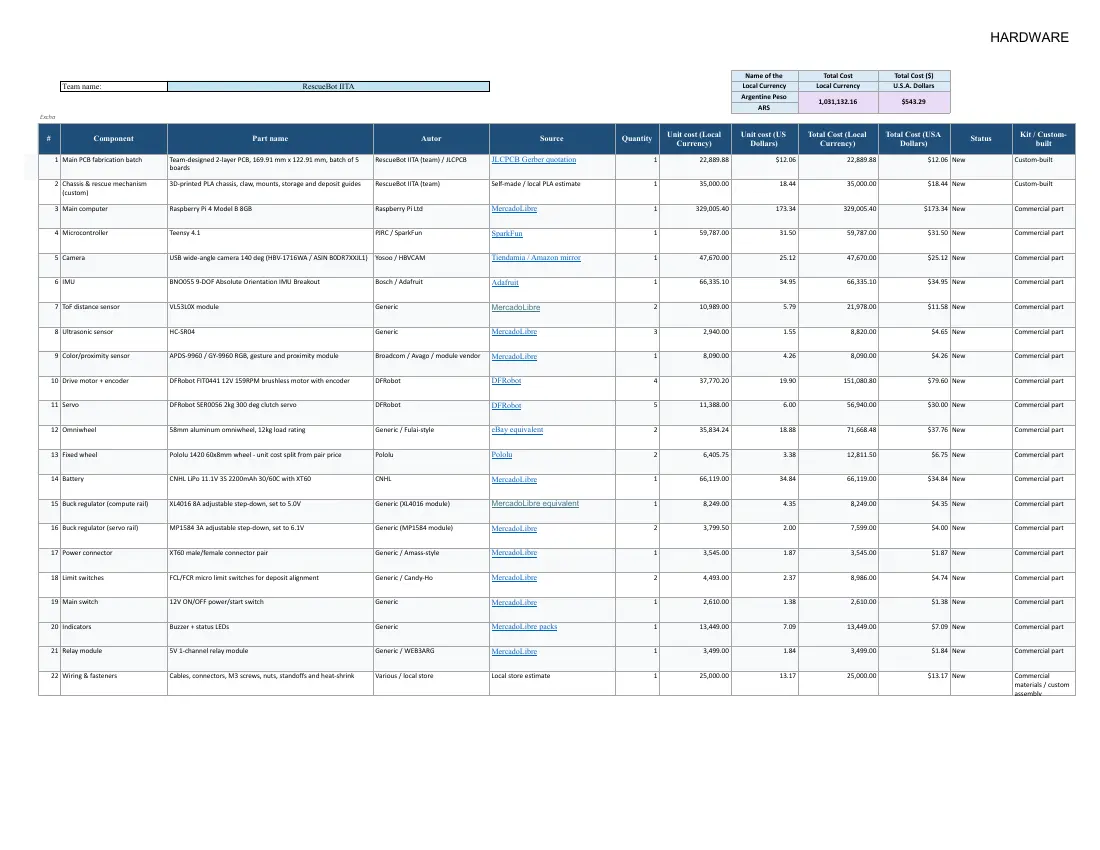
= ARS1 Main PCB fabrication batch Team-designed 2-layer PCB, 169.91 mm x 122.91 mm, batch of 5 RescueBot IITA (team) / JLCPCB JLCPCB Gerber quotation 1 22,889.88 $12.06 22,889.88 $12.06 New Custom-built
1,898.
boards
Prices
review
2 Chassis & rescue mechanism 3D-printed PLA chassis, claw, mounts, storage and deposit guides RescueBot IITA (team) Self-made / local PLA estimate 1 35,000.00 18.44 35,000.00 $18.44 New Custom-built
ed on
(custom)
2026-
06-08.
Hardw
3 Main computer Raspberry Pi 4 Model B 8GB Raspberry Pi Ltd MercadoLibre 1 329,005.40 173.34 329,005.40 $173.34 New Commercial part
are
status
and 4 Microcontroller Teensy 4.1 PJRC / SparkFun SparkFun 1 59,787.00 31.50 59,787.00 $31.50 New Commercial part
kit/cus
tom-
built 5 Camera USB wide-angle camera 140 deg (HBV-1716WA / ASIN B0DR7XXJL1) Yosoo / HBVCAM Tiendamia / Amazon mirror 1 47,670.00 25.12 47,670.00 $25.12 New Commercial part
fields
are
includ6 IMU BNO055 9-DOF Absolute Orientation IMU Breakout Bosch / Adafruit Adafruit 1 66,335.10 34.95 66,335.10 $34.95 New Commercial part
ed in
colum
ns L- 7 ToF distance sensor VL53L0X module Generic MercadoLibre 2 10,989.00 5.79 21,978.00 $11.58 New Commercial part
M.
8 Ultrasonic sensor HC-SR04 Generic MercadoLibre 3 2,940.00 1.55 8,820.00 $4.65 New Commercial part
9 Color/proximity sensor APDS-9960 / GY-9960 RGB, gesture and proximity module Broadcom / Avago / module vendor MercadoLibre 1 8,090.00 4.26 8,090.00 $4.26 New Commercial part
10 Drive motor + encoder DFRobot FIT0441 12V 159RPM brushless motor with encoder DFRobot DFRobot 4 37,770.20 19.90 151,080.80 $79.60 New Commercial part
11 Servo DFRobot SER0056 2kg 300 deg clutch servo DFRobot DFRobot 5 11,388.00 6.00 56,940.00 $30.00 New Commercial part
12 Omniwheel 58mm aluminum omniwheel, 12kg load rating Generic / Fulai-style eBay equivalent 2 35,834.24 18.88 71,668.48 $37.76 New Commercial part
13 Fixed wheel Pololu 1420 60x8mm wheel - unit cost split from pair price Pololu Pololu 2 6,405.75 3.38 12,811.50 $6.75 New Commercial part
14 Battery CNHL LiPo 11.1V 3S 2200mAh 30/60C with XT60 CNHL MercadoLibre 1 66,119.00 34.84 66,119.00 $34.84 New Commercial part
15 Buck regulator (compute rail) XL4016 8A adjustable step-down, set to 5.0V Generic (XL4016 module) MercadoLibre equivalent 1 8,249.00 4.35 8,249.00 $4.35 New Commercial part
16 Buck regulator (servo rail) MP1584 3A adjustable step-down, set to 6.1V Generic (MP1584 module) MercadoLibre 2 3,799.50 2.00 7,599.00 $4.00 New Commercial part
17 Power connector XT60 male/female connector pair Generic / Amass-style MercadoLibre 1 3,545.00 1.87 3,545.00 $1.87 New Commercial part
18 Limit switches FCL/FCR micro limit switches for deposit alignment Generic / Candy-Ho MercadoLibre 2 4,493.00 2.37 8,986.00 $4.74 New Commercial part
19 Main switch 12V ON/OFF power/start switch Generic MercadoLibre 1 2,610.00 1.38 2,610.00 $1.38 New Commercial part
20 Indicators Buzzer + status LEDs Generic MercadoLibre packs 1 13,449.00 7.09 13,449.00 $7.09 New Commercial part
21 Relay module 5V 1-channel relay module Generic / WEB3ARG MercadoLibre 1 3,499.00 1.84 3,499.00 $1.84 New Commercial part
22 Wiring & fasteners Cables, connectors, M3 screws, nuts, standoffs and heat-shrink Various / local store Local store estimate 1 25,000.00 13.17 25,000.00 $13.17 New Commercial
materials / custom
assembly
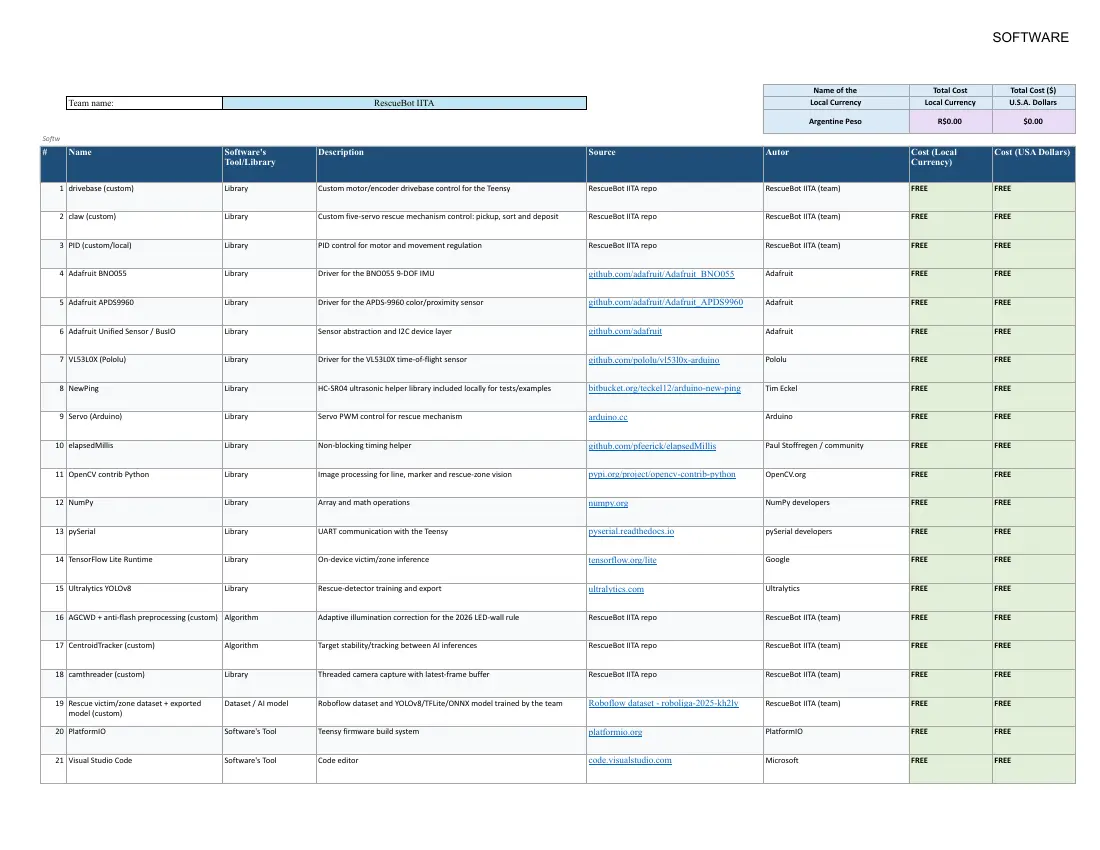
SOFTWARE
Name of the Total Cost Total Cost ($)
Team name: RescueBot IITA Local Currency Local Currency U.S.A. Dollars
Argentine Peso R$0.00 $0.00
Softw
are
# Name Software's Description Source Autor Cost (Local Cost (USA Dollars)
tools,
librari Tool/Library Currency)
es,
team 1 drivebase (custom) Library Custom motor/encoder drivebase control for the Teensy RescueBot IITA repo RescueBot IITA (team) FREE FREE
algorit
hms
and AI
2 claw (custom) Library Custom five-servo rescue mechanism control: pickup, sort and deposit RescueBot IITA repo RescueBot IITA (team) FREE FREE
assets
are
free/n
3 PID (custom/local) Library PID control for motor and movement regulation RescueBot IITA repo RescueBot IITA (team) FREE FREE
o-cost
for the
team.
4 Adafruit BNO055 Library Driver for the BNO055 9-DOF IMU github.com/adafruit/Adafruit_BNO055 Adafruit FREE FREE
5 Adafruit APDS9960 Library Driver for the APDS-9960 color/proximity sensor github.com/adafruit/Adafruit_APDS9960 Adafruit FREE FREE
6 Adafruit Unified Sensor / BusIO Library Sensor abstraction and I2C device layer github.com/adafruit Adafruit FREE FREE
7 VL53L0X (Pololu) Library Driver for the VL53L0X time-of-flight sensor github.com/pololu/vl53l0x-arduino Pololu FREE FREE
8 NewPing Library HC-SR04 ultrasonic helper library included locally for tests/examples bitbucket.org/teckel12/arduino-new-ping Tim Eckel FREE FREE
9 Servo (Arduino) Library Servo PWM control for rescue mechanism arduino.cc Arduino FREE FREE
10 elapsedMillis Library Non-blocking timing helper github.com/pfeerick/elapsedMillis Paul Stoffregen / community FREE FREE
11 OpenCV contrib Python Library Image processing for line, marker and rescue-zone vision pypi.org/project/opencv-contrib-python OpenCV.org FREE FREE
12 NumPy Library Array and math operations numpy.org NumPy developers FREE FREE
13 pySerial Library UART communication with the Teensy pyserial.readthedocs.io pySerial developers FREE FREE
14 TensorFlow Lite Runtime Library On-device victim/zone inference tensorflow.org/lite Google FREE FREE
15 Ultralytics YOLOv8 Library Rescue-detector training and export ultralytics.com Ultralytics FREE FREE
16 AGCWD + anti-flash preprocessing (custom) Algorithm Adaptive illumination correction for the 2026 LED-wall rule RescueBot IITA repo RescueBot IITA (team) FREE FREE
17 CentroidTracker (custom) Algorithm Target stability/tracking between AI inferences RescueBot IITA repo RescueBot IITA (team) FREE FREE
18 camthreader (custom) Library Threaded camera capture with latest-frame buffer RescueBot IITA repo RescueBot IITA (team) FREE FREE
19 Rescue victim/zone dataset + exported Dataset / AI model Roboflow dataset and YOLOv8/TFLite/ONNX model trained by the team Roboflow dataset - roboliga-2025-kh2ly RescueBot IITA (team) FREE FREE
model (custom)
20 PlatformIO Software's Tool Teensy firmware build system platformio.org PlatformIO FREE FREE
21 Visual Studio Code Software's Tool Code editor code.visualstudio.com Microsoft FREE FREE
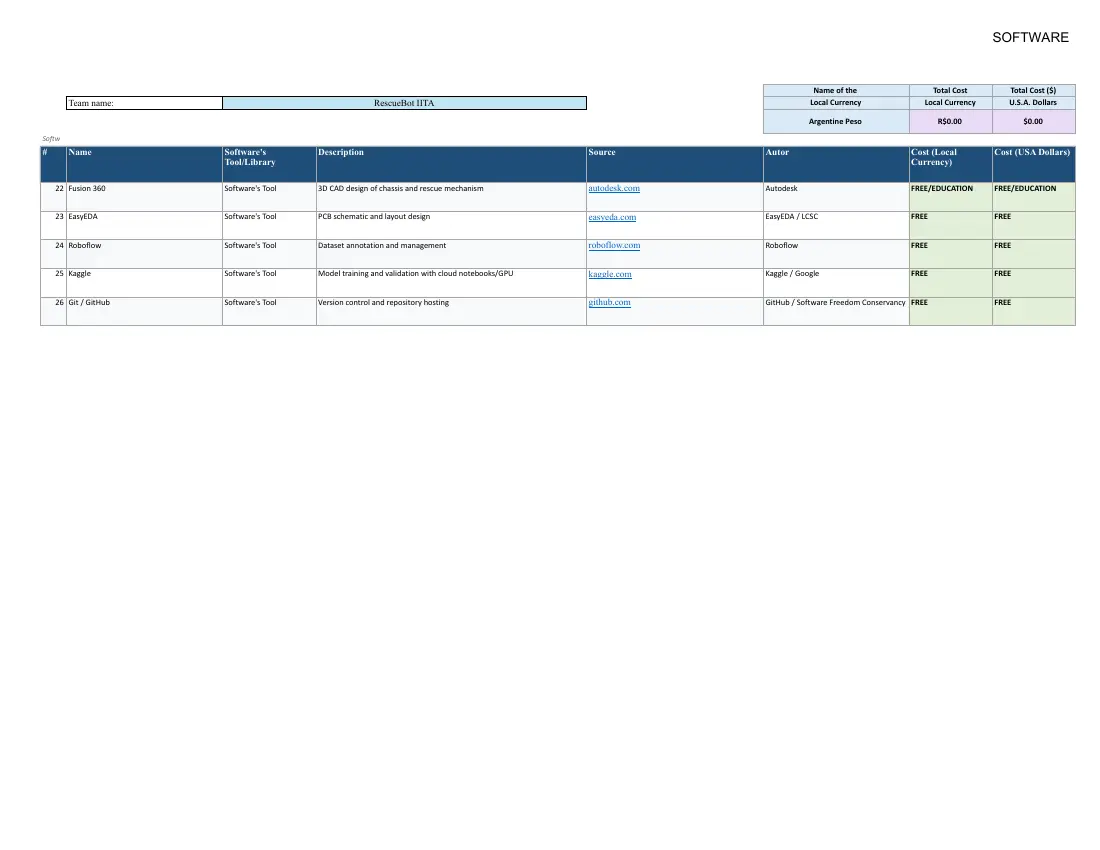
SOFTWARE
Name of the Total Cost Total Cost ($)
Team name: RescueBot IITA Local Currency Local Currency U.S.A. Dollars
Argentine Peso R$0.00 $0.00
Softw
are
# Name Software's Description Source Autor Cost (Local Cost (USA Dollars)
tools,
librari Tool/Library Currency)
es,
team22 Fusion 360 Software's Tool 3D CAD design of chassis and rescue mechanism autodesk.com Autodesk FREE/EDUCATION FREE/EDUCATION
algorit
hms
and AI
23 EasyEDA Software's Tool PCB schematic and layout design easyeda.com EasyEDA / LCSC FREE FREE
assets
are
free/n
24 Roboflow
o-cost
Software's Tool Dataset annotation and management roboflow.com Roboflow FREE FREE
for the
team.
25 Kaggle Software's Tool Model training and validation with cloud notebooks/GPU kaggle.com Kaggle / Google FREE FREE
26 Git / GitHub Software's Tool Version control and repository hosting github.com GitHub / Software Freedom Conservancy FREE FREE
3 pages, rendered as images so they load quickly. The text above is the document's own, extracted from the PDF.
Source code
The team's own source code, 23.2 MB. It is a download rather than part of this page, because a zip is something you open on your computer. It comes from GitHub, which some school networks block.