
FATEN

Line league · USA · RoboCup 2026

Document register

  1. Poster1 pagePublished
  2. Presentation videoYouTubePublished
  3. Bill of materials40 KBPublished
  4. Team description paper455 KBPublished
  5. Engineering journalNot shared
  6. Source code31.6 MB · GitHubPublished

Sharing each document is the team's decision. “Not shared” means this team chose not to publish it, or did not submit one — not that it is missing from the archive.
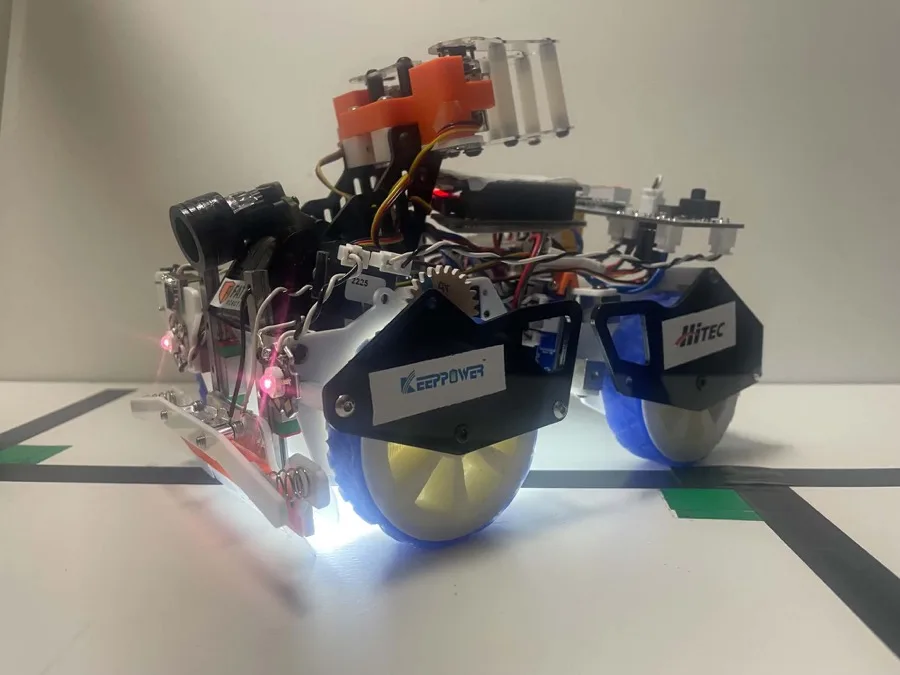
FATEN's robot
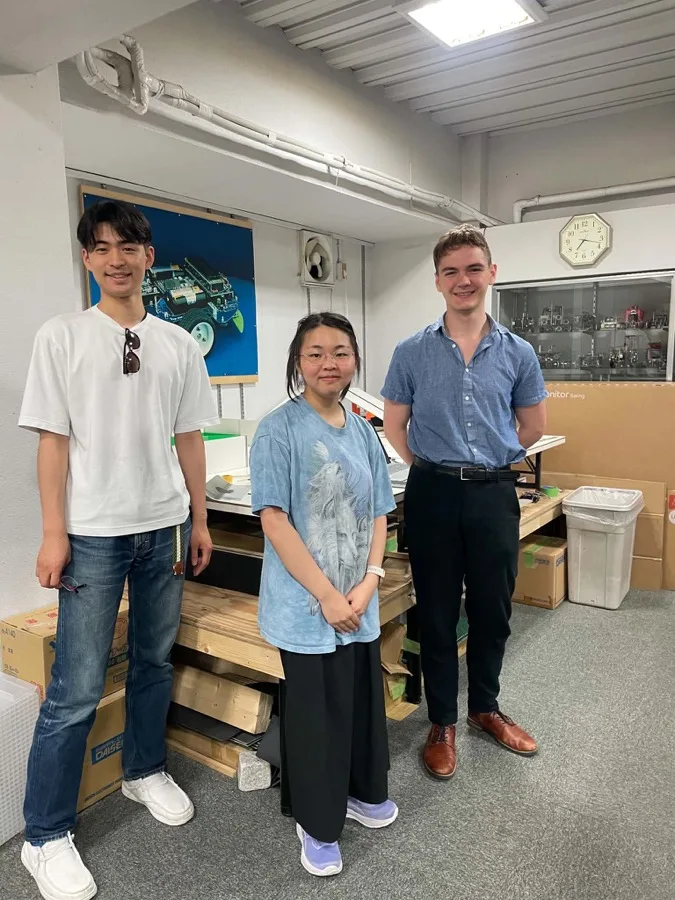
The FATEN team

In their words

FATEN is a RoboCupJunior Rescue Line robot designed with reliability as the main goal. The robot was not designed only to complete one good run. It was designed to make the same behavior repeat even when the field condition changes. For this reason, our design focused on three main ideas: stable contact with the ground, separated sensing systems, and modular decision making.

Mechanically, the robot uses a flexible enhanced-acrylic suspension plate. This suspension lets the wheels keep contact with the field even when the ground height changes. The robot is about 140 mm by 180 mm and weighs about 800 g, with mainly laser-cut acrylic parts. It uses four STS3032 serial servos, custom 3D-printed wheels with silicone molded tires, and an arm mechanism that can pick up and hold two victims.

Electronically and computationally, the robot is separated into several clear roles. The Teensy 4.1 handles the main control, motor output, state logic, mapping, and sensors. The XIAO ESP32-S3 with an OV2640 camera handles line and feature detection. The K230D runs a YOLOv8n model for victim detection in the evacuation zone. This separation makes debugging easier because each controller has a clear responsibility.

Testing showed that the robot could run line following and intersection behavior for 40 minutes continuously without a mistake, and the suspension could pass over a 60 mm height difference. The evacuation-zone AI system is still being improved, especially the ONNX to kmodel conversion process, but the current design gives a stable base for the 2026 competition.

Poster
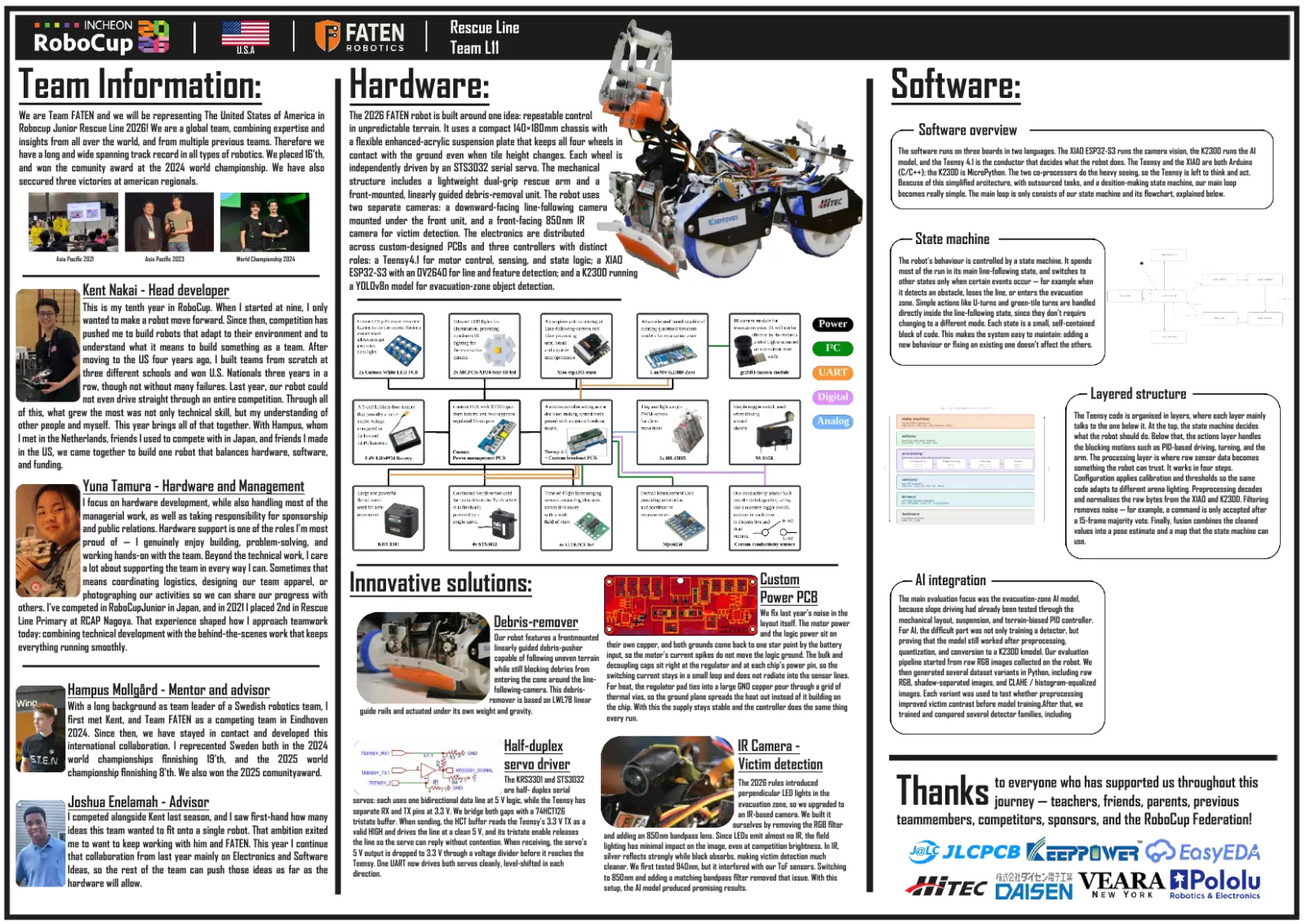
Read the text of this document — 1504 words
Rescue Line
                                                             U.S.A                                                        Team L11

Team Information:                                                                        Hardware:                                                                                                                                                                 Software:
We are Team FATEN and we will be representing The United States of America in            The 2026 FATEN robot is built around one idea: repeatable control
Robocup Junior Rescue Line 2026! We are a global team, combining expertise and           in unpredictable terrain. It uses a compact 140×180mm chassis with                                                                                                              Software overview
insights from all over the world, and from multiple previous teams. Therefore we         a flexible enhanced-acrylic suspension plate that keeps all four wheels in
have a long and wide spanning track record in all types of robotics. We placed 16'th,    contact with the ground even when tile height changes. Each wheel is                                                                                                      The software runs on three boards in two languages. The XIAO ESP32-S3 runs the camera vision, the K230D runs the AI
                                                                                                                                                                                                                                                                   model, and the Teensy 4.1 is the conductor that decides what the robot does. The Teensy and the XIAO are both Arduino
and won the comunity award at the 2024 world championship. We have also                  independently driven by an STS3032 serial servo. The mechanical                                                                                                           (C/C++); the K230D is MicroPython. The two co-processors do the heavy seeing, so the Teensy is left to think and act.
seccured three victories at american regionals.                                          structure includes a lightweight dual-grip rescue arm and a                                                                                                               Beacuse of this simplified arcitecture, with outsourced tasks, and a desition-making state machine, our main loop
                                                                                         front-mounted, linearly guided debris-removal unit. The robot uses                                                                                                        becomes really simple. The main loop is only consists of our state machine and its flowchart, explained below.
                                                                                         two separate cameras: a downward-facing line-following camera
                                                                                         mounted under the front unit, and a front-facing 850nm IR
                                                                                         camera for victim detection. The electronics are distributed
                                                                                         across custom-designed PCBs and three controllers with distinct
                                                                                                                                                                                                                                                                        State machine
          Asia Pacific 2021         Asia Pacific 2023        World Championship 2024     roles: a Teensy4.1 for motor control, sensing, and state logic; a XIAO                                                                                                    The robot’s behaviour is controlled by a state machine. It spends
                                                                                         ESP32-S3 with an OV2640 for line and feature detection; and a K230D running                                                                                               most of the run in its main line-following state, and switches to
                                                                                                                                                                                                                                                                   other states only when certain events occur — for example when
                                                                                         a YOLOv8n model for evacuation-zone object detection.
                     Kent Nakai - Head developer                                                                                                                                                                                                                   it detects an obstacle, loses the line, or enters the evacuation
                                                                                                                                                                                                                                                                   zone. Simple actions like U-turns and green-tile turns are handled
                  This is my tenth year in RoboCup. When I started at nine, I only                                                                                                                                                                                 directly inside the line-following state, since they don’t require
                  wanted to make a robot move forward. Since then, competition has                                                                                                                                                                                 changing to a different mode. Each state is a small, self-contained
                  pushed me to build robots that adapt to their environment and to                                                                                                                                                                                 block of code. This makes the system easy to maintain: adding a
                  understand what it means to build something as a team. After                                                                                                                                                                                     new behaviour or fixing an existing one doesn’t affect the others.
                  moving to the US four years ago, I built teams from scratch at
                  three different schools and won U.S. Nationals three years in a
                  row, though not without many failures. Last year, our robot could
                  not even drive straight through an entire competition. Through all                                                                                                                                                                                                                                                Layered structure
of this, what grew the most was not only technical skill, but my understanding of                                                                                                                                                                                                                                             The Teensy code is organised in layers, where each layer mainly
other people and myself. This year brings all of that together. With Hampus, whom                                                                                                                                                                                                                                             talks to the one below it. At the top, the state machine decides
I met in the Netherlands, friends I used to compete with in Japan, and friends I made                                                                                                                                                                                                                                         what the robot should do. Below that, the actions layer handles
                                                                                                                                                                                                                                                                                                                              the blocking motions such as PID-based driving, turning, and the
in the US, we came together to build one robot that balances hardware, software,                                                                                                                                                                                                                                              arm. The processing layer is where raw sensor data becomes
and funding.                                                                                                                                                                                                                                                                                                                  something the robot can trust. It works in four steps.
                                                                                                                                                                                                                                                                                                                              Configuration applies calibration and thresholds so the same
                     Yuna Tamura - Hardware and Management                                                                                                                                                                                                                                                                    code adapts to different arena lighting. Preprocessing decodes
                 I focus on hardware development, while also handling most of the                                                                                                                                                                                                                                             and normalises the raw bytes from the XIAO and K230D. Filtering
                                                                                                                                                                                                                                                                                                                              removes noise — for example, a command is only accepted after
                 managerial work, as well as taking responsibility for sponsorship                                                                                                                                                                                                                                            a 15-frame majority vote. Finally, fusion combines the cleaned
                 and public relations. Hardware support is one of the roles I’m most                                                                                                                                                                                                                                          values into a pose estimate and a map that the state machine can
                 proud of — I genuinely enjoy building, problem-solving, and                                                                                                                                                                                                                                                  use.
                 working hands-on with the team. Beyond the technical work, I care
                 a lot about supporting the team in every way I can. Sometimes that
                 means coordinating logistics, designing our team apparel, or
                 photographing our activities so we can share our progress with
                                                                                         Innovative solutions:                                                                                                                   Custom
                                                                                                                                                                                                                                 Power PCB
                                                                                                                                                                                                                                                                        AI integration
                                                                                                                                                                                                                                                                   The main evaluation focus was the evacuation-zone AI model,
others. I’ve competed in RoboCupJunior in Japan, and in 2021 I placed 2nd in Rescue                                                                                                                                              We fix last year’s noise in the   because slope driving had already been tested through the
Line Primary at RCAP Nagoya. That experience shaped how I approach teamwork                                                              Debris-remover                                                                          layout itself. The motor power    mechanical layout, suspension, and terrain-biased PID controller.
                                                                                                                                                                                                                                                                   For AI, the difficult part was not only training a detector, but
today: combining technical development with the behind-the-scenes work that keeps                                                       Our robot features a frontmounted                                                        and the logic power sit on
                                                                                                                                                                            their own copper, and both grounds come back to one star point by the battery          proving that the model still worked after preprocessing,
everything running smoothly.                                                                                                            linearly guided debris-pusher                                                                                              quantization, and conversion to a K230D kmodel. Our evaluation
                                                                                                                                        capable of following uneven terrain input, so the motor’s current spikes do not move the logic ground. The bulk and        pipeline started from raw RGB images collected on the robot. We
                                                                                                                                        while still blocking debries from   decoupling caps sit right at the regulator and at each chip’s power pin, so the
                                                                                                                                                                                                                                                                   then generated several dataset variants in Python, including raw
                                                                                                                                        entering the cone around the line- switching current stays in a small loop and does not radiate into the sensor lines.     RGB, shadow-separated images, and CLAHE / histogram-equalized
               Hampus Mollgård - Mentor and advisor                                                                                    following-camera. This debris-       For heat, the regulator pad ties into a large GND copper pour through a grid of
                                                                                                                                                                            thermal vias, so the ground plane spreads the heat out instead of it building on       images. Each variant was used to test whether preprocessing
                                                                                                                                      remover is based on LWL7B linear                                                                                             improved victim contrast before model training.After that, we
               With a long background as team leader of a Swedish robotics team, I         guide rails and actuated under its own weight and gravity.                       the chip. With this the supply stays stable and the controller does the same thing
                                                                                                                                                                            every run.                                                                             trained and compared several detector families, including
               first met Kent, and Team FATEN as a competing team in Eindhoven
               2024. Since then, we have stayed in contact and developed this
               international collaboration. I reprecented Sweden both in the 2024                                                           Half-duplex                                                                   IR Camera -
               world championships finnishing 19'th, and the 2025 world
               championship finnishing 8'th. We also won the 2025 comunityaward.
                                                                                                                                            servo driver                                                                  Victim detection

                                                                                                                                                                                                                                                                   Thanks         to everyone who has supported us throughout this
                                                                                                                                               The KRS3301 and STS3032                                                     The 2026 rules introduced
                                                                                                                                               are half- duplex serial                                                     perpendicular LED lights in the
               Joshua Enelamah - Advisor                                                 servos: each uses one bidirectional data line at 5 V logic, while the Teensy has                                                  evacuation zone, so we upgraded to                     journey — teachers, friends, parents, previous
                                                                                         separate RX and TX pins at 3.3 V. We bridge both gaps with a 74HCT126                                                             an IR-based camera. We built it
               I competed alongside Kent last season, and I saw first-hand how many      tristate buffer. When sending, the HCT buffer reads the Teensy’s 3.3 V TX as a                                                  ourselves by removing the RGB filter      teammembers, competitors, sponsors, and the RoboCup Federation!
               ideas this team wanted to fit onto a single robot. That ambition exited   valid HIGH and drives the line at a clean 5 V, and its tristate enable releases     and adding an 850nm bandpass lens. Since LEDs emit almost no IR, the field
               me to want to keep working with him and FATEN. This year I continue       the line so the servo can reply without contention. When receiving, the servo’s     lighting has minimal impact on the image, even at competition brightness. In IR,
               that collaboration from last year mainly on Electronics and Software      5 V output is dropped to 3.3 V through a voltage divider before it reaches the      silver reflects strongly while black absorbs, making victim detection much
                                                                                         Teensy. One UART now drives both servos cleanly, level-shifted in each              cleaner. We first tested 940nm, but it interfered with our ToF sensors. Switching
               Ideas, so the rest of the team can push those ideas as far as the         direction.                                                                          to 850nm and adding a matching bandpass filter removed that issue. With this
               hardware will allow.                                                                                                                                          setup, the AI model produced promising results.

Open as plain text

1 page, rendered as images so they load quickly. The text above is the document's own, extracted from the PDF.

Download the original PDF (384 KB) from GitHub

Presentation video

Hosted on YouTube. The player loads only when you press play.

Open in YouTube

Bill of materials

Shown as the original PDF, because this one is smaller that way and its text stays selectable and searchable.

Open Bill of materials

Team description paper

Shown as the original PDF, because this one is smaller that way and its text stays selectable and searchable.

Open Team description paper

Source code

The team's own source code, 31.6 MB. It is a download rather than part of this page, because a zip is something you open on your computer. It comes from GitHub, which some school networks block.

Download FATEN's source code