
Dry Lettuce
Document register
- Poster1 pagePublished
- Presentation videoYouTubePublished
- Bill of materials46 KBPublished
- Team description paperNot shared
- Engineering journalNot shared
- Source code44.4 MB · GitHubPublished
Sharing each document is the team's decision. “Not shared” means this team chose not to publish it, or did not submit one — not that it is missing from the archive.
In their words
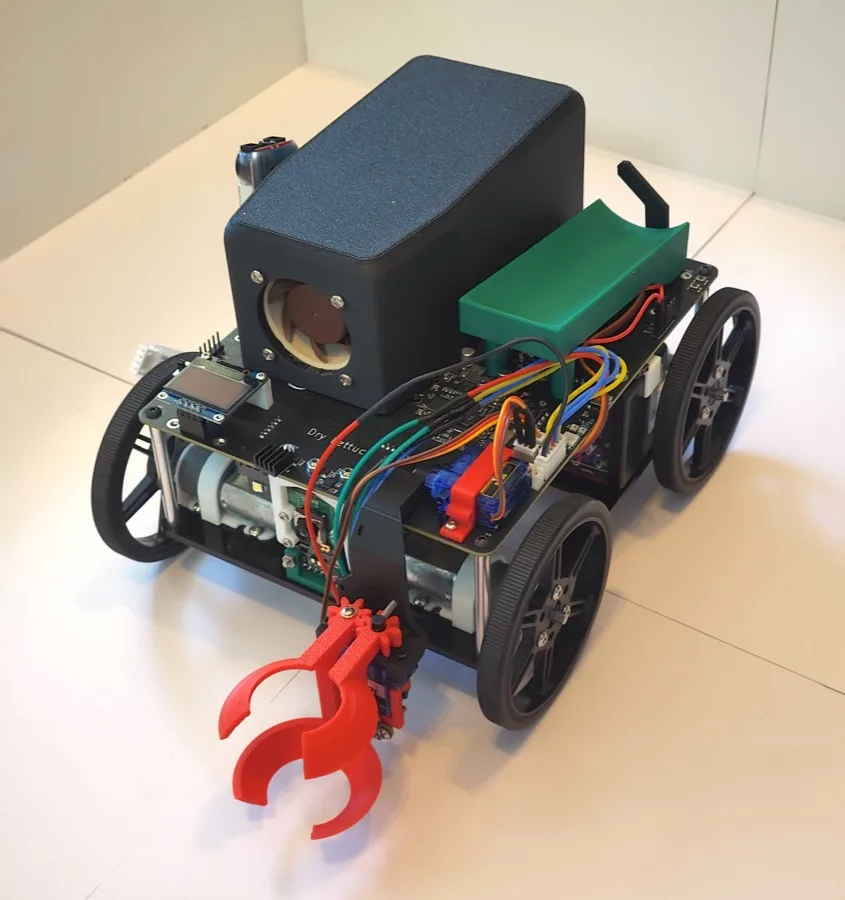
Our robot is four-wheel-drive and custom built around a tightly integrated hardware and software stack. All electronics, apart from the Raspberry Pi and most sensors, are consolidated onto a single custom PCB, which houses an STM32 microcontroller responsible for driving motors, servos, and all PWM driven components. This approach reduces wiring complexity and improves overall signal integrity.
Accurate locomotion is achieved through a closed-loop feedback control system that combines data from the onboard IMU and motor encoders, allowing for precise and consistent movement which is especially useful during the rescue section of the course. The four-wheel-drive configuration provides more traction and stability across inclines, debris fields, and speed bumps.
The robot uses the ROS2 framework, allowing modular, maintainable software architecture and seamless integration between subsystems. A forward-facing camera paired with a custom-trained machine learning model enables the detection of rescue victims, while Simultaneous Localisation and Mapping (SLAM) allow the robot to build and navigate a map of the rescue zone.
Poster
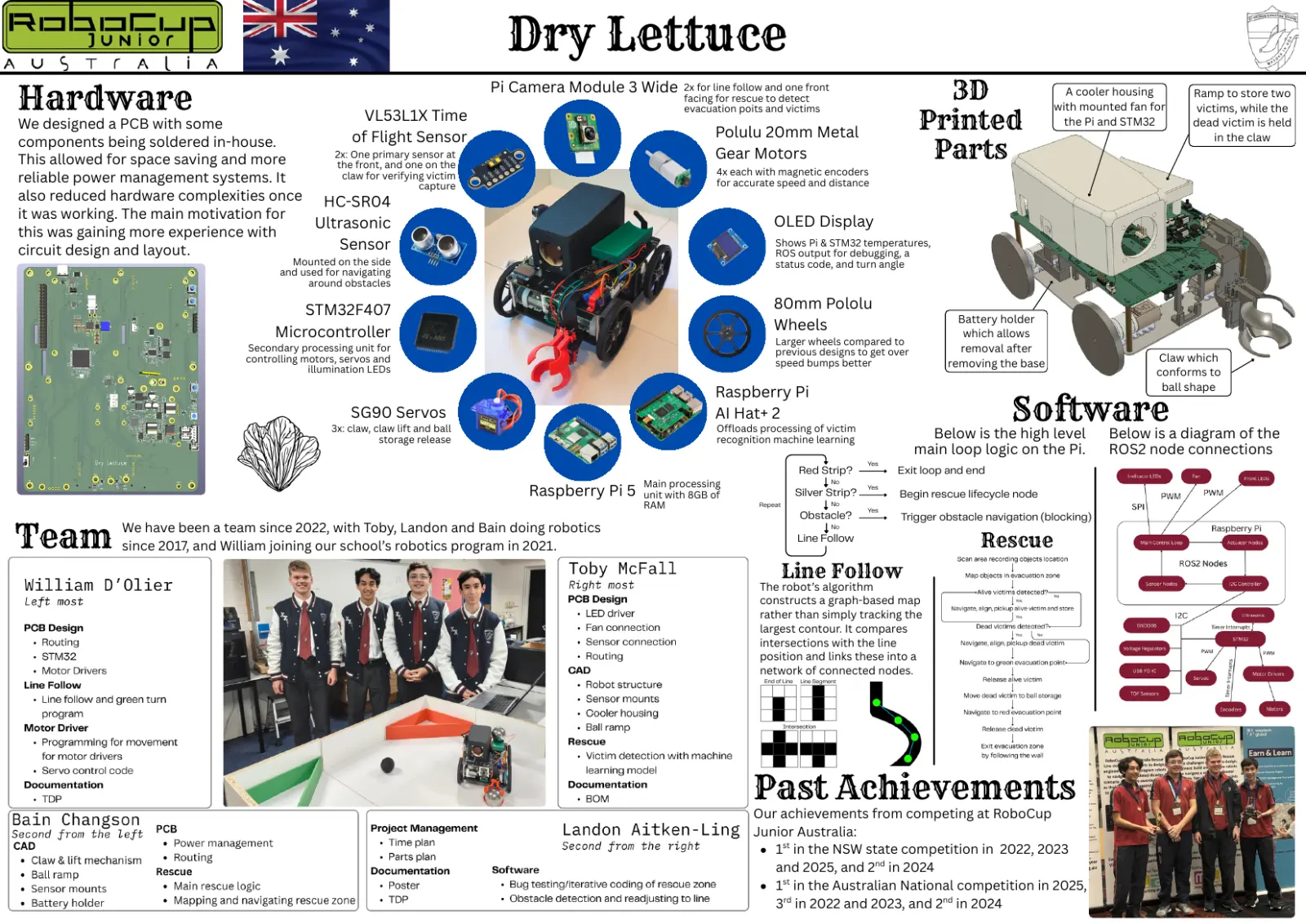
Read the text of this document — 384 words
Dry Lettuce
Hardware
Pi Camera Module 3 Wide 2x for line follow and one front
facing for rescue to detect
evacuation poits and victims
3D A cooler housing
with mounted fan for
Ramp to store two
victims, while the
We designed a PCB with some
VL53L1X Time
of Flight Sensor Polulu 20mm Metal Printed the Pi and STM32 dead victim is held
in the claw
components being soldered in-house.
This allowed for space saving and more 2x: One primary sensor at
the front, and one on the
Gear Motors Parts
4x each with magnetic encoders
reliable power management systems. It claw for verifying victim
for accurate speed and distance
capture
also reduced hardware complexities once HC-SR04
it was working. The main motivation for
Ultrasonic OLED Display
this was gaining more experience with
circuit design and layout. Sensor Shows Pi & STM32 temperatures,
ROS output for debugging, a
Mounted on the side status code, and turn angle
and used for navigating
around obstacles
STM32F407 80mm Pololu
Battery holder
Microcontroller Wheels which allows
Larger wheels compared to
Secondary processing unit for previous designs to get over removal after
controlling motors, servos and Claw which
speed bumps better removing the base
illumination LEDs conforms to
ball shape
Raspberry Pi
SG90 Servos
3x: claw, claw lift and ball
AI Hat+ 2
Offloads processing of victim
Software
storage release recognition machine learning Below is the high level Below is a diagram of the
main loop logic on the Pi. ROS2 node connections
Yes
Red Strip? Exit loop and end
Main processing No
Raspberry Pi 5 unit with 8GB of Silver Strip?
Yes
Begin rescue lifecycle node
RAM Repeat No
Yes
Obstacle? Trigger obstacle navigation (blocking)
Team We have been a team since 2022, with Toby, Landon and Bain doing robotics No
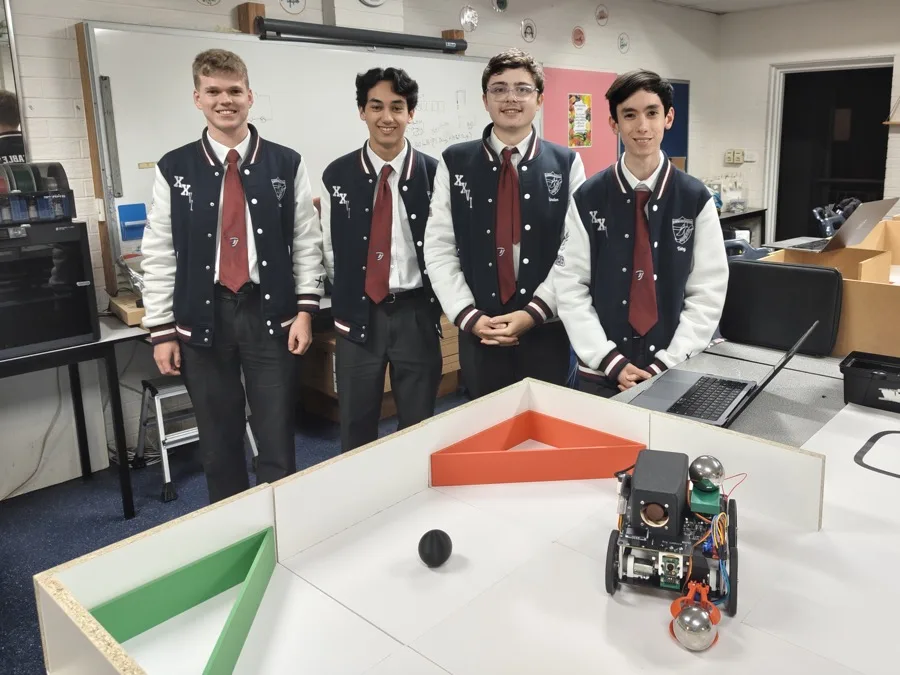
since 2017, and William joining our school’s robotics program in 2021.
Line Follow
Rescue
Line Follow
The robot’s algorithm
constructs a graph-based map
rather than simply tracking the
largest contour. It compares
intersections with the line
position and links these into a
network of connected nodes.
Past Achievements
Our achievements from competing at RoboCup
Junior Australia:
1st in the NSW state competition in 2022, 2023
and 2025, and 2nd in 2024
1st in the Australian National competition in 2025,
3rd in 2022 and 2023, and 2nd in 2024
1 page, rendered as images so they load quickly. The text above is the document's own, extracted from the PDF.
Presentation video
Hosted on YouTube. The player loads only when you press play.
Bill of materials
Shown as the original PDF, because this one is smaller that way and its text stays selectable and searchable.
Source code
The team's own source code, 44.4 MB. It is a download rather than part of this page, because a zip is something you open on your computer. It comes from GitHub, which some school networks block.