
Alpha
Document register
- Poster1 pagePublished
- Presentation videoNot shared
- Bill of materials92 KBPublished
- Team description paperNot shared
- Engineering journalNot shared
- Source codeNot shared
Sharing each document is the team's decision. “Not shared” means this team chose not to publish it, or did not submit one — not that it is missing from the archive.
In their words
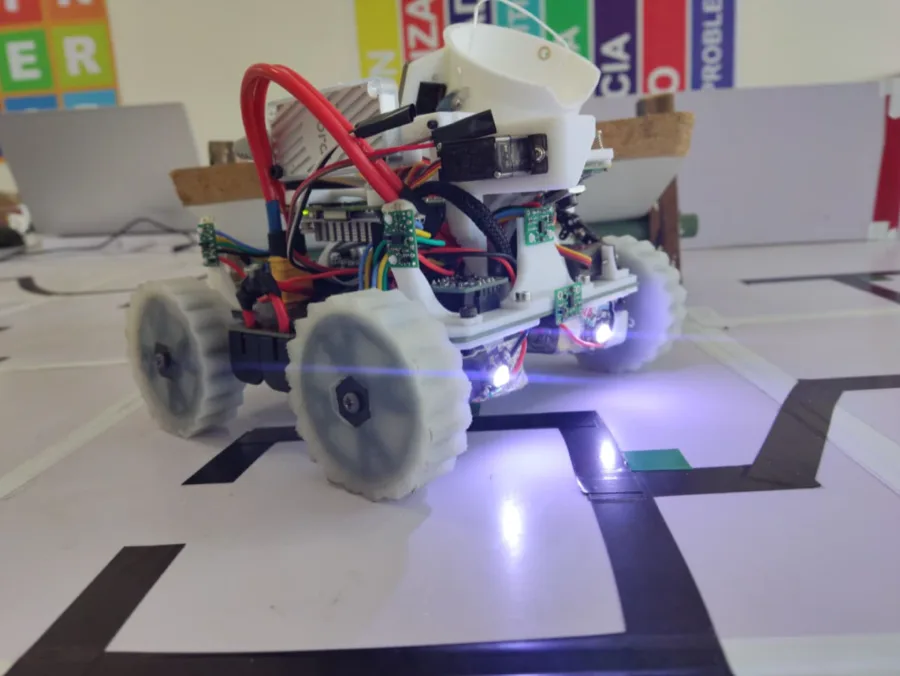
The robot developed is primarily designed for line following with a high level of precision and stability, aiming for outstanding performance in track tests. To achieve this, a Raspberry Pi 5 was integrated as the central processing unit, responsible for decision-making, data analysis, and overall coordination of the electronic systems. It acts as the master controller for the Teensy, which manages the robot's mechanical movements.
The motion control system is based on two TB6612FNG H-bridges, enabling precise speed and direction control. A distinguishing feature of our robot is its navigation system, which exhibits superior autonomous intelligence compared to typical line followers. Another key aspect is the use of different hardware components, allowing for the assignment of tasks based on the most suitable role for each component, whether sensors or actuators.
Poster
Read the text of this document — 682 words
TEAM
RESCUE LINE SOFTWARE
ALEJANDRO BENJAMÍN VARGAS GALLARDO
Capitán. - Programador y Diseñador
Elec.
Primarily responsible for programming the
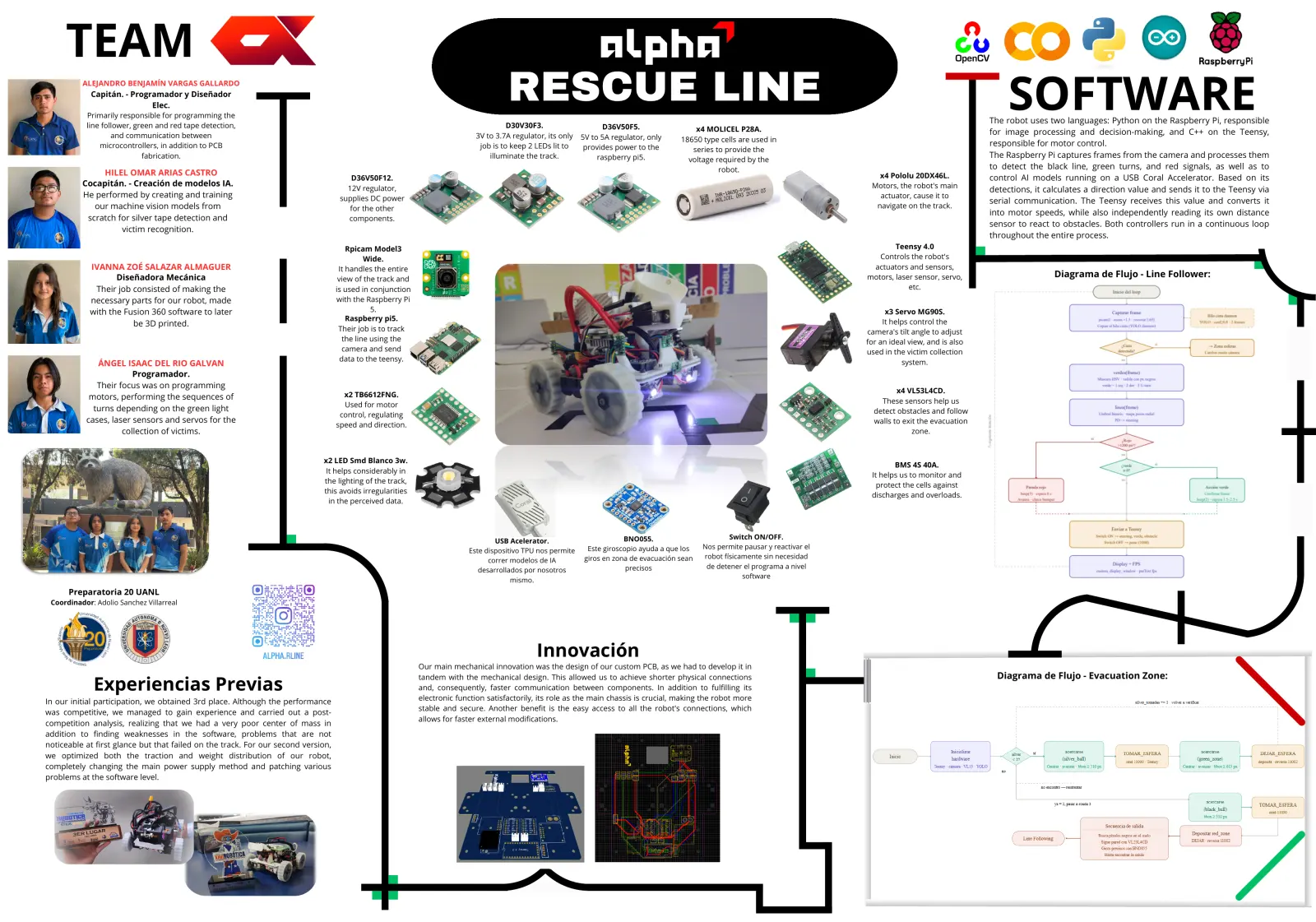
The robot uses two languages: Python on the Raspberry Pi, responsible
line follower, green and red tape detection, D30V30F3. D36V50F5. x4 MOLICEL P28A. for image processing and decision-making, and C++ on the Teensy,
and communication between 3V to 3.7A regulator, its only 5V to 5A regulator, only 18650 type cells are used in
microcontrollers, in addition to PCB job is to keep 2 LEDs lit to provides power to the responsible for motor control.
series to provide the
fabrication. illuminate the track. raspberry pi5. The Raspberry Pi captures frames from the camera and processes them
voltage required by the
robot. to detect the black line, green turns, and red signals, as well as to
HILEL OMAR ARIAS CASTRO x4 Pololu 20DX46L.
D36V50F12. control AI models running on a USB Coral Accelerator. Based on its
Cocapitán. - Creación de modelos IA. Motors, the robot's main
12V regulator, detections, it calculates a direction value and sends it to the Teensy via
He performed by creating and training supplies DC power actuator, cause it to
serial communication. The Teensy receives this value and converts it
our machine vision models from for the other navigate on the track.
into motor speeds, while also independently reading its own distance
scratch for silver tape detection and components.
sensor to react to obstacles. Both controllers run in a continuous loop
victim recognition.
throughout the entire process.
Rpicam Model3 Teensy 4.0
Wide. Controls the robot's
IVANNA ZOÉ SALAZAR ALMAGUER It handles the entire actuators and sensors,
Diseñadora Mecánica view of the track and motors, laser sensor, servo, Diagrama de Flujo - Line Follower:
Their job consisted of making the is used in conjunction etc.
necessary parts for our robot, made with the Raspberry Pi
with the Fusion 360 software to later 5. x3 Servo MG90S.
Raspberry pi5. It helps control the
be 3D printed.
Their job is to track camera's tilt angle to adjust
the line using the for an ideal view, and is also
camera and send used in the victim collection
data to the teensy. system.
ÁNGEL ISAAC DEL RIO GALVAN
Programador.
Their focus was on programming
x4 VL53L4CD.
motors, performing the sequences of x2 TB6612FNG.
These sensors help us
Used for motor
turns depending on the green light detect obstacles and follow
control, regulating
cases, laser sensors and servos for the walls to exit the evacuation
speed and direction.
collection of victims. zone.
x2 LED Smd Blanco 3w.
BMS 4S 40A.
It helps considerably in
It helps us to monitor and
the lighting of the track,
protect the cells against
this avoids irregularities
discharges and overloads.
in the perceived data.
BNO055. Switch ON/OFF.
USB Acelerator.
Este giroscopio ayuda a que los Nos permite pausar y reactivar el
Este dispositivo TPU nos permite
giros en zona de evacuación sean robot físicamente sin necesidad
correr modelos de IA
precisos de detener el programa a nivel
desarrollados por nosotros
software
mismo.
Preparatoria 20 UANL
Coordinador: Adolio Sanchez Villarreal
Innovación
Our main mechanical innovation was the design of our custom PCB, as we had to develop it in
Diagrama de Flujo - Evacuation Zone:
Experiencias Previas
tandem with the mechanical design. This allowed us to achieve shorter physical connections
and, consequently, faster communication between components. In addition to fulfilling its
In our initial participation, we obtained 3rd place. Although the performance electronic function satisfactorily, its role as the main chassis is crucial, making the robot more
stable and secure. Another benefit is the easy access to all the robot's connections, which
was competitive, we managed to gain experience and carried out a post-
allows for faster external modifications.
competition analysis, realizing that we had a very poor center of mass in
addition to finding weaknesses in the software, problems that are not
noticeable at first glance but that failed on the track. For our second version,
we optimized both the traction and weight distribution of our robot,
completely changing the main power supply method and patching various
problems at the software level.
1 page, rendered as images so they load quickly. The text above is the document's own, extracted from the PDF.
Bill of materials
Shown as the original PDF, because this one is smaller that way and its text stays selectable and searchable.